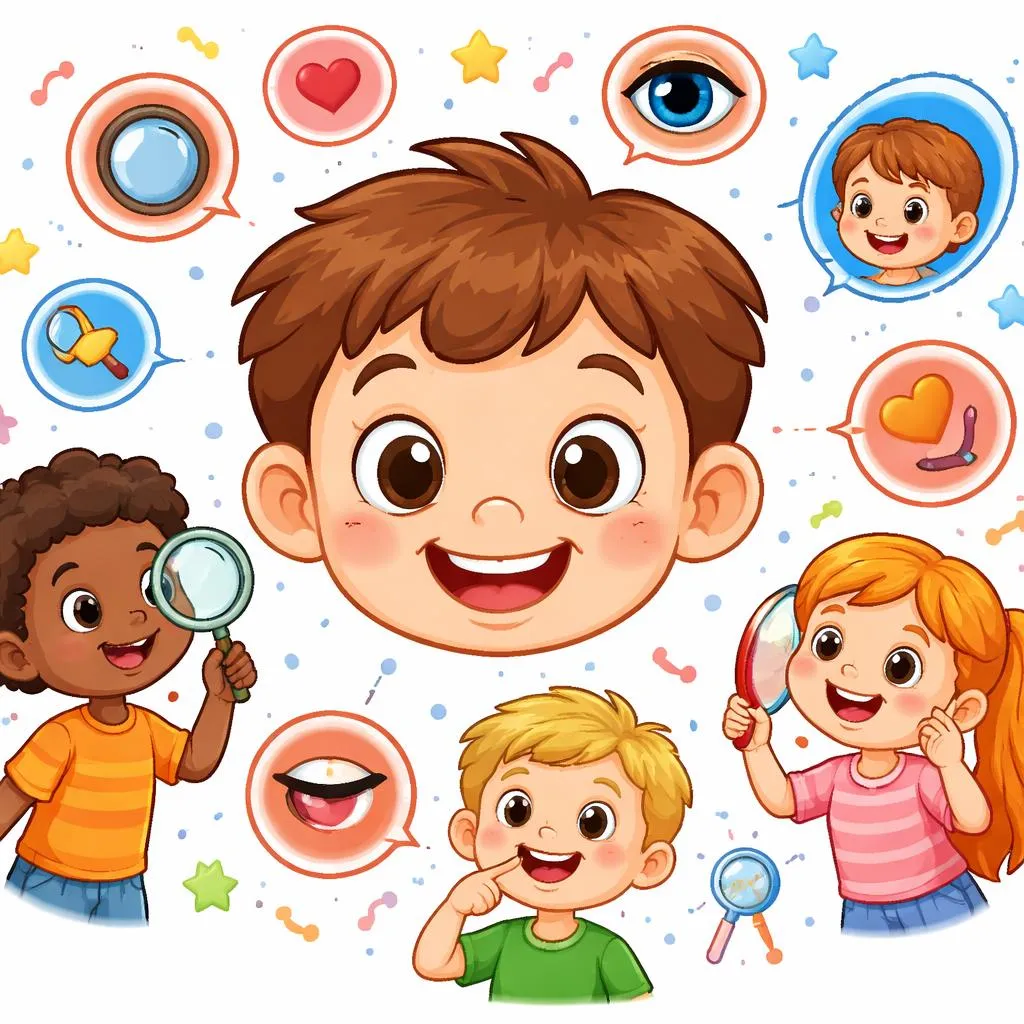

What is this topic about?
Let's look in the mirror and start a fun learning journey. The topic of parts the face focuses on learning the English names for all the features on our head. This is more than just memorizing words. It's about connecting language to our own bodies, which is one of the most personal and engaging ways to learn.
When we study parts the face, we build essential vocabulary for describing people, expressing feelings, and following instructions. It helps children talk about themselves and understand others. This topic is perfect for songs, games, and art, making English learning interactive, relevant, and full of smiles.
Meaning and explanation
Why is it important to learn the parts the face? This vocabulary is used every day. We use it to communicate how we feel ("My nose itches"), to give compliments ("You have beautiful eyes"), and to understand stories ("The character had a big smile").
Knowing these words helps children follow simple commands like "Touch your ears" or "Open your mouth." It also builds a foundation for more advanced topics like the five senses, as many sense organs are on the face. Learning parts the face empowers children to describe the world around them, starting with their own reflection.
Categories or lists
We can think about the parts the face in a simple, logical order. A good way is to start from the top and work down. The main features include: Hair, Forehead, Eyebrows, Eyes, Ears, Nose, Cheeks, Mouth, Lips, Teeth, Tongue, Chin.
We can also group them by function. Sensory Parts: eyes (for seeing), ears (for hearing), nose (for smelling), mouth/tongue (for tasting). Expressive Parts: eyebrows, eyes, mouth (for showing emotions like happiness or surprise). Creating these lists helps organize the words and makes them easier to remember and use.
Daily life examples
We use words for parts the face constantly in daily life. During morning routines, we wash our face, brush our teeth, and comb our hair. Parents might say, "Let's wipe your nose," or "Look at those bright eyes!"
When looking at photos or drawings, we can point and name: "Here are Grandpa's glasses over his eyes." Playing games like "Simon Says" uses this vocabulary: "Simon says touch your chin!" Even simple acts like eating ("Use your mouth") or listening ("Use your ears") reinforce these words. These everyday moments make the vocabulary practical and memorable.
Printable flashcards
Printable flashcards are a fantastic tool for learning parts the face. Create a set with a clear, friendly picture of a face on one side. On the other side, list the parts with arrows or numbers pointing to them. For individual cards, have a close-up picture of an eye on one side and the word "EYE" on the other.
Use these cards for matching games. You can also play "Guess the Part" by giving a clue ("I use this to smell. What am I?") before showing the picture. For a creative twist, provide a blank face outline and separate flashcards with features. Children can "build" a face by placing the correct feature card on the outline. This hands-on approach solidifies learning.
Learning activities and games
Learning comes alive with fun activities. A classic and effective game is "Mirror, Mirror." Pair up children. One makes a slow facial expression (a big smile, a surprised "O" with the mouth). The partner must copy the expression and name the parts the face that are moving. "You moved your mouth and cheeks!"
Another engaging activity is "Feel and Guess." Put various safe objects in a bag: a soft cotton ball, a smooth button, a piece of sandpaper. Without looking, a child picks an object and touches it to a specific part of their face (e.g., cheek). They describe the texture and guess the object, using sentences like "The soft thing is on my cheek."
For a group art project, create a "Class Face Collage." Provide a large outline of a face. Have each child contribute by drawing, painting, or gluing pre-cut shapes to create one feature. As they add an eye or a nose, they say its name. This collaborative activity builds vocabulary and community.
What is the rhyme?
Many wonderful songs and rhymes teach the parts the face. One of the most popular is "Head, Shoulders, Knees and Toes," which starts with the face. A more face-specific song goes like this:
Eyes and ears and mouth and nose, Mouth and nose, mouth and nose. Eyes and ears and mouth and nose, This is how my face grows!
There's also a fun chant with actions: Touch your eyes, what do you do? (Point to eyes) I see you! I see you! Touch your ears, what do you do? (Touch ears) I listen to you! I listen to you! (Repeat with nose/smell, mouth/eat and talk).
These rhymes use rhythm, repetition, and movement to make the vocabulary stick.
Vocabulary learning
These songs directly teach the core nouns: eyes, ears, mouth, nose, head. They also introduce simple but powerful action verbs associated with each part: see (with eyes), hear (with ears), smell (with nose), eat/talk (with mouth), think (with head).
The rhymes connect the body part to its function, creating a deeper understanding than just a name. This helps children remember the words because they are linked to an action or sense they use every day.
Phonics points
The face vocabulary in these rhymes is excellent for phonics. Many words start with distinct consonant sounds: the /m/ in mouth, the /n/ in nose, the long /i/ sound in eyes, the /ēr/ sound in ears.
The songs often use rhyming pairs like nose/grows or do/you. Clapping along with the rhythm helps children hear the syllables in words like shoulders (2) or together (3). The repetitive nature of the chants allows for confident practice of these sounds.
Grammar patterns
The face rhymes model several useful grammar patterns. They often use imperative sentences for actions: "Touch your eyes." "Point to your nose." This is the grammar of giving and following instructions.
They also use the simple present tense to state facts about body functions: "I see with my eyes." "Ears hear." The structure "This is my..." is used for identification. These patterns are learned naturally through the melody and repetition of the song.
Printable materials
Create a "My Face Book" mini-book printable. Each page has a sentence frame like "I see with my ______." with a space for drawing the eyes, or "I have two _______." for ears. Children can draw, color, and assemble their book, practicing reading, writing, and vocabulary.
A "Face Parts Matching" worksheet is also helpful. On one side, have pictures of the face parts scattered. On the other, have an empty face outline. Children draw lines from the word to the correct spot on the face. This tests comprehension and spelling.
Educational games
Play "Face Part Bingo." Create bingo cards with pictures of different face parts (one eye, two ears, a nose, etc.). Call out the words. For a listening challenge, call out a function: "I use this to taste!" (mouth/tongue). This reinforces the connection between the part and its job.
Another active game is "Command Circle." Children stand in a circle. The leader calls out a command touching two face parts: "Nose and ear!" Everyone must quickly touch their nose with one hand and their ear with the other. Increase the challenge with three parts. This game tests listening speed and vocabulary recall in a fun, physical way.
Mastering the parts the face in English is a foundational and joyful step in language learning. It connects words directly to a child's own body and daily experiences. By using songs, games, art, and play, we transform vocabulary practice into an engaging adventure. This approach ensures that words like eyes, ears, and smile are not just memorized, but understood, used, and enjoyed, building confidence for all future conversations.