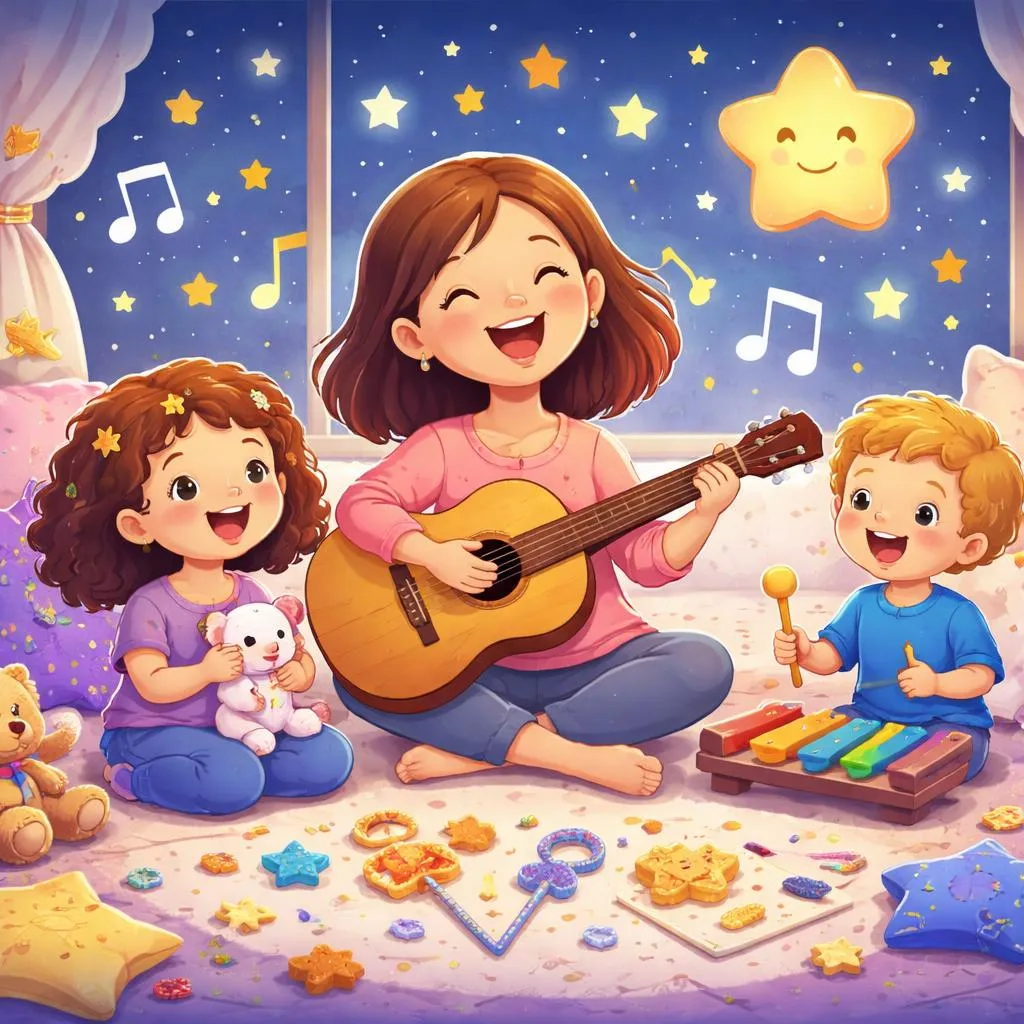

What is the rhyme?
Let's look up at the sky together, even if it's daytime. The Twinkle Twinkle Little Star song is one of the most beloved and well-known nursery rhymes in the English language. Its gentle melody and simple, wondering lyrics have been a first song for generations of children. It is more than just a tune; it's a gateway to language, rhythm, and a sense of wonder about the natural world.
This classic rhyme poses a beautiful, poetic question to a star. It transforms a distant celestial object into a friendly, sparkling point of light that a child can talk to. The Twinkle Twinkle Little Star song is often a child's first introduction to poetry, music, and the joy of memorizing and performing something beautiful. Its predictable structure makes it an ideal teaching tool.
The lyrics of nursery rhymes
The lyrics of the Twinkle Twinkle Little Star song are a single, elegant stanza that repeats. They are based on a 19th-century poem by Jane Taylor. The words are:
Twinkle, twinkle, little star, How I wonder what you are! Up above the world so high, Like a diamond in the sky. Twinkle, twinkle, little star, How I wonder what you are!
The rhyme scheme is simple (AABB), and the rhythm is a steady, rocking meter that is easy to clap or sway to. The repetition of the first two lines at the end creates a comforting, circular feeling, perfect for a lullaby or a calm classroom moment. This repetition is also key for language acquisition.
Vocabulary learning
This short song is packed with rich, descriptive vocabulary. It introduces key nouns related to nature and space: star, world, sky, diamond. These words open conversations about science and the universe in a poetic way.
The song is excellent for adjectives that describe appearance and position: little, high, above. Most importantly, it features wonderful action verbs and verbs of being: twinkle, wonder, are. "Twinkle" is a particularly magical word that describes both light and movement. Learning these words in the context of a familiar song helps them stick and provides a foundation for building more complex sentences about observation and description.
Phonics points
The Twinkle Twinkle Little Star song is a fantastic resource for early phonics work. The most prominent feature is the clear rhyme between star/are and high/sky. This helps children develop phonemic awareness by identifying similar ending sounds.
We can focus on several initial consonant blends and sounds. The /tw/ blend in twinkle is less common and great for practice. The /w/ sound appears in wonder and what. The /sk/ blend is in sky. We can also highlight the long I sound in I, high, sky, and the /ar/ sound in star and are. Tapping out the steady beat of the song helps children feel the syllables in each word, such as won-der (2) and dia-mond (2).
Grammar patterns
This rhyme beautifully illustrates several basic grammar patterns. The opening line, "Twinkle, twinkle, little star," is a classic example of a vocative phrase—directly addressing the star. This teaches children about direct address in a natural way.
The line "How I wonder what you are!" is an exclamatory sentence expressing strong feeling. It also contains an embedded noun clause ("what you are") acting as the object of the verb "wonder." While we don't need to explain this to young children, they absorb the correct structure. The simile "Like a diamond in the sky" is a gentle, perfect introduction to figurative language, showing how we compare two unlike things.
Learning activities
Extend the song's magic with creative learning activities. A wonderful art-and-science activity is "Star Scopes." Provide black construction paper and toothpicks. Let children punch tiny holes in the paper to create their own star constellations. Hold the papers up to a window or a light source. They will see their stars "twinkle" as light shines through the holes, physically illustrating the song's main verb.
Another activity is "Rhyming Word Hunt." After singing, write the words star and high on a board. Ask learners to brainstorm or find objects in the room that rhyme with these words (e.g., car, jar, far; sky, pie, tie). This builds phonemic awareness and connects the song to a broader word family.
Printable materials
Printable resources can make the learning visual and tactile. Create a "Twinkle Twinkle Storyboard." This printable sheet has four boxes in a row. Each box has a line from the song (1. Twinkle, twinkle... 2. Up above the world... etc.) and a space for drawing. Children draw their interpretation of each line, creating a visual story sequence that reinforces comprehension and vocabulary.
A "Word Family Sparkle" worksheet is great for phonics. At the top, draw a large star with "-ar" in the center. Around it, have smaller stars with beginnings: st-, c-, f-, j-, b-. Children write the complete word on each small star (star, car, far, jar, bar). This turns word family practice into a themed, engaging task connected directly to the Twinkle Twinkle Little Star song.
Educational games
Turn the song into playful games. Play "Star, Star, Moon!" (a variation of Duck, Duck, Goose). Children sit in a circle. One child walks around, gently tapping heads saying "star" each time. When they say "moon!" the tapped child gets up and chases them around the circle. This connects the theme to a high-energy game.
For a calming listening and memory game, try "Musical Star Pass." Sit in a circle and pass a glittery star cut-out while singing the song. Whoever is holding the star when the song finishes must say one thing they "wonder" about, using the sentence frame: "I wonder how/why/what ______." For example, "I wonder why the sky is blue." This encourages curiosity and full-sentence speaking in a supportive, musical context.
The enduring power of the Twinkle Twinkle Little Star song lies in its perfect simplicity and profound sense of wonder. It provides a gentle, rhythmic framework for exploring language, sound, and the natural world. By using this familiar favorite as a springboard, we can teach essential literacy skills not as isolated drills, but as part of a beautiful, shared cultural experience. The song reminds us that learning can be both structured and full of magic, encouraging children to look up, wonder, and express their curiosity—one twinkling word at a time.