
Meaning
Let's begin with the most fundamental verb in English. The verb of be is special. It is not an action verb like "run" or "eat." Instead, it is a linking verb. Its job is to connect the subject of a sentence to more information about that subject. It tells us what someone or something is, where they are, or what they are like.
For example, in "The sky is blue," the word "is" links "the sky" to its color, "blue." In "I am here," "am" links "I" to the location "here." The verb of be is essential for stating facts, describing states, and expressing existence. It is the cornerstone for building simple, declarative sentences.
Conjugation
The verb of be is irregular, meaning it does not follow the typical pattern of adding "-s" or "-ed." It has unique forms that change based on the subject and the tense. This change is called conjugation. It is crucial to match the correct form with its subject.
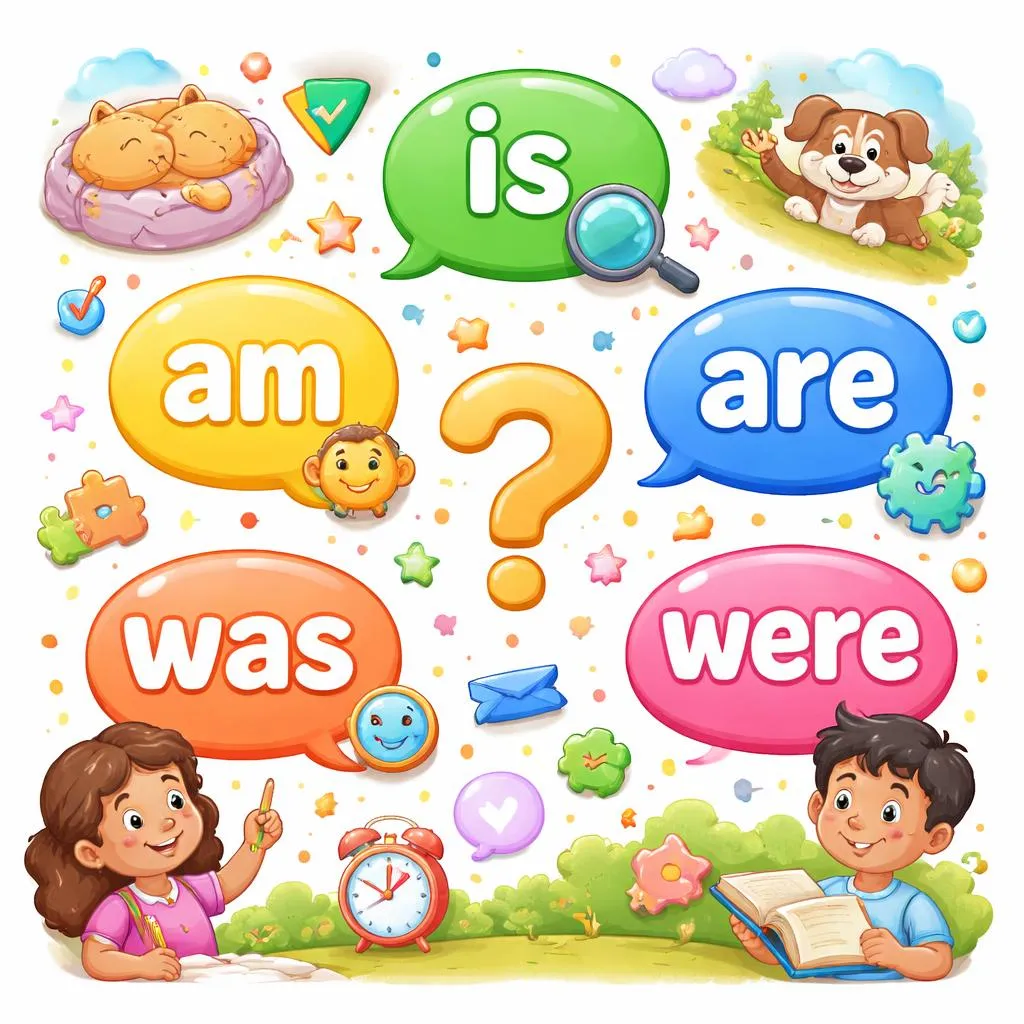
In the present tense, we use am with "I," is with "he," "she," "it," or a singular noun, and are with "you," "we," "they," or a plural noun. For example: I am tall. The cat is sleepy. You are my friend. In the past tense, we use was for I, he, she, it, and singular nouns, and were for you, we, they, and plural nouns.
Present tense
We use the present tense forms of the verb of be (am, is, are) to talk about current realities. We use it for identity: "She is a teacher." For location: "My keys are on the table." For characteristics: "Elephants are big." For feelings: "We are happy."
We also use it for the time and weather: "Today is Monday." "It is sunny." These forms are used constantly in daily conversation. Mastering the correct use of am, is, and are ensures clarity and forms the basis for all other sentence structures.
Past tense
The past tense forms (was, were) describe states or situations that were true in the past but may not be true now. We use them to tell stories, share memories, and give historical facts.
For example: "I was at home yesterday." "They were young once." "The movie was interesting." It helps us create a timeline and talk about finished events or past conditions. Using "was" and "were" correctly is key for clear communication about anything that happened before this moment.
Future tense
To talk about future states, we use will be for all subjects. This form is much simpler and does not change. We use it for predictions, promises, and certain future facts.
For example: "I will be ten years old next week." "It will be cold tomorrow." "They will be at the party." We can also use "going to be": "She is going to be a scientist." This tense helps learners express hopes, plans, and things they expect to happen later.
Questions
Forming questions with the verb of be is simple. We invert the order of the verb and the subject. Statement: "You are busy." Question: "Are you busy?" Statement: "She was late." Question: "Was she late?"
This rule applies to all tenses. We answer these questions with short answers: "Yes, I am." / "No, he isn't." / "Yes, they were." / "No, we weren't." Practicing this question-and-answer format builds fluency and confidence in basic dialogue, which is a critical communication skill.
Other uses
The verb of be has several other vital functions. It acts as a helping verb (auxiliary) to form the continuous tenses. For example: "I am reading." (Present continuous - ongoing action now). "They were sleeping." (Past continuous - ongoing action in the past).
It is also used to form the passive voice: "The cake was eaten." Furthermore, it appears in imperative sentences for instructions: "Be quiet!" Understanding these different roles shows how central and versatile the verb of be is in the English language.
Learning tips
A powerful way to learn is to personalize it. Practice with "I am..." sentences about yourself: "I am a boy/girl." "I am happy." "I am seven." Use toys or pictures: "The dinosaur is green." "The cars are fast."
Create a simple chart:
I am
He/She/It is
You/We/They are
I/He/She/It was
You/We/They were Refer to this chart often during practice. Use songs like "Hello, Hello, How Are You?" which repeats "I am fine." Repetition and real-life application are the keys to mastery.
Educational games
Play "Be Verb Detective." Read a short, simple story or show a picture scene. Ask learners to find and list all the "am," "is," "are," "was," and "were" they can see or hear. This sharpens their recognition skills in context.
For an active game, try "Subject-Verb Match Relay." Write subjects (I, the dog, you and I, she, the books) on cards and place them at one end of the room. At the other end, place signs for "am," "is," "are," "was," "were." In teams, a runner picks a subject card, runs to the correct verb sign, and says the full phrase (e.g., "The books are!") aloud. This combines physical activity with grammar drill.
Mastering the verb of be is the first and most important step in constructing proper English sentences. It provides the framework for description, identification, and storytelling. While its irregular forms require focused practice, this effort lays an unshakeable foundation. With consistent use through games, conversation, and writing, am, is, are, was, and were become natural tools for young learners. This knowledge empowers them to define their world, share their experiences, and build confidently towards more complex language structures.