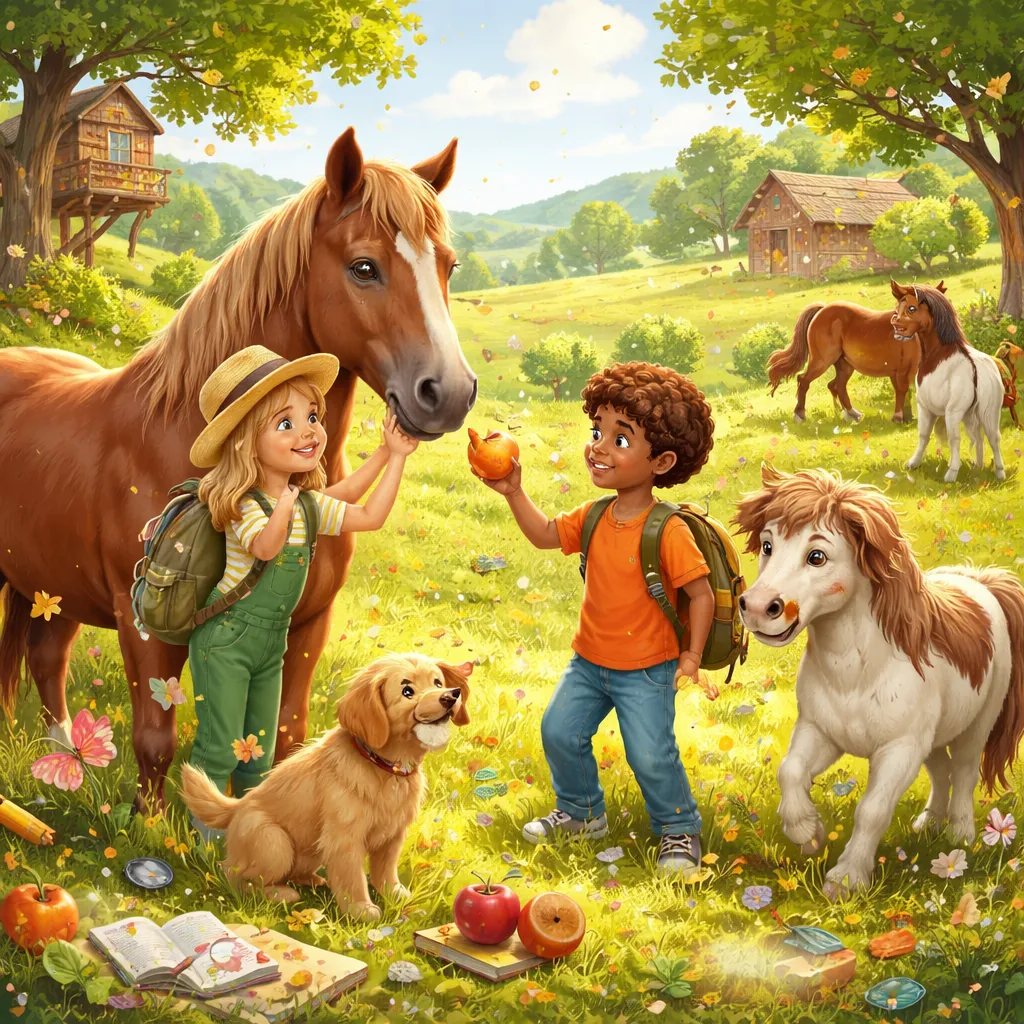

Have you ever seen a horse running in a field or in a movie? With their flowing mane, strong legs, and gentle eyes, horses are beautiful and powerful animals. People and horses have been friends for thousands of years. Learning about horses is an exciting adventure that takes us to farms, fields, and even into history. Let’s saddle up and begin learning about horse power and partnership!
English Language Learning
Vocabulary and Spelling
Our fast friend is called a horse.
The word "horse" is a noun. A noun names a person, place, or thing. So, a horse is a thing—a strong, living animal.
Let’s spell it: H-O-R-S-E. The 'H' stands tall at the start, like a horse’s head. The 'O' and 'R' are in the middle, and it ends with 'S-E'. H-O-R-S-E spells horse.
Sound and Pronunciation
Let’s say the word correctly. It sounds like this: /hɔːrs/.
We can say it in one clear part. First, say the sound "h". It’s a soft breath of air, like in "hello". Next, say "ors". It rhymes with "source" or "force".
Now, blend it together! "H" "ors". Horse! Great!
The word "horse" has just one beat, or one syllable. Clap your hands once: Horse! It’s a strong, swift-sounding word.
Related Words
Learning about horses is more fun with new words! Here are some important ones.
Body Parts: The long hair on a horse’s neck is called a mane. The hair on its tail is the tail. A horse’s foot is called a hoof.
Sound: The sound a horse makes is a neigh or a whinny.
Action: Horses love to gallop, which is a very fast run. They also trot and canter, which are different speeds.
A Famous Saying
There is a very old and true saying: "Don’t look a gift horse in the mouth."
This means if someone gives you a gift, you should be grateful and not check it for flaws. It comes from the fact that you can tell a horse’s age by looking at its teeth. It teaches us to be thankful and not too critical.
Say the saying with me: "Don’t look a gift horse in the mouth." It’s a good lesson in gratitude!
Now you know the word "horse"! Are you ready to gallop into some amazing facts? Let’s ride from words to wonderful knowledge!
Animal Knowledge
Who Are They? – Family and Group
What kind of animal is a horse? Horses are mammals. They have hair, are warm-blooded, and mother horses feed their babies milk.
They are part of the equine family. This family also includes donkeys and zebras. All modern horses belong to one species, but there are many different breeds, like Shetland ponies and Clydesdales.
What Do They Look Like? – Amazing Bodies
Horses come in many sizes, from as small as a large dog to taller than a grown-up! They have a coat of short hair that can be black, brown, white, gray, or spotted.
Their most famous features are their long legs and hooves. Their legs are built for running fast. Their hooves are like one big toenail that protects their foot. Horses have the biggest eyes of any land mammal!
Horses have special adaptations. They can sleep both lying down and standing up. They have a great sense of balance. Their teeth keep growing, so they need to chew a lot.
Where Do They Live and How? – Home and Habits
Horses live all over the world. Domestic horses live on farms, ranches, and in stables. Some wild horses, called mustangs, live in open plains in North America.
Horses are herbivores. This means they only eat plants. They eat grass, hay, and grains like oats. They spend a large part of their day grazing.
Horses are very social and live in groups called herds. In a herd, they look out for each other. They are most active during the day. They spend their time eating, grooming each other, and running.
A Horse’s Life Story – Growing Up
A baby horse is called a foal. Horses are mammals, so foals are born live from their mother, which is called a mare. A mare usually has one foal at a time.
The mother horse takes excellent care of her foal. The foal can stand and walk just a few hours after birth! The mother feeds it milk for several months.
Foals are born with long, wobbly legs. They grow quickly, learning to run and play. A young horse is called a colt (male) or a filly (female). A horse becomes an adult at about four years old.
How Do They "Talk"? – Communication
Horses talk with sounds and body language. They neigh, whinny, snort, and squeal. Each sound can mean something different, like a greeting or a warning.
They use their ears, eyes, and tail to show their feelings. Ears pinned back might mean the horse is angry. A relaxed horse will have its ears forward. They nudge and groom each other to be friendly.
Their best sense is their amazing eyesight and hearing. They can see almost all the way around their body without turning their head! Their ears can turn to catch sounds from any direction.
Are They Okay? – Taking Care of Them
Most domestic horses are well cared for by their owners. Some wild horse herds are protected, but they can face challenges.
Problems for horses include losing their land, not being cared for properly, or being worked too hard. Some wild horses are rounded up and put in holding pens.
You can be a horse hero! If you visit a stable, always be calm and gentle. You can support groups that rescue and care for horses in need. Always remember that horses are living beings that deserve kindness and respect.
Life Connections and Inspiration
How to Be With Them – Safety and Love
Horses are large, powerful animals. Being around them requires calmness, respect, and safety.
If you meet a horse: Always have an adult with you. Move slowly and talk softly. Let the horse see and sniff your hand before you touch it. Pet the horse on its neck or shoulder, not on its face first. Never stand directly behind a horse, as it might kick if scared.
Owning a horse is a huge responsibility. They need a safe stable, fresh water, good food, a vet, a farrier (for hooves), and lots of love and exercise every day.
We show our love by being gentle, patient, and learning how to care for them properly. A happy horse is a healthy horse with a kind human friend.
Super Qualities We Learn from Them
Horses teach us wonderful things. One super quality is loyalty and trust. Horses can form deep bonds with their human friends. They teach us to be loyal, to build trust, and to work as a team with others.
Another quality is graceful strength and freedom. Horses are strong enough to carry us, yet they move with beauty and grace. They remind us to be strong and confident, but also to move through life with grace and to appreciate our own freedom.
Think about it: How can you be a loyal and trustworthy friend? How can you use your own strength in a graceful and kind way?
Take Action! – Your "Horse Care" Project
Let’s do a fun and caring activity! Your project is to design a perfect day for a horse.
Draw a large poster or write a story. What time does the horse wake up? What does it eat for breakfast? Does it get groomed? Does it go for a ride or run in the field? What does it do for fun? Draw or describe the horse’s stable, its friends, and its caretaker. Make sure to include all the things a horse needs to be happy and healthy. Share your plan with your family or friends.
Closing
Learning about horse heroes is a fantastic adventure! We learned the word "horse" and how to say its strong, one-syllable name. We discovered amazing facts about their powerful legs, their herd life, and their special bond with people. We know that horses are loyal, graceful animals who have been our partners for centuries. You can use your new words to tell stories about these magnificent creatures. You can use your knowledge to be a safe, kind, and responsible friend to horses. The animal world is full of powerful and gentle teachers. Always remember to approach animals with respect, build trust with patience, and value the freedom of all living beings. Keep exploring with curiosity, move through life with graceful strength, and be a loyal companion to animals and people alike. Your caring heart and mindful actions make you a true friend to the noble horse.