
What Is This Animal?
A termite is a small insect that lives in large colonies. It has a soft body and straight antennae. Most termites are pale in color. They avoid light. They spend their lives underground or inside wood. Termites work together in huge numbers.
Termites are often called white ants. But they are not ants. Ants are related to bees and wasps. Termites have their own insect group. They have been on Earth for over one hundred million years. They are found on every continent except Antarctica.
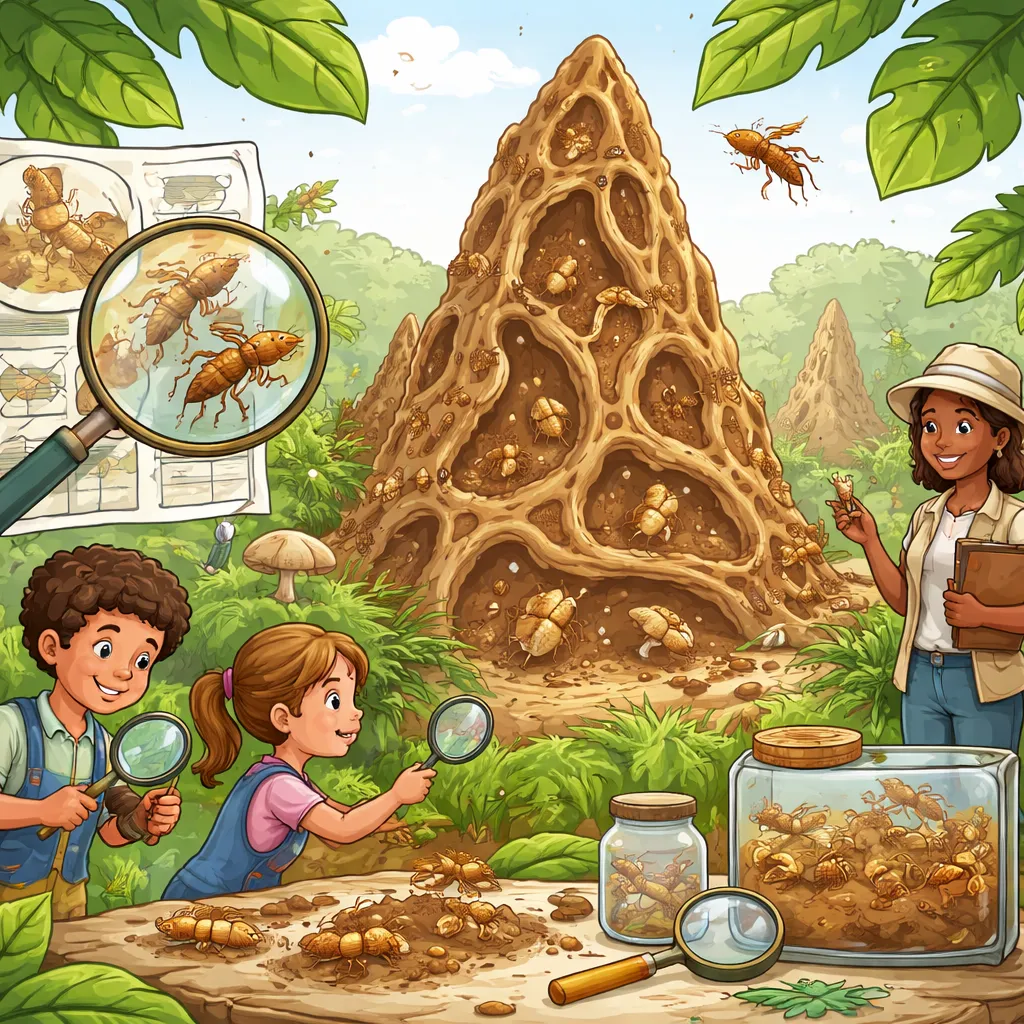
These insects live in colonies. A termite colony can have millions of members. They build massive nests underground. Some termites build tall mounds above ground. These mounds have tunnels and chambers. The colony works as one family.
For children, termites are fascinating builders. Learning about them teaches children about teamwork, construction, and the importance of protecting homes from pests.
English Learning About This Animal
Let us learn the English word termite. We say it like this: /ˈtɜːrmaɪt/. The word has two parts. Ter sounds like “tur.” Mite sounds like “mite.” Put them together: termite. Say it three times. Termite. Termite. Termite.
Now let us learn words about a termite’s body. The head holds the mouthparts and antennae. The antennae are straight and bead-like. The thorax is the middle part where legs attach. The abdomen is the soft back part. The wings appear on some termites during mating season. The mandibles are the strong jaws for chewing wood.
There is a wise saying about termites. An African proverb says, “Termites build their mound one grain of soil at a time.” This reminds us that big things start small. Another saying is, “The termite’s strength is in the colony.” This highlights the power of working together.
These English words help children understand termite anatomy. When they say mandibles, they learn about the chewing tools. When they say antennae, they understand how termites sense. Parents can practice these words while looking at pictures. Point to the parts. Say the words together.
Animal Facts and Science Knowledge
Termites belong to the insect order Isoptera. This name means “equal wings.” There are over two thousand termite species. Termites are social insects. They live in colonies with a caste system. Each termite has a specific job.
Termites live in colonies underground or in wood. They build complex nests with tunnels and chambers. Some termites build mounds that reach fifteen feet tall. The mound has ventilation systems. It stays cool inside even in hot weather.
Termites eat wood and plant material. They cannot digest wood alone. They have special microorganisms in their guts. These microorganisms break down cellulose. This turns wood into food. Termites are important decomposers in nature. They break down dead trees and return nutrients to soil.
Termites have special abilities. They build structures that regulate temperature and humidity. They communicate using chemicals and vibrations. Some termites can explode their bodies to defend the colony. Termites can live for many years. Queens can live for decades.
Termite colonies have different roles. The queen lays eggs. She can lay thousands of eggs each day. Workers gather food and build the nest. Soldiers defend the colony with large heads and strong jaws. Reproductives have wings. They leave the colony to start new ones.
How to Interact With This Animal Safely
Termites are not dangerous to people. They do not bite or sting. But they can damage wooden structures. The best way to interact is to protect the home. Teach children to report signs of termites. Mud tubes on walls, damaged wood, or winged insects indoors may mean termites.
Keep firewood away from the house. Do not let wood touch the soil near the foundation. Fix leaky pipes. Termites need moisture. Dry homes are less attractive to them. These habits protect the home.
If you see a termite swarm, stay calm. Winged termites leave the colony to mate. They are attracted to light. They will die within hours if they cannot find soil. Vacuum them up. Do not spray. Call a professional if termites are inside the home.
Teach children that termites have important jobs in nature. In forests, they break down dead trees. They create space for new plants. They enrich the soil. Their mounds provide homes for other animals. Termites are part of healthy ecosystems.
If your home has termites, seek professional help. Termite control requires special knowledge. Do not try to treat them yourself. Professionals can protect the home safely. Learning about termites helps us appreciate their role while protecting our homes.
What Can We Learn From This Animal
Termites teach us about teamwork. Millions of termites work together. Each has a job. Children learn that working together achieves big things. Families, teams, and communities succeed when everyone helps.
Termites teach us about building. They construct complex mounds from simple materials. Children learn that building takes planning and patience. Building skills, building friendships, and building a future all start with small steps.
Termites teach us about recycling. They break down dead wood. They turn it into soil. Children learn that waste can become something useful. Dead leaves become rich earth. Old materials can become new things.
Termites teach us that every creature has a place. In nature, they are vital. In homes, they are pests. Children learn that context matters. The same creature can be helpful in one setting and harmful in another. Knowing the difference helps us respond wisely.
Fun Learning Activities
Let us make learning about termite fun. One activity is the termite tunnel game. Ask your child to build tunnels with blocks or cardboard boxes. Crawl through them. Talk about how termite tunnels connect the whole colony. Say “termites build tunnels” and “termites work together.”
Another activity is exploring termite mounds in nature. If you live in an area with termite mounds, visit one from a distance. Observe the shape and size. Notice how the mound faces the sun. Draw what you see. Use words like “mound,” “tunnels,” and “colony.”
Draw a termite and label its parts. Draw the head, antennae, thorax, abdomen, and mandibles. Write the words next to each part. Say them aloud. For younger children, draw the termite first. Let them point to the parts as you say the words.
Create a story about a termite colony. Ask your child what the workers do. Do they gather wood? Do they build tunnels? Does the queen lay eggs? Write a few sentences together. Let your child draw pictures. Read the story aloud.
Make a termite mound craft. Use clay or playdough. Build a mound shape. Add tunnels with straws or sticks. Create chambers inside. Talk about how termites build with soil, saliva, and droppings. Use words like “architecture” and “ventilation.”
Learn about decomposers. Talk about how termites, earthworms, and fungi all break down dead things. Make a list of decomposers in your area. Use words like “recycle,” “nutrients,” and “soil.”
These simple activities bring learning to life. Children build English vocabulary while playing. They learn science through understanding ecosystems. They develop awareness through home protection discussions. Learning about termite becomes a lesson in teamwork, construction, and the delicate balance between nature and home. Each moment spent together strengthens language, curiosity, and a growing appreciation for the tiny builders that move mountains of soil, reminding us that great things are possible when we work together.