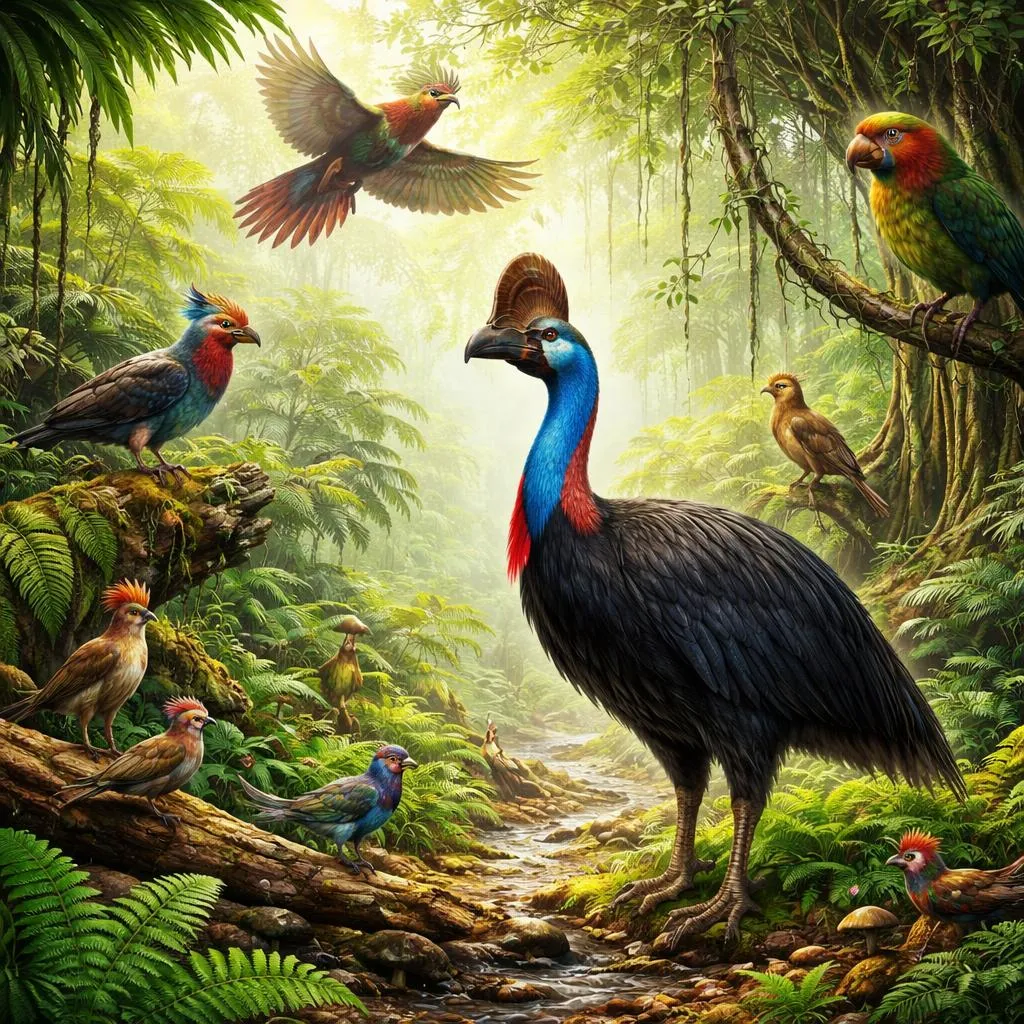

What Is This Animal?
A cassowary is a large, flightless bird with glossy black feathers and a tall, helmet-like crest on its head. It has a bright blue neck with patches of red. Its legs are powerful. Each foot has three toes with a long, dagger-like claw on the inner toe. Cassowaries are one of the most dangerous birds in the world.
Cassowaries live in the tropical rainforests of northern Australia, New Guinea, and nearby islands. They are shy and secretive. They avoid people. They are most active at dawn and dusk. They are excellent at hiding in dense forest.
These birds belong to a group called ratites. This group includes ostriches, emus, and kiwis. Cassowaries are the third-largest bird in the world. Only ostriches and emus are larger. They have been living in rainforests for millions of years.
For children, cassowaries are mysterious. Their colorful necks and helmet-like crests make them look like ancient dinosaurs. Learning about cassowaries teaches children about rainforest wildlife, bird adaptations, and the importance of respecting powerful wild animals.
English Learning About This Animal
Let us learn the English word cassowary. We say it like this: /ˈkæsəweri/. The cas sounds like “kass.” The so sounds like “uh.” The war sounds like “ware.” The y sounds like “ee.” Put them together: cassowary. Say it three times. Cassowary. Cassowary. Cassowary.
Now let us learn words about a cassowary’s body. The casque is the helmet-like crest on the head. The neck is bright blue and red. The feathers are black and glossy. The claw on the inner toe is long and sharp. The chicks are striped baby cassowaries.
There is a wise saying about cassowaries. Rainforest people say, “The cassowary walks softly but strikes hard.” This describes their quiet nature and powerful defense. Another saying is, “Respect the cassowary, for it was here before us.” This reminds us of their ancient lineage.
These English words help children understand cassowary anatomy. When they say casque, they learn about the helmet. When they say chicks, they know the babies. Parents can practice these words while looking at pictures. Point to the parts. Say the words together.
Animal Facts and Science Knowledge
Cassowaries belong to the ratite family Casuariidae. There are three cassowary species. The southern cassowary lives in Australia and New Guinea. The dwarf cassowary lives in New Guinea. The northern cassowary also lives in New Guinea. Cassowaries are one of the oldest bird groups. They have remained unchanged for millions of years.
Cassowaries live in tropical rainforests. They need dense forest with plenty of fruit. They are solitary birds. They have large territories. They travel through the forest each day. They follow the same paths. These paths become trails used by other animals.
Cassowaries are frugivores. They eat fruit that falls from trees. They swallow fruit whole. They are important seed dispersers. They spread seeds throughout the forest. Many rainforest trees depend on cassowaries to spread their seeds.
Cassowaries have special abilities. They can run up to thirty miles per hour through thick forest. They are good swimmers. They can leap high. Their inner toe claw is five inches long. It is like a dagger. They use it for defense. A cassowary kick can be deadly.
Cassowary fathers are devoted parents. Females lay eggs. Then they leave. The male sits on the eggs for about fifty days. He does not eat much during this time. After chicks hatch, he raises them for about nine months. He protects them and teaches them to find food.
How to Interact With This Animal Safely
Cassowaries are wild and dangerous. They are not pets. They can attack if they feel threatened. Their kicks are powerful. Their claws are sharp. The best way to interact is to watch from a very safe distance. Never approach a cassowary.
If you visit cassowary habitat, stay on trails. Do not approach cassowaries. Do not try to feed them. Feeding makes them lose their fear of people. It can lead to dangerous encounters. Keep a safe distance.
Teach children to respect cassowaries. They are not like zoo birds. They are powerful wild animals. Watching them from behind a fence or from a vehicle is the safest way to see them.
If you see a cassowary in the wild, back away slowly. Do not run. Do not turn your back. Give it space. It will likely move away if it does not feel threatened.
Cassowaries are endangered. Their habitat is disappearing. Roads and cars kill them. Conservation programs work to protect them. Learning about them helps us understand why they need protection.
What Can We Learn From This Animal
Cassowaries teach us about being ancient. They have lived for millions of years. Children learn that some animals are very old on Earth. They have seen many changes. We are new compared to them.
Cassowaries teach us about being powerful. They are strong and fast. Children learn that strength comes in many forms. Being strong, being fast, and being capable are good things.
Cassowaries teach us about parenting. Fathers raise the chicks alone. Children learn that fathers take care of children too. Dads protect, teach, and care for their young.
Cassowaries teach us about respect. They are beautiful but dangerous. Children learn that some things are best admired from a distance. Respecting wild animals keeps us safe and keeps them safe.
Fun Learning Activities
Let us make learning about cassowary fun. One activity is the cassowary walk game. Ask your child to walk quietly like a cassowary through a forest. Use long strides. Keep head high. Stay alert. Kick gently. Say “cassowary walks softly” and “cassowary watches.”
Another activity is drawing a cassowary. Look at pictures of cassowaries. Notice the casque, bright blue neck, and long claw. Draw a cassowary in the rainforest. Add fruit on the ground. Label the parts. Say the words aloud.
Create a story about a cassowary father. Ask your child what the father does. Does he guard the eggs? Does he protect the chicks? Do they walk through the forest together? Write a few sentences together. Let your child draw pictures. Read the story aloud.
Make a cassowary craft. Use black paper for the feathers. Add a tall casque on the head. Add a bright blue and red neck. Add a long claw on the foot. Move the craft cassowary. Practice saying “cassowary walks” and “father cassowary guards the chicks.”
Learn about Australian rainforest animals. Talk about other animals that live with cassowaries. Compare cassowaries to emus. Use words like “rainforest,” “endemic,” and “seed disperser.”
Learn about animal defenses. Talk about why cassowaries have powerful kicks. Compare to other animals with strong defenses. Use words like “defense,” “adaptation,” and “predator.”
These simple activities bring learning to life. Children build English vocabulary while playing. They learn science through understanding rainforest ecosystems. They develop respect through learning about powerful wild animals. Learning about cassowary becomes a journey to ancient rainforests. Each moment spent together strengthens language, curiosity, and a growing appreciation for the helmeted, bright-necked birds that walk softly through the forest, teaching us that power, patience, and protecting what is ancient are lessons from a time before us.