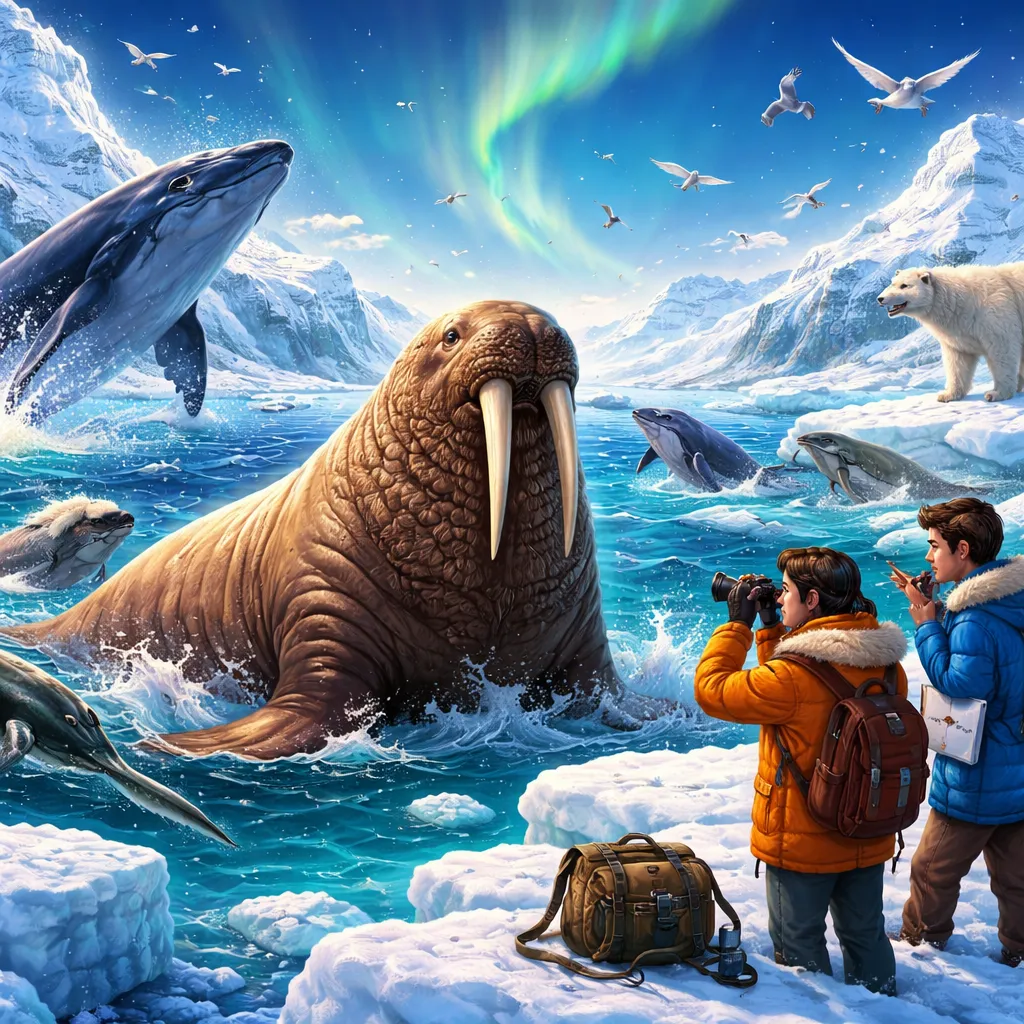

What Is This Animal?
A walrus is a large marine mammal with thick skin and long tusks. It lives in the cold Arctic seas. Its body is bulky and covered in wrinkled skin. It has stiff whiskers on its face. Walruses use their whiskers to find food on the ocean floor.
Walruses are related to seals and sea lions. They belong to the group called pinnipeds. This means “fin-footed.” They have flippers instead of feet. Their front flippers help them swim. Their back flippers help them steer. On land, they can turn their back flippers forward to walk.
These animals spend much of their time in the water. They come onto ice or land to rest. They gather in large groups called herds. A herd can have hundreds or thousands of walruses. They lie close together for warmth and safety.
For children, walruses are fascinating Arctic animals. Their tusks, whiskers, and bulky bodies make them easy to recognize. Learning about walruses teaches children about adaptation to cold environments and the importance of family groups.
English Learning About This Animal
Let us learn the English word walrus. We say it like this: /ˈwɔːlrəs/. The word has two parts. Wal sounds like “wahl.” Rus sounds like “russ.” Put them together: walrus. Say it three times. Walrus. Walrus. Walrus.
Now let us learn words about a walrus’s body. The tusks are long teeth that grow from the upper jaw. Both males and females have tusks. The whiskers are stiff hairs called vibrissae. They help find food. The flippers are the front and back limbs for swimming. The blubber is thick fat under the skin. The skin is thick and wrinkled.
There is a traditional saying from Arctic peoples. They say, “The walrus knows where the ice is safe.” This means experience teaches wisdom. Another saying is, “A walrus without tusks is like a person without hands.” This shows how important tusks are for survival.
These English words help children understand walrus anatomy. When they say tusks, they learn about the long teeth. When they say blubber, they understand how walruses stay warm. Parents can practice these words while looking at pictures. Point to the parts. Say the words together.
Animal Facts and Science Knowledge
Walruses belong to the family Odobenidae. Their scientific name means “tooth-walker.” Walruses use their tusks to pull themselves onto ice. They are one of the largest pinnipeds. Males can weigh over 3,000 pounds. They can grow up to twelve feet long.
Walruses live in the Arctic Ocean and surrounding seas. They spend time on sea ice and in shallow waters. They prefer areas with ice floes. The ice provides a place to rest and give birth. Walruses migrate with the ice as it changes with seasons.
Walruses eat clams, snails, and other creatures from the sea floor. They use their whiskers to find food. They suck the meat from the shell. They do not chew. They swallow their food whole. An adult walrus eats thousands of clams each day.
Walruses have special abilities. They can slow their heartbeat to conserve oxygen. They can stay underwater for up to thirty minutes. Their tusks grow throughout their lives. They use tusks to haul out on ice and to defend themselves. Their blubber can be six inches thick. It keeps them warm in freezing water.
Walruses are social animals. They live in herds. Females and young stay together. Males gather in separate groups during non-breeding season. Mothers are very protective of their calves. Calves stay with their mothers for two to three years.
How to Interact With This Animal Safely
Walruses are wild Arctic animals. They are not pets. They are powerful and can be dangerous. The best way to interact is to observe from a safe distance. In the wild, never approach a walrus. They may charge if they feel threatened.
If you see walruses in a zoo or aquarium, follow the rules. Stay behind barriers. Do not tap on glass. Do not try to feed them. Watch them swim. Notice their tusks and whiskers. Learn from the information signs.
Teach children that wild animals need space. Walruses are protected animals. Disturbing them can harm them. In the Arctic, people keep a safe distance. This allows walruses to rest and care for their young.
If you are in an area with walruses, stay in a boat or on land at a distance. Never come between a walrus and the water. They need to escape quickly. Mothers with calves are especially protective. Give them extra space.
Walruses are affected by climate change. Sea ice is important for their survival. Learning about them helps us understand why protecting their habitat matters. We can help by learning and sharing what we know.
What Can We Learn From This Animal
Walruses teach us about family. Mothers care for their calves for years. Herds stay together for protection. Children learn that family takes care of each other. Helping family, staying close, and protecting one another are important.
Walruses teach us about adaptation. They have thick blubber for cold water. They have tusks for pulling onto ice. Children learn that adapting to our environment helps us thrive. Wearing warm clothes in winter, learning new skills, and adjusting to change are all adaptations.
Walruses teach us about using what we have. They use tusks for many tasks. They use whiskers to find food. Children learn that their own talents and tools help them succeed. Using our strengths, asking for help when needed, and being resourceful are valuable.
Walruses teach us about the Arctic. They show us that life thrives in cold places. Children learn that different parts of the world have different animals. Each place has its own wonders. Exploring the world teaches us about diversity.
Fun Learning Activities
Let us make learning about walrus fun. One activity is the walrus crawl game. Ask your child to lie on the floor. Use arms as front flippers. Pull the body forward. Move slowly like a walrus on ice. Say “walrus hauls out” and “walrus rests on ice.”
Another activity is drawing a walrus. Look at pictures of walruses. Notice the long tusks and thick whiskers. Draw a large body. Add the tusks. Add the whiskers. Add flippers. Label the parts. Say the words aloud.
Create a story about a walrus family. Ask your child what the mother walrus does. Does she find clams? Does she protect her calf? Does the herd sleep together? Write a few sentences together. Let your child draw pictures. Read the story aloud.
Make a walrus craft. Use a small paper bowl for the body. Add clay or paper tusks. Add yarn whiskers. Add paper flippers. Paint or color the skin gray-brown. Move the craft walrus. Practice saying “walrus swims” and “walrus uses tusks.”
Learn about Arctic animals. Compare walruses to seals and sea lions. Notice the differences in tusks, size, and movement. Talk about how each animal survives in cold water. Use words like “blubber,” “pinniped,” and “adaptation.”
Learn about sea ice. Talk about why ice is important for walruses. Use a map to show where walruses live. Discuss how climate affects their habitat. Use words like “Arctic,” “ice floe,” and “migration.”
These simple activities bring learning to life. Children build English vocabulary while playing. They learn science through understanding adaptation. They develop respect through learning about wild animals. Learning about walrus becomes a journey to the frozen north. Each moment spent together strengthens language, curiosity, and a growing appreciation for the tusked giants that gather on Arctic ice, teaching us that family, adaptation, and using our unique gifts help us thrive in even the coldest places.