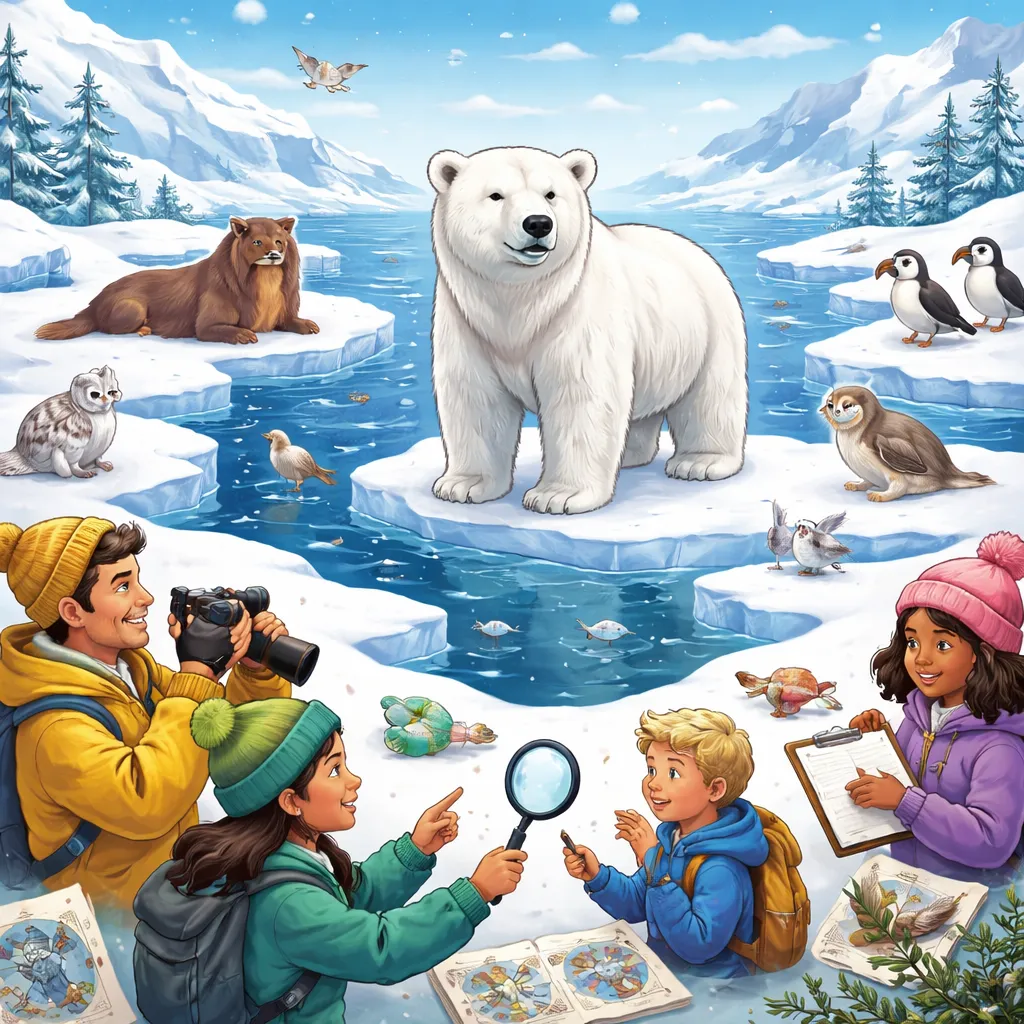

What Is This Animal?
A polar bear is a large bear with white or yellowish fur. It lives in the Arctic. Its fur blends in with snow and ice. Under the fur, its skin is black. This black skin absorbs heat from the sun. Polar bears are the largest land carnivores on Earth.
Polar bears are marine mammals. They spend much of their time on sea ice. They hunt seals from the ice. They are powerful swimmers. They can swim for miles between ice floes. Their bodies are built for cold water and icy conditions.
These animals live in the Arctic regions. They are found in Alaska, Canada, Russia, Greenland, and Norway. They follow the sea ice as it changes with seasons. They travel vast distances across ice and water.
For children, polar bears are majestic animals. Their white fur and Arctic home capture imagination. Learning about polar bears teaches children about adaptation to extreme cold and the importance of protecting our planet.
English Learning About This Animal
Let us learn the English words polar bear. We say it like this: /ˈpoʊlər bɛr/. Polar sounds like “po-lar.” Bear sounds like “bair.” Put them together: polar bear. Say it three times. Polar bear. Polar bear. Polar bear.
Now let us learn words about a polar bear’s body. The fur is white or yellowish. Each hair is hollow. This traps heat. The skin underneath is black. The paws are large and covered in fur. They help the bear walk on ice. The claws are short and curved for gripping ice. The blubber is a thick layer of fat under the skin.
There is a traditional saying from Arctic peoples. They say, “The polar bear walks where others cannot.” This means the bear is master of its frozen world. Another saying is, “Respect the bear, for it knows the ice better than you.” This reminds us to honor the knowledge of creatures in their own home.
These English words help children understand polar bear anatomy. When they say blubber, they learn how polar bears stay warm. When they say paws, they understand how they walk on ice. Parents can practice these words while looking at pictures. Point to the parts. Say the words together.
Animal Facts and Science Knowledge
Polar bears belong to the bear family Ursidae. Their scientific name means “sea bear.” They are closely related to brown bears. They evolved from brown bears about 150,000 years ago. They adapted to life on Arctic ice.
Polar bears live on sea ice over shallow waters. This is where seals live. They follow the ice as it expands and melts. In summer, when ice melts, some polar bears come onto land. They wait for ice to form again in autumn.
Polar bears eat mostly seals. They hunt ringed seals and bearded seals. They wait by breathing holes in the ice. When a seal comes up for air, the bear catches it. They also eat walrus calves, bird eggs, and whale carcasses when available.
Polar bears have special abilities. They can smell seals from a mile away. They can swim for hours without rest. Their paws act like paddles. They can travel over 1,000 miles in a season. Their fur keeps them so warm that they can overheat when running.
Polar bears are mostly solitary. They hunt alone. Mothers stay with cubs for over two years. Cubs are born in snow dens during winter. They are tiny at birth. They grow quickly on mother’s rich milk. They learn to hunt on ice as they grow.
How to Interact With This Animal Safely
Polar bears are wild and powerful animals. They are dangerous to humans. The best way to interact is from a very safe distance. In the Arctic, people carry safety equipment. They never approach polar bears. They respect the bear’s space.
Teach children that polar bears are not like zoo bears. They are not tame. They are top predators. They see humans as neither friend nor food, but they are curious. A curious polar bear can be dangerous. Never approach a polar bear.
If you see a polar bear in the wild, stay in a vehicle or building. Do not get out. Do not run. Running may trigger a chase response. Back away slowly if you are on foot. Make yourself look large. Use noisemakers if available.
In zoos and aquariums, follow the rules. Stay behind barriers. Do not tap on glass. Polar bears in captivity are still wild animals. Respect their space. Enjoy watching them swim and play from a safe distance.
Polar bears are affected by climate change. Sea ice is melting. This affects their hunting. Learning about polar bears helps us understand why protecting the Arctic matters. We can help by learning and sharing.
What Can We Learn From This Animal
Polar bears teach us about adaptation. They live in the coldest place on Earth. Their bodies are perfect for ice and water. Children learn that adapting to our environment helps us thrive. Dressing for weather, learning new skills, and adjusting to change are all adaptations.
Polar bears teach us about patience. They wait for hours at seal holes. They do not rush. Children learn that waiting is sometimes necessary. Waiting for the right moment, being patient with others, and taking time to do things well are valuable.
Polar bears teach us about strength. They are powerful swimmers and hunters. Children learn that strength comes in many forms. Physical strength, mental strength, and emotional strength all help us face challenges.
Polar bears teach us about the Arctic. They show us that life exists in extreme places. Children learn that different parts of the world have unique animals. Protecting these animals means protecting their homes.
Fun Learning Activities
Let us make learning about polar bear fun. One activity is the polar bear walk game. Ask your child to walk on hands and feet. Walk slowly like a bear. Pretend to walk on ice. Say “polar bear walks” and “polar bear hunts on ice.”
Another activity is drawing a polar bear. Look at pictures of polar bears. Notice the white fur, black nose, and large paws. Draw a polar bear on ice. Add a seal hole nearby. Label the parts. Say the words aloud.
Create a story about a polar bear family. Ask your child what the mother bear does. Does she hunt seals? Does she teach her cubs? Does she build a den? Write a few sentences together. Let your child draw pictures. Read the story aloud.
Make a polar bear craft. Use a small paper plate for the face. Add paper ears. Draw eyes and nose. Add white cotton balls for fur. Attach to a paper body with large paws. Move the craft bear. Practice saying “polar bear swims” and “polar bear waits.”
Learn about Arctic animals. Compare polar bears to other Arctic animals like seals and walruses. Talk about how each animal survives in cold climates. Use words like “blubber,” “insulation,” and “adaptation.”
Learn about sea ice. Use a map to show where polar bears live. Talk about how ice changes with seasons. Discuss how climate affects their habitat. Use words like “Arctic,” “ice floe,” and “conservation.”
These simple activities bring learning to life. Children build English vocabulary while playing. They learn science through understanding adaptation. They develop respect through learning about wild animals. Learning about polar bear becomes a journey to the frozen north. Each moment spent together strengthens language, curiosity, and a growing appreciation for the great white bears that rule the ice, teaching us that strength, patience, and adaptation help us survive in even the harshest places.