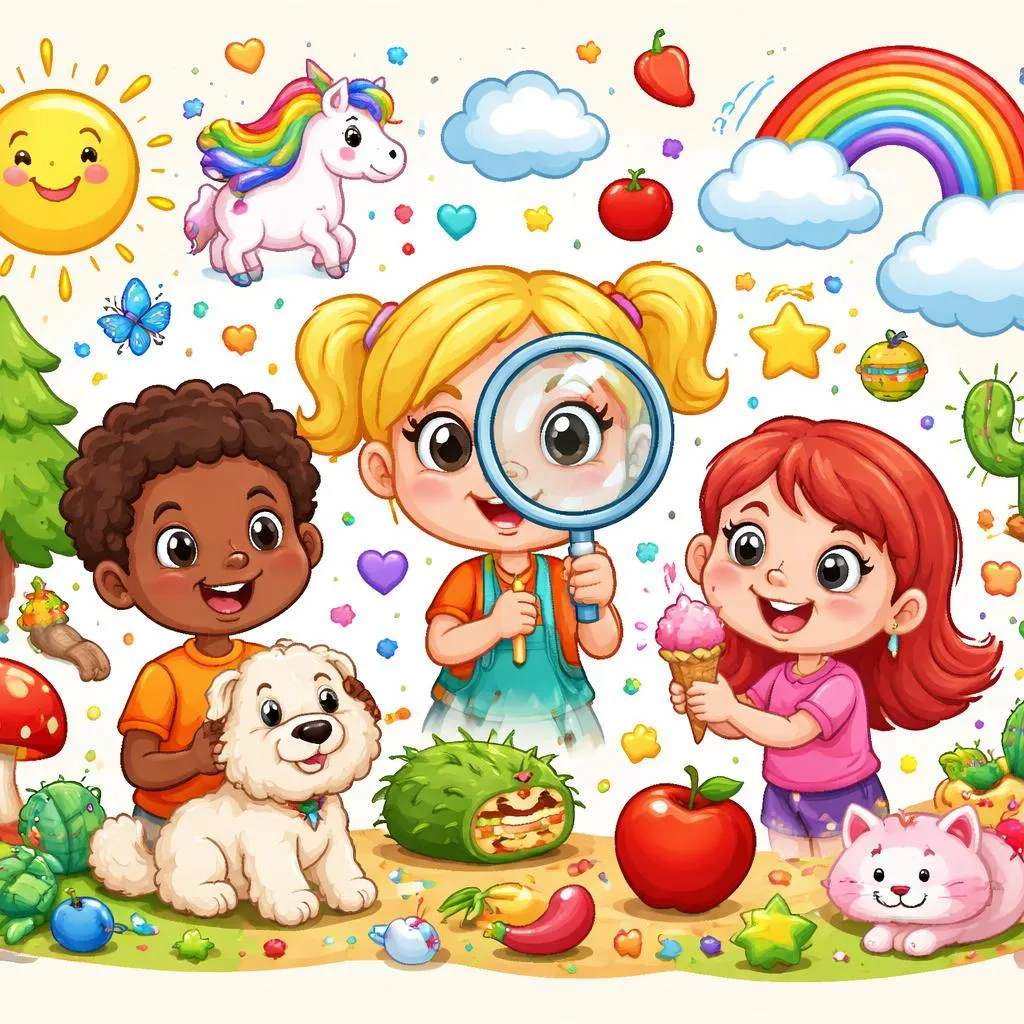

Hello, young word wizards! Today, we’re going on a fantastic adventure. Our mission is to find the secret helpers that make our sentences sparkle and shine. These helpers are called adjectives. Every time you describe something, you’re using an adjective. Let’s discover how they work and how to use them to tell wonderful stories!
Meaning
So, what are adjectives? Think of adjectives as your own personal word paintbox. They are special words that describe things. They add color, size, shape, and feeling to everything you see and talk about. An adjective gives more information about a person, a place, an animal, or a thing. It makes your words more interesting and much clearer. Without adjectives, the world in our stories would be very plain. Learning adjectives is like getting a superpower for your speech.
Conjugation
This is a tricky word, conjugation. But don’t worry. For adjectives, it’s easy. Conjugation is about how words change. Verbs change a lot. Adjectives are different. Most adjectives do not change their form. Look at these sentences. The word “happy” stays the same. You can be a happy child. You can have a happy day. The adjective “happy” is always happy! It doesn’t need to change for one child or many children. Isn’t that nice? This makes learning adjectives much simpler.
Present tense
We use adjectives all the time, right now. This is the “present tense” use. When you look around your room, you can describe it. Tell me what you see. You might see a blue ball. You could point to a soft pillow. Your dog is a furry friend. The sun is a bright light. These sentences are about now. The adjectives describe how things are at this moment. Let’s practice. Say this out loud. “I am wearing a (color) shirt.” The word you said for color is an adjective. Great job. You are using present tense adjectives.
Past tense
We can also describe how things were. This is talking about the past. The adjectives themselves don’t change. The sentence around them changes. Let’s look at examples. Maybe yesterday, you saw a scary movie. Last week, you ate a delicious cake. The cake was delicious. The movie was scary. The adjectives “scary” and “delicious” are the same. The verb “was” tells us it happened before. You can say, “The room was messy.” Now the room is clean. The adjective “messy” told us about the past. Try it. Think of a toy you had. Was it a big toy? Was it a fun toy? You just used past tense with adjectives.
Future tense
We can also dream about tomorrow. We can describe what will be. This is the future. We use words like “will be” to talk about the future. Imagine a party. The cake will be huge. The balloons will be colorful. The games will be exciting. Here, “huge,” “colorful,” and “exciting” are adjectives. They describe things that are not here yet. What do you want to be? You can say, “I will be strong.” Or, “I will be happy.” You are using adjectives to paint a picture of the future. It’s fun to plan with descriptive words.
Questions
We can ask questions using adjectives. This helps us learn about the world. How do you make a question? You often start with “how” or “what.” For example, you can ask, “How is the weather?” The answer uses an adjective. “It is sunny.” Another great question is, “What color is your bag?” The answer is an adjective. “It is red.” You can even ask about feelings. “Are you hungry?” The word “hungry” is an adjective. Questions make conversations fun. They help you get more details. Asking “What kind of book is that?” will get you a wonderful descriptive answer.
Other uses
Adjectives are very flexible. They can do more than just follow “is” or “are.” You can use them right before a noun. This is very common. Look at this phrase: a fluffy cat. The adjective “fluffy” comes right before the noun “cat.” It tells you about the cat immediately. You can have a tall building. You can eat a sweet apple. You can read a funny book. This makes your speaking quick and clear. You can also use more than one adjective. You might see a big, yellow bus. You could have a small, spotted dog. Just use a comma between them. Try describing your favorite toy with two adjectives.
Learning tips
Learning adjectives is easy and fun. Here are some top tips. First, play the “I Spy” game. Say, “I spy with my little eye, something that is (color).” This is all about adjectives. Second, keep a description diary. Each day, write one sentence about your day. Use a new adjective. “Today was a busy day.” Third, read picture books. Point to the pictures and describe them. See a big elephant? A tiny mouse? You’re practicing. Listen to songs that describe things. Sing along. The best tip is to talk. Describe your food, your clothes, your friends. Use adjectives every day.
Educational games
Games are the best way to learn. Let’s play some adjective games. Game one is Adjective Charades. Write different adjectives on cards. Words like “sleepy,” “angry,” “fast,” “cold.” Pick a card and act it out. Your friends must guess the adjective. Game two is the Sorting Game. Gather toys or objects from your house. Sort them into piles. Make a pile of soft things. Make a pile of hard things. Make a pile of round things. You are thinking about their qualities. Game three is the Story Starter. Someone says a noun, like “dragon.” Everyone takes turns adding an adjective. “A scary dragon.” “A big, scary dragon.” “A big, scary, green dragon.” See how long you can make the description. Have fun playing.