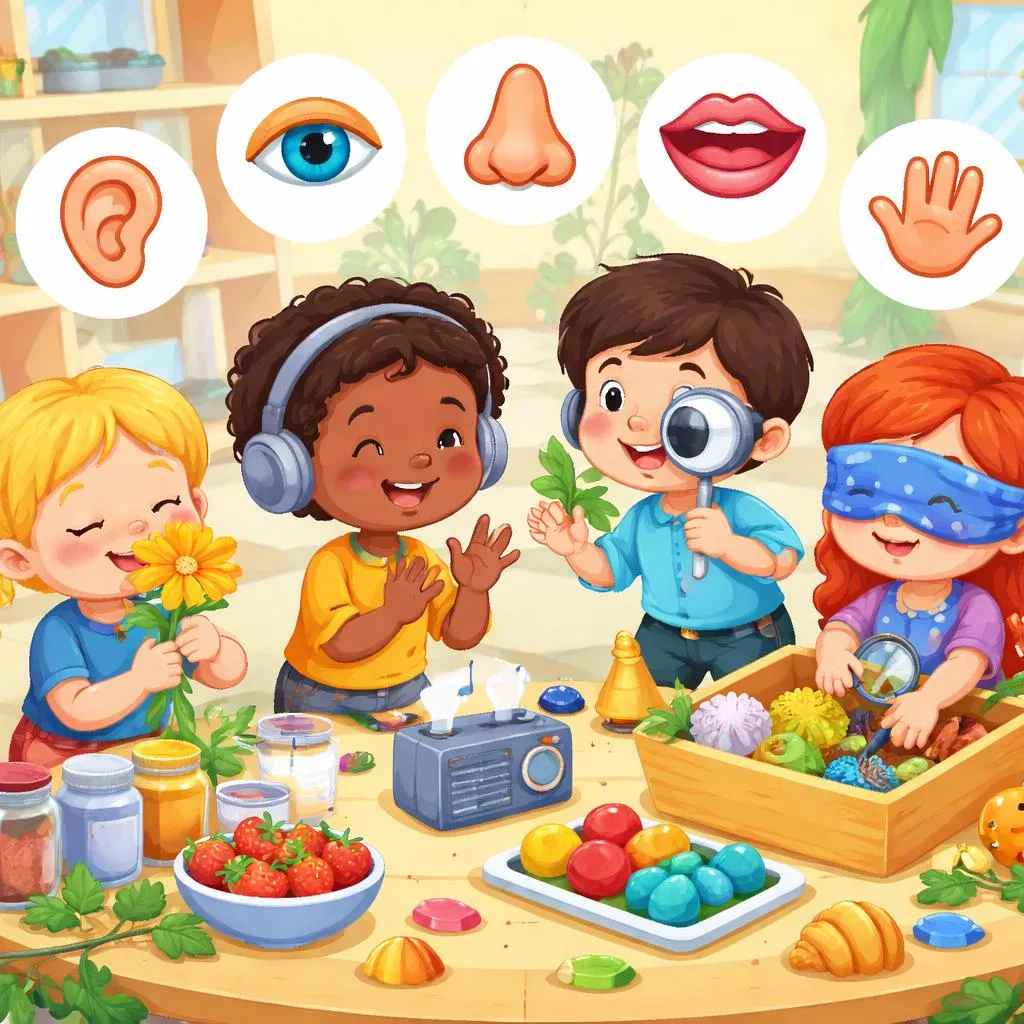

What Is The Rhyme? Many simple songs introduce the five senses in a playful way. A classic rhyme goes: "With my eyes I see, with my ears I hear, with my nose I smell, with my mouth I taste, with my hands I touch!" This song is perfect for activities on five senses for preschoolers. The melody is repetitive and easy to learn. It pairs each sense organ with its action verb. Singing this rhyme provides a perfect framework for hands-on exploration. It turns a science lesson into a joyful, musical, and linguistic experience. The song becomes a guide for the sensory discovery to follow.
The Lyrics of Nursery Rhymes The lyrics of nursery rhymes for the senses are clear and instructional. They often follow a direct pattern: "I have two little eyes to see with, I have two little ears to hear with..." Another fun version is "Head, Shoulders, Knees and Toes," which focuses on touch and body parts. For taste and smell, a rhyme might say, "Yummy, yummy in my tummy, for my mouth to taste!" The lyrics connect the body part (noun) directly to its function (verb). This structure is ideal for language learning. The repetition allows children to sing along confidently, reinforcing the vocabulary with each verse.
Vocabulary Learning Engaging in activities on five senses for preschoolers builds a rich, practical English vocabulary. We learn the five sense nouns: sight, hearing, smell, taste, touch. We learn the body parts: eyes, ears, nose, tongue/mouth, hands/skin. Then, we learn powerful action verbs: see, look; hear, listen; smell, sniff; taste; touch, feel. The real power comes with descriptive adjectives. For sight: bright, dark, red, shiny. For hearing: loud, quiet, crunchy. For smell: sweet, stinky, fresh. For taste: sweet, sour, salty, bitter. For touch: soft, hard, smooth, rough, bumpy. This creates a vibrant toolkit for describing the world.
Phonics Points The vocabulary from these activities on five senses for preschoolers offers wonderful phonics practice. We focus on beginning sounds and blends. The /s/ sound in see, sight, smell, soft. The /l/ sound in listen and loud. The /t/ sound in touch, taste, tongue. The /h/ sound in hear, hard, hands. We practice blends like /sm/ in smell and /st/ in sticky. Words like rough and smooth help practice different vowel sounds and the /gh/ ending. Clapping syllables in longer words like "colorful" (col-or-ful) or "listening" (lis-ten-ing) builds phonological awareness.
Grammar Patterns These activities on five senses for preschoolers naturally teach key grammar. We use the modal verb "can" to express ability. "I can see. You can hear." We practice simple present tense for observations. "The lemon tastes sour. The blanket feels soft." We use the verb "to be" with adjectives. "The popcorn is salty. The music is loud." We form questions. "What do you see? What does it smell like? How does it feel?" We also use possessive pronouns. "My eyes see. Your hands touch." These patterns are essential for describing experiences.
Learning Activities Hands-on activities on five senses for preschoolers are the core of learning. For sight, create an "I Spy Color Hunt." "I spy something red and round!" For hearing, play "Sound Bingo" with recorded everyday sounds (bell, rain, car). For smell, use "Mystery Scent Jars" with safe items like lemon, cinnamon, or mint. For taste, have a "Sweet/Sour/Salty" tasting with safe foods (apple slice, lemon drop, cracker). For touch, a "Feely Box" is perfect. A child feels an object inside and describes it. "It is bumpy and hard. I think it is a pinecone." Each activity prompts descriptive English.
Printable Materials Printable resources extend the sensory exploration. Create "Five Senses Sorting Mats." Each mat has a picture of an eye, ear, etc. Children sort picture cards (a rainbow, a bell, a flower) onto the correct mat. Design "My Senses Journal" pages. Each page says, "With my eyes I see ______" with space to draw and write. A "Senses Wheel" with a spinning arrow lets children spin, land on a sense, and name an example. "Touch! Something soft!" Simple "Vocabulary Cards" with pictures of sense organs and actions are perfect for matching games.
Educational Games Games make vocabulary practice playful. "Senses Charades" is fun. A child acts out an action like "listening to music" or "smelling a flower." Others guess the sense and the action. "Simon Says" is perfect. "Simon says, point to something you can taste. Simon says, touch something rough." For a group game, try "Pass the Sound." Whisper a descriptive word like "crunchy" around a circle. The last child says it aloud and names a crunchy food. A "Texture Scavenger Hunt" with a checklist (find something smooth, fuzzy) gets children moving and describing.
Integrating English learning into activities on five senses for preschoolers is a powerful, natural strategy. Children are already eager to explore their world through sight, sound, smell, taste, and touch. By pairing this innate curiosity with targeted English vocabulary and sentence structures, we create meaningful and memorable learning experiences. The multi-sensory nature of the activities ensures that words are learned in context, linked to real feelings and observations. This method builds far more than a word list; it builds a child's confidence to observe, describe, and share their unique perspective on the world in English, fostering both scientific thinking and language fluency from the very start.