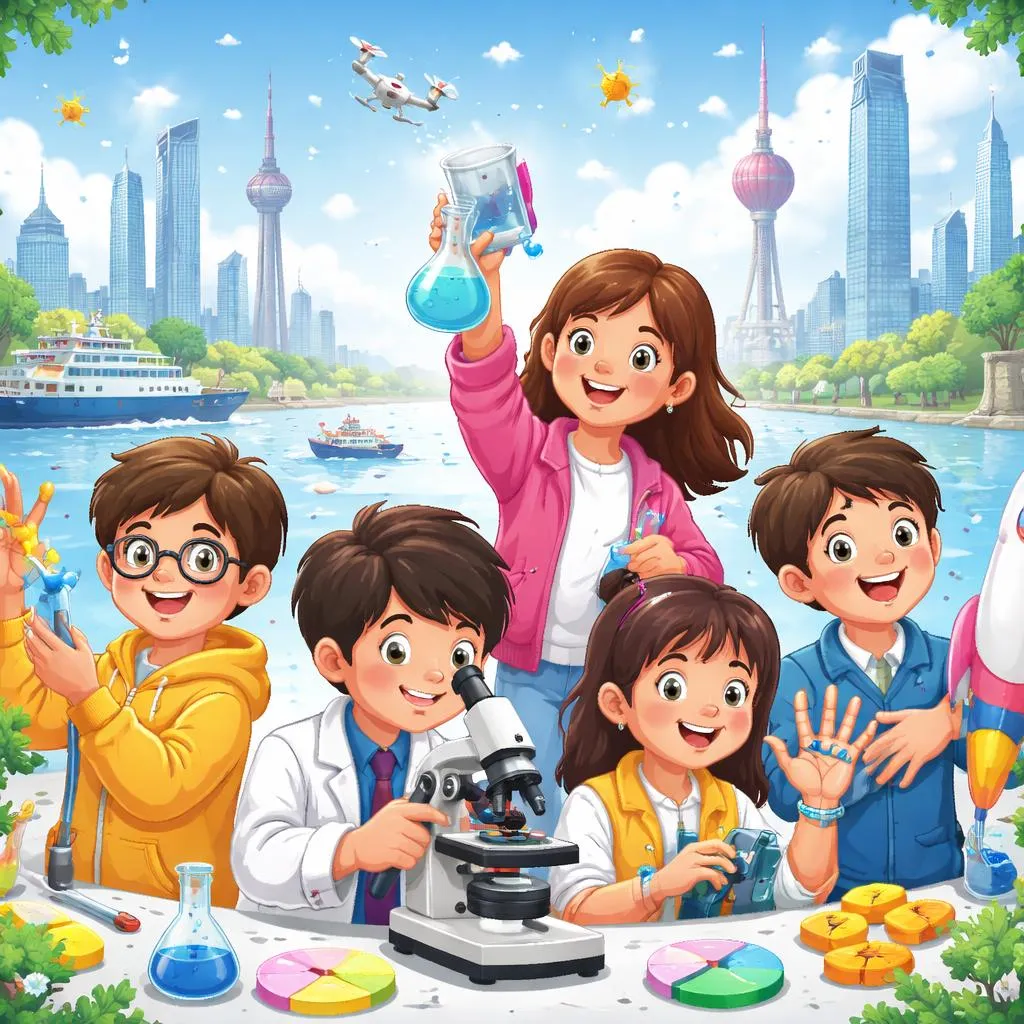

Hello, future Science Stars! Are you ready for an adventure? Today we explore two amazing science events. They happen in China. They are perfect for curious minds. You love science. You want to improve your English. This is for you. Let us dive into the world of discovery. We will learn about the Greater Bay Area Science Festival. We will also explore Shanghai's "Tomorrow's Science Stars". You can join this exciting journey. It mixes fun science with great English learning.
The Great Science Parties
First, imagine a big science party. It happened in April 2026. Many science stars came. They are real top scientists. We call them academicians. Twenty of them joined the fun. They visited schools in Shenzhen and Guangzhou. They gave twenty-two fantastic talks. More than ten thousand students listened. They learned about the universe. They learned about the moon. They learned about amazing new materials. The scientists even gave books to the students. They are stories about their own lives. It was a true science feast for young minds.
In Shanghai, another big event happened. It is the "Tomorrow's Science Stars" contest. It is the twenty-fourth time. Many, many students joined. Elementary school kids joined. Middle school students joined. Even university students joined. The theme was wonderful. It was "Technology Creates a Better Life". Students worked in teams. They solved real problems from daily life. This year was special. The public could watch. Anyone interested in science could come. It was very open and exciting.
Why It's Perfect for You
Why are these events so good for you? Science and English are best friends. Many activities mix them together. For example, Shanghai has a science English contest. It started long ago, in 1991. Now, there is also a science debate. Students use English to argue about science. It is so cool. Other cities have similar fun. In Hangzhou, kids "talk" about science in English. You can read, draw, write, and speak about science. All in English. It makes learning both subjects much more fun.
These activities know how you think. You like to do things. You do not just listen. The Shanghai event understands. Younger kids make videos. They create colorful posters. Scientists ask you questions. They make you think. "Are we at the center of the Earth?" one scientist asked. This makes your brain active. You also meet real heroes. The scientists share their stories. They tell you to stay curious. They tell you to be creative. This is very encouraging. It makes you dream big.
You also build important skills. Science debate teaches critical thinking. You must use real evidence. You learn to see the world. You use English to learn global science. You can also tell China's science stories. You learn to solve problems. You look at your daily life. You find a small issue. Then you invent a solution. This builds true innovation power. It follows our country's educational goals. It makes learning deeper and more meaningful.
Your Amazing Rewards
So, what can you gain? You gain a lot of knowledge. You learn about space exploration. You learn about new materials like graphene. Your English gets much better. You read science articles in English. You learn special science words. You practice speaking and writing. You also learn a real scientist's method. You see a problem. You design a test. You find an answer. It is a complete process. It is like being a detective for truth.
You grow many great abilities. Your thinking becomes sharper. You learn to judge with evidence. Your creativity shines. You make new things for your home or school. You learn to work with friends. Teamwork is very important. You also learn to present your ideas. You can use video. You can use posters. You can talk to judges. All these skills are super useful. They help you in school. They help you in future life.
Most importantly, you grow inside. You feel the scientists' passion. You see their love for the country. You want to be like them. You want to use technology to help our nation. Your curiosity becomes a fire. You want to explore everything. This is the spirit of a true Science Star. It is about knowledge. It is also about heart and character.
Your Action Plan
How can you start your journey? Let us make a simple plan. Start with small steps. Look for local science events. Go to your city's science museum. Check the youth activity center. Join a national event online. Try a science reading show. Form a small study group. Get two friends. Make a team of three. Have regular meetings. Share cool science facts in English. Do a small project together. Use online resources every day. Watch science videos in English. Listen to the scientists' talks. Learn the professional words.
Build your skills over months. Make a personal study plan. Read one science book in English each month. Join a speech or debate class. Learn to use science tools. Try a small project at home. Find a simple problem. Can you make something better? Make a short video about it. Use both Chinese and English. Join your school's science fair. Prepare to share your work. Practice a three-minute English speech. Make a portfolio of your projects. Write notes in English. Be ready to answer questions.
Think about the long term. Choose a topic you love. Do you like stars? Do you like robots? Study that area more deeply. Find English books about it. Try to write a small report. Prepare for a big contest. Look at the "Tomorrow's Science Stars" website. See what they need. Start your project one year early. Find a teacher to help you. Look at the world. Learn about international science contests. Try to meet friends from other countries. Talk about science with them.
Make science and English a daily habit. Spend fifteen minutes every day. Read a short science article in English. Watch a fun science video. Carry a small notebook. Write your science questions. Share one cool fact each week. Tell your family in English. Do a fun experiment each month. Write down what happened. Use simple English words. This makes you a real Science Star every day.
What You Can Learn from This Article
You can learn about two great science events. You know the Greater Bay Area Science Festival. You know Shanghai's "Tomorrow's Science Stars". You see how science and English work together. You understand why it fits young learners. You see the amazing rewards for joining. You get a clear plan to start your own journey. You feel excited to explore and learn. This knowledge opens a new door for you. It mixes your interests in a smart way. It shows you a path to grow.
Life Practice Application
Talk to your science teacher today. Ask about science contests. Form a team with two classmates. Pick a simple problem at home. Maybe a messy desk. Design a small organizer. Make a poster about it. Write three English sentences on the poster. Practice saying them. Join an online science club. Listen to an English science podcast this week. Tell your parents one new fact. Use your new English words. Start your Science Star journey now. Your future is bright and full of discovery.