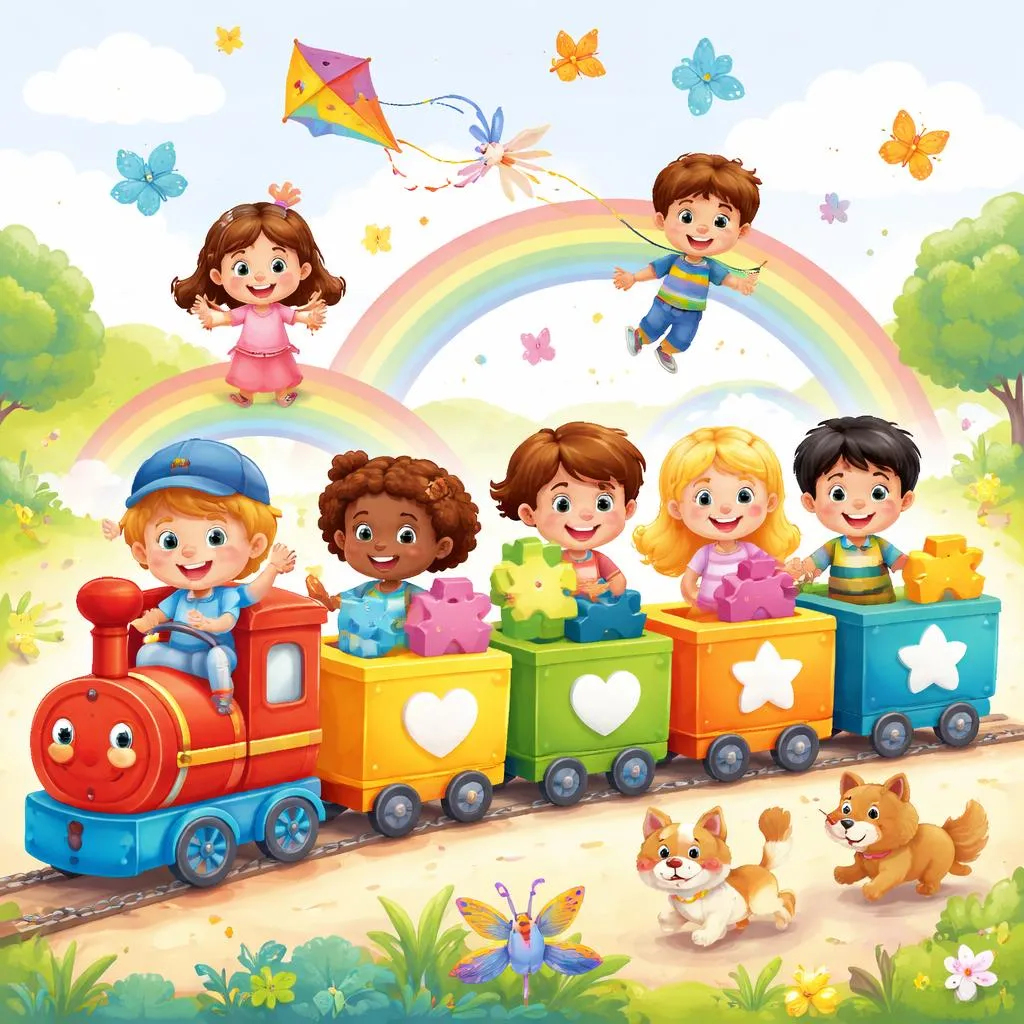

Hello, little word engineer! Do you know about trains? A train has many cars. They are connected by a special part called a coupler. Words can make trains too! A compound sentence is like a word train. It connects two simple sentences. Each simple sentence is a train car. They are joined by a special word called a conjunction. Today, we will build forty wonderful word trains. Our guide is Connie the Conductor. Connie loves to connect train cars and sentences! She will show us compound sentences at home, the playground, school, and at the train station. Let's build our trains!
What Is a Compound Sentence?
A compound sentence is a word train. It is two simple sentences joined together. Each simple sentence is a complete thought. They are equal. We connect them with a special word. Words like "and", "but", "or", "so". These words are the couplers. At home, you say "I eat, and I drink." This is a compound sentence. Car one: "I eat." Car two: "I drink." The coupler is "and". At the playground, you say "I run, but I get tired." Car one: "I run." Car two: "I get tired." The coupler is "but". At school, you say "I can read, or I can draw." This is a compound sentence. In nature, Connie says "The sun is hot, so I sit in the shade." "Connie drives the train, and she blows the whistle." This is a compound sentence. Learning these must-know compound sentences helps you make longer, better stories.
Why Build Word Trains?
Compound sentences are your connecting tools! They help your ears listen. You can hear how two ideas are linked. They help your mouth speak. You can tell more interesting stories. "I was hungry, so I ate a snack." They help your eyes read. You will see how authors connect ideas in books. They help your hand write. You can write sentences that flow together. Word trains make your talking smoother. They help you share more than one idea at a time.
What Are the Main Couplers?
We have a few main coupler words. Each one links ideas in a different way.
First, the adding coupler: AND. This coupler adds more information. It is for ideas that go together. "I have a ball, and I have a bat."
Next, the contrasting coupler: BUT. This coupler shows a difference. The second idea is different from the first. "I want to play, but it is raining."
Here is the choosing coupler: OR. This coupler gives a choice. "We can swim, or we can slide."
Last, the result coupler: SO. This coupler shows a cause and effect. The first idea causes the second. "I was tired, so I went to bed."
These are the most important couplers for your word trains.
How Can You Spot a Word Train?
Spotting a compound sentence is like being a train spotter! Look for two complete sentences. Each one can stand alone. Then look for the coupler word in the middle. The coupler is often with a comma. The formula is: Simple Sentence + Comma + Coupler + Simple Sentence. Look at Connie's train. "The train is long, and it is fast." Do you see two simple sentences? "The train is long." and "It is fast." Do you see the coupler? "and". You found a compound sentence! Another trick: Read the sentence. If you can break it into two complete thoughts, it might be a word train.
How Do We Build a Word Train?
Building is a three-step job. First, have two simple sentences. Make sure each one is complete. Next, choose a coupler word that fits. Do you want to add, contrast, give a choice, or show a result? Then, connect them with a comma and the coupler. The pattern is: Sentence 1 + , + Coupler + Sentence 2. "I like apples, but I don't like bananas." Connie uses this pattern. "I work on the train, and I love my job." Start with two short sentences. Then use "and" to link them. It is the easiest coupler.
Let's Fix Some Train Wrecks.
Sometimes our word trains crash. Let's fix them. A common wreck is a run-on sentence. This is when two sentences are stuck without a coupler or correct punctuation. "I have a dog he is fluffy." This is two trains crashed. Fix it with a coupler and comma. "I have a dog, and he is fluffy." Another wreck is using the wrong coupler. "I am sad, and I lost my toy." This is okay, but "so" might be better to show cause. "I lost my toy, so I am sad." Also, don't forget the comma before the coupler in a compound sentence. It is like the space between the train cars.
Can You Be a Train Engineer?
You are a great engineer! Let's play a game. The "Connect the Cars" game. I will give you two simple sentences. You connect them with a coupler. Sentences: "I am hungry. I will eat." You say: "I am hungry, so I will eat." Sentences: "I can jump. I can hop." You say: "I can jump, and I can hop." Great! Here is a harder challenge. Take a long compound sentence and break it into its two simple sentence cars. "I wanted ice cream, but the shop was closed." The cars are: "I wanted ice cream." and "The shop was closed." You are building and breaking apart must-know compound sentences.
Your Roundhouse of 40 Must-Know Compound Sentences.
Ready to fill the roundhouse? Here are forty wonderful word trains. Connie the Conductor has sorted them by their coupler. These are your must-know compound sentences.
AND Trains (Adding More). I have a cat, and she has kittens. I brush my teeth, and I wash my face. My dad cooks dinner, and my mom sets the table. The sky is blue, and the sun is bright. I put on my shoes, and I go outside. I like red, and I like blue. I can count, and I can sing. We play inside, and we play outside. I have a book, and I will read it. My toy is new, and it is fun.
BUT Trains (Showing Difference). I want a cookie, but it is not time. I like dogs, but I am allergic. I tried to build, but it fell down. The blanket is soft, but it is too small. I am small, but I am strong. It is sunny, but it is cold. I called you, but you did not hear. I am tired, but I am not sleepy. The shirt is clean, but it is wrinkled. I am hungry, but I am not thirsty.
OR Trains (Giving a Choice). We can read a book, or we can tell a story. Do you want juice, or do you want milk? Is it a dog, or is it a cat? Can I stay, or should I go? Will you help me, or will you watch? Shall we paint, or shall we draw? Is the light on, or is it off? Are you happy, or are you sad? Does it go here, or does it go there? Will we eat now, or will we eat later?
SO Trains (Showing Result). I was cold, so I put on a sweater. I finished my lunch, so I can have dessert. The toy broke, so I felt sad. I heard a noise, so I looked up. I am thirsty, so I will drink water. I did a good job, so I got a sticker. The light is green, so we can go. I lost my ball, so I am looking for it. I like you, so I will share. It started to rain, so we went inside.
These forty sentences are your must-know compound sentences. Practice connecting ideas with "and", "but", "or", and "so".
Building Longer Ideas with Your Word Trains.
You did it! You are a compound sentence expert. You know a compound sentence is a word train. It connects two simple sentences with a coupler word. You know the main couplers and their jobs. You can spot a compound sentence by looking for two complete thoughts and a linking word. You know how to build them with a comma and a coupler. Connie the Conductor uses compound sentences to describe her busy day. Now you can too! Your stories will be longer and more connected. You can explain causes, choices, and differences.
Here is what you can learn from our train adventure. You will know what a compound sentence is. You will understand the four main conjunctions for compound sentences. You can identify the two independent clauses in a compound sentence. You can use a comma and a conjunction to join two simple sentences. You have a roundhouse of forty example compound sentences.
Now, let's do some life practice! Your mission is today. Try to use compound sentences when you talk. Tell your grown-up: "I played with blocks, and I built a tower. I wanted to go outside, but it was raining. I am getting sleepy, so I will go to bed." You just used "and", "but", and "so" trains! Keep building your word trains. Have fun, little engineer!