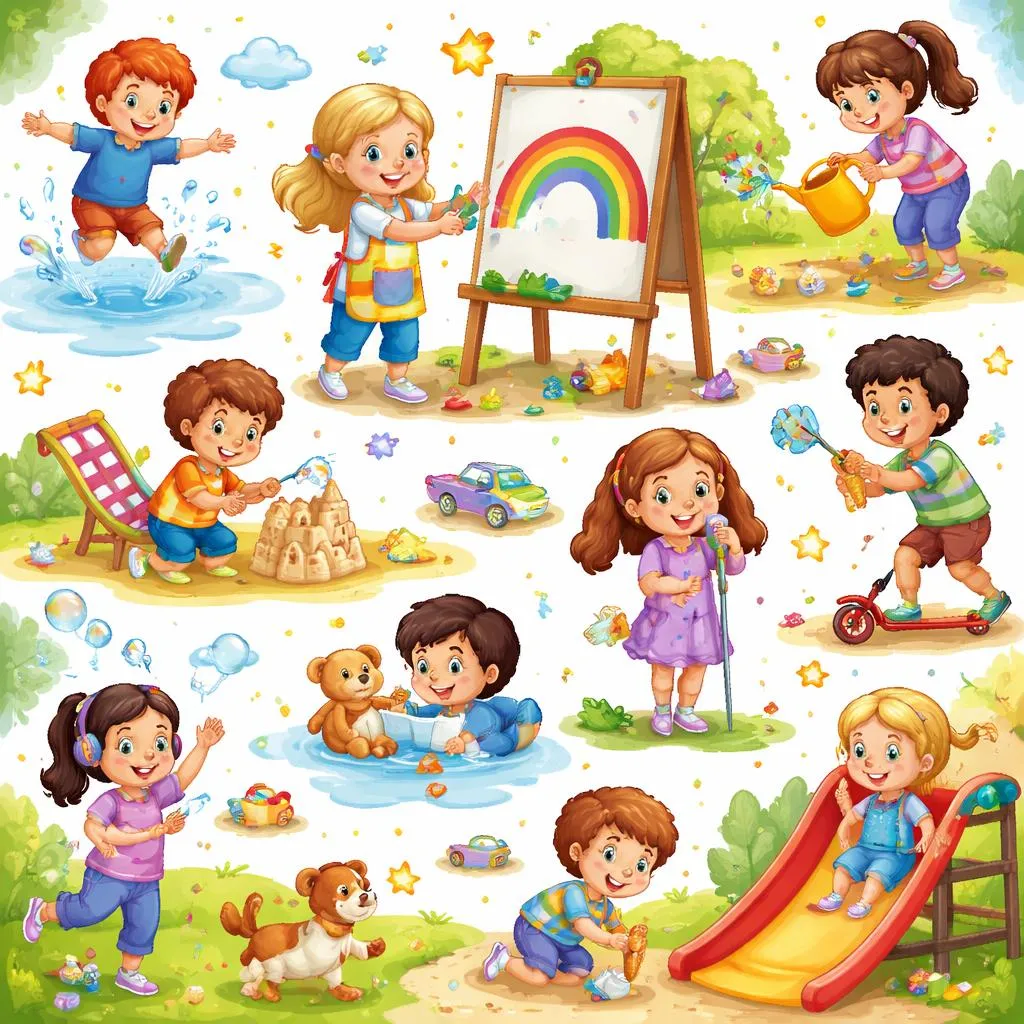

Hello, little word painter! Do you know about painting? You take a brush and add color. You make a picture more interesting. Words can paint pictures too! These word painters are called participles. A participle is a verb that can put on a costume to describe a noun. It adds action and detail. Today, we will paint with forty wonderful word colors. Our guide is Picasso the Painter. Picasso is a happy parrot who loves to paint with words! He will show us participles at home, the playground, school, and in the jungle. Let's start painting!
What Is a Participle?
A participle is a word painter. It is a verb that dresses up. It puts on a special costume to describe a person, place, or thing. It describes by showing action or a state. We have two main costumes. The -ing costume (present participle). The -ed or -en costume (past participle). At home, you see a "sleeping baby." The word "sleeping" is a participle. It describes the baby. At the playground, you hear "laughing children." The word "laughing" is a participle. At school, you see a "broken crayon." The word "broken" is a participle. In nature, Picasso says "Look at the flying bird!" The word "flying" is a participle. "Picasso has painted feathers." The word "painted" is a participle. Learning these must-know participles makes your talking colorful and clear.
Why Do We Need Word Painters?
Participles are your detail brushes! They help your ears listen. You can picture the action in your mind. "The barking dog" lets you hear the sound. They help your mouth speak. You can describe things in a lively way. "I want the shiny ball." They help your eyes read. You will see them in exciting storybooks. They help your hand write. You can write sentences that create a picture. A word painter makes your language bright and fun.
What Are the Two Main Costumes?
Our word painters have two favorite costumes. Each one paints a different picture.
First, the -ing costume. This is the present participle. It shows an action that is happening now. It is active. "The girl is smiling." "I see the rising sun." "The boiling water is hot."
Next, the -ed/-en costume. This is the past participle. It often shows an action that is completed. It can describe a state. "The door is closed." "I ate the baked cookie." "The lost toy was found."
Some verbs have special past participle costumes. "eaten", "seen", "gone", "done". We will learn the common ones.
How Can You Spot a Word Painter?
Spotting a participle is a fun game. Look for a verb wearing a costume. Look for words ending in -ing, -ed, -en, or other special forms. Then ask: "Is this word describing a noun?" If yes, it is probably a participle. Look at Picasso's painting. "The chattering monkey is loud." The word "chattering" ends in -ing and describes the monkey. You found a participle! Another trick: Participles are often used with helper verbs like "is", "was", "has". "The cake was eaten." But they can also be alone before a noun. "the eaten cake".
How Do We Use Our Word Painters?
Using participles is about placing them near the noun they describe. You can put them before the noun. The formula is: Participle + Noun. "the crying baby", "the fallen leaf". You can use them after a linking verb. Noun + Linking Verb + Participle. "The baby is crying." "The leaf has fallen." Picasso uses them. "Picasso sees a swinging vine." Participle: swinging. Noun: vine. Start by adding -ing or -ed to a verb and putting it before a noun you see.
Let's Fix Some Painting Mistakes.
Sometimes our word painters get a little messy. Let's clean up. A common mix-up is using the wrong costume. A child might say "I am interesting in the story." This is a bit off. We say "I am interested in the story." because it describes your feeling. "The story is interesting." describes the story. Another mix-up is forgetting the helper verb when needed. "The toy broken" is not a sentence. Say "The toy is broken." Also, do not confuse a gerund (-ing as a noun) with a participle. "Swimming is fun" (gerund) vs. "The swimming duck" (participle).
Can You Be a Word Painter?
You are a great artist! Let's play a game. The "Color the Noun" game. I will give you a noun. You paint it with a participle. Noun: "dog". You say: "barking dog" or "sleeping dog". Great! Here is a harder challenge. Look at a room. Can you find three things and describe them with a participle? "a closed door, a shining light, a soft chair" (soft is an adjective, not a participle, so let's use a participle: "a cushioned chair"). You are using must-know participles.
Your Paint Box of 40 Must-Know Participles.
Ready to open the paint box? Here are forty wonderful word painters. Picasso the Painter uses them all. They are sorted by their costume. Remember, these are the participle forms.
-ing Participles (Happening Now).
sleeping, eating, drinking, crying, laughing, playing, running, jumping, reading, drawing, singing, dancing, cooking, washing, talking, walking, flying, swimming, growing, shining.
-ed/-en/-t Participles (Completed Action or State).
broken, closed, opened, finished, washed, baked, colored, loved, wanted, needed, helped, shared, seen, eaten, gone, done, fallen, lost, found, hurt.
These forty words are your must-know participles. They are your word paints. Use them to add action and description to your nouns.
Creating Vivid Pictures with Your Words.
You did it! You are now a participle pro. You know a participle is a word painter. It is a verb in an -ing or -ed costume that describes a noun. You know the two main types. You can spot them by their endings and their describing job. Picasso the Painter uses participles to make his stories burst with color. Now you can too! You can describe the world in action-filled detail. Your sentences will be lively and engaging.
Here is what you can learn from our painting adventure. You will know what a participle is. You will understand the difference between present and past participles. You can identify participles in sentences. You can use participles to describe nouns. You have a paint box of forty essential participles.
Now, let's do some life practice! Your mission is today. Be a word painter. Describe three things you see using a participle. Tell your grown-up: "I see a moving car. I am eating a sliced apple. I hear a singing bird." You just used three participles! Keep painting your world with colorful words. Have fun, little painter!