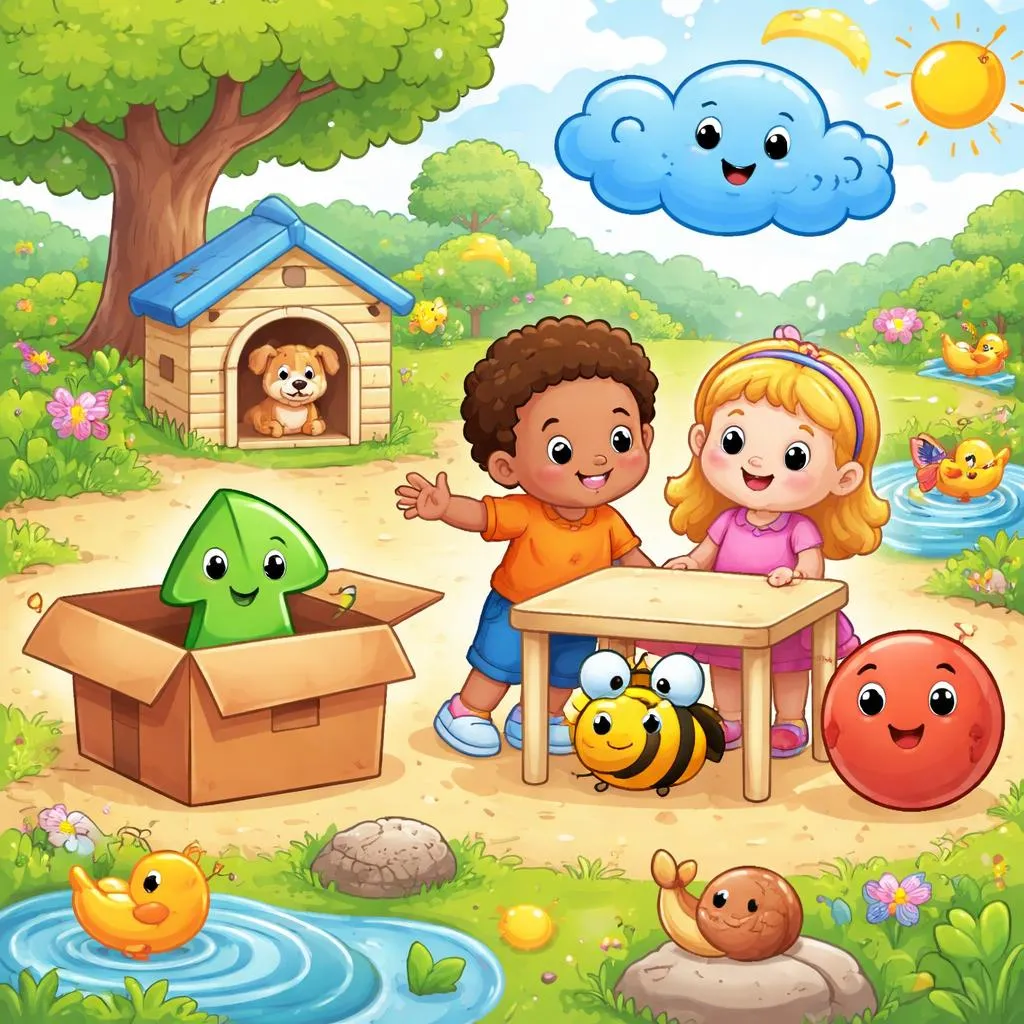

Hello, little explorer! Do you know about helpers? Some helpers show you where to go. Words have helpers too! These special helper words are called prepositions. A preposition is a small word that shows position. It tells us where something is. Is it in the box? Is it on the table? Is it under the chair? These tiny words are like a map for your toys! Today, we will find the must-know prepositions for 3-year-olds. Our guide is Tilly, a little turtle. Tilly moves slowly, so she always knows exactly where she is! She will show us prepositions at home, the playground, school, and in her garden. Let's follow Tilly!
What Is a Preposition? A preposition is a place word. It shows the relationship between two things. It answers the question: "Where?" Where is the ball? The ball is under the couch. "Under" is the preposition. It connects the ball to the couch. At home, your juice is on the table. "On" is a preposition. At the playground, you slide down the slide. "Down" is a preposition. At school, you sit next to your friend. "Next to" is a preposition. In nature, the bird is in the tree. "In" is a preposition. "Tilly hides under a leaf." Where is Tilly? Under a leaf! "Under" is our place helper. Learning these prepositions helps you give perfect directions.
Why Are Place Helpers So Important? Prepositions are your talking map! They help your ears listen. You can follow where things are in a story. "The cat is on the mat" paints a clear picture. They help your mouth speak. You can tell someone exactly where to find your lost shoe. "It is under my bed!" They help your eyes read. You will understand how pictures and words go together. They help your hand write. You can write notes to tell people where you are. Prepositions make your world make sense.
What Kinds of Place Do They Show? Prepositions show us all sorts of places. Let's look at the groups.
First, prepositions for IN, ON, UNDER. These are the superstar trio! "In" means inside. "On" means touching the top. "Under" means below. "The toy is in the box."
Next, prepositions for NEAR and FAR. These show distance. "Near" means close. "Far" means not close. "Sit near me." "The park is far."
Here are prepositions for NEXT TO, BETWEEN. These show side-by-side place. "Next to" means beside. "Between" means in the middle of two things. "I sit next to you." "The ball is between the cones."
We have prepositions for UP and DOWN. These show direction. "The cat climbs up the tree." "The ball rolls down the hill."
Last, prepositions for IN FRONT OF and BEHIND. "Stand in front of the line." "Hide behind the door."
How Can You Find a Preposition? Finding prepositions is a seek-and-find game! Here is a simple trick. Ask the question: "Where?" Find the two things in the sentence. Then ask where one is in relation to the other. Where is Tilly? Tilly is on a rock. "On" is the preposition. Look at your cup. Where is it? It is on the table. You found a preposition! Another trick: these words are often short. They are little connectors like "at", "by", "to", "from". They love to be with a noun. "At home." "By me." "To school."
How Do We Use Prepositions in Sentences? Prepositions are team players. They are almost always in a phrase with a noun. The pattern is: Preposition + Noun (or Pronoun). This makes a "prepositional phrase". Here is the main formula: Thing + is/are + Preposition + Place. "The book is on the shelf." "My shoes are under the bed." "We are at the park." You can also put the phrase at the start. "On the shelf, there is a book." "Under the bed, I found my shoes." For moving actions, use: Verb + Preposition + Place. "Tilly walks to the pond." "I throw the ball into the basket."
Let's Fix Some Place Helper Mix-Ups! Sometimes we use the wrong place helper. Let's practice together. A common mix-up is "in" and "on". You might say "The apple is on the bowl." This sounds funny if the apple is inside the bowl. If it is inside, the right helper is "in". "The apple is in the bowl." Use "on" for things resting on top. "The apple is on the table." Another mix-up is forgetting the helper. A child might say "I go school." This is missing the word that connects "go" and "school". The right way is "I go to school." The preposition "to" shows direction toward the place.
Can You Be a Preposition Detective? You are a great word helper! Let's play a game. Play the "Where Is Tilly?" game. Have your grown-up hide a toy. Then ask: "Is it under the pillow? Is it on the chair? Is it in the box?" Use your prepositions to guess! Here is a harder challenge. Look around your living room. Can you make three sentences using "in", "on", and "under"? "The remote is on the couch. The rug is under the table. The plant is in a pot." You are a preposition pro!
Your Big List of 40 Must-Know Prepositions Are you ready for the helper list? Here are forty wonderful place words. Practice with Tilly! In, on, at, by, near, close to, next to, beside, between, among. Under, below, beneath, over, above, on top of. Up, down, off, onto, into, out of, from, to, towards. In front of, behind, before, after. Inside, outside, within, without. Around, through, across, past, against. With, without, about, like, of, for. Start with the easy ones: in, on, under, by, to, from. These are your first must-know prepositions. They are your best word helpers.
Mapping Your World with Tiny Words Wonderful! You know all about prepositions now. You know a preposition is a place helper. It shows where things are. You know why these little words are so powerful. You can find them by asking "Where?". You know how to use them in phrases and sentences. Tilly uses prepositions to find her way home every day. Now you can use them too! You can give clear directions. You can describe your room perfectly. You are the boss of knowing where things are.
Here is what you can learn from our place adventure. You will know what a preposition does. You will understand many different place words. You can spot prepositions when you listen and read. You can use prepositions to explain where things are. You have a big map of helper words in your mind.
Now, let's do some life practice! Your mission starts right now. At clean-up time, use prepositions. Tell your grown-up: "I will put the blocks in the bin. I will put the book on the shelf. I found a crayon under the table." You used the prepositions "in", "on", and "under"! Keep using your place helpers every day. They make you a super explainer. Have fun, little guide!