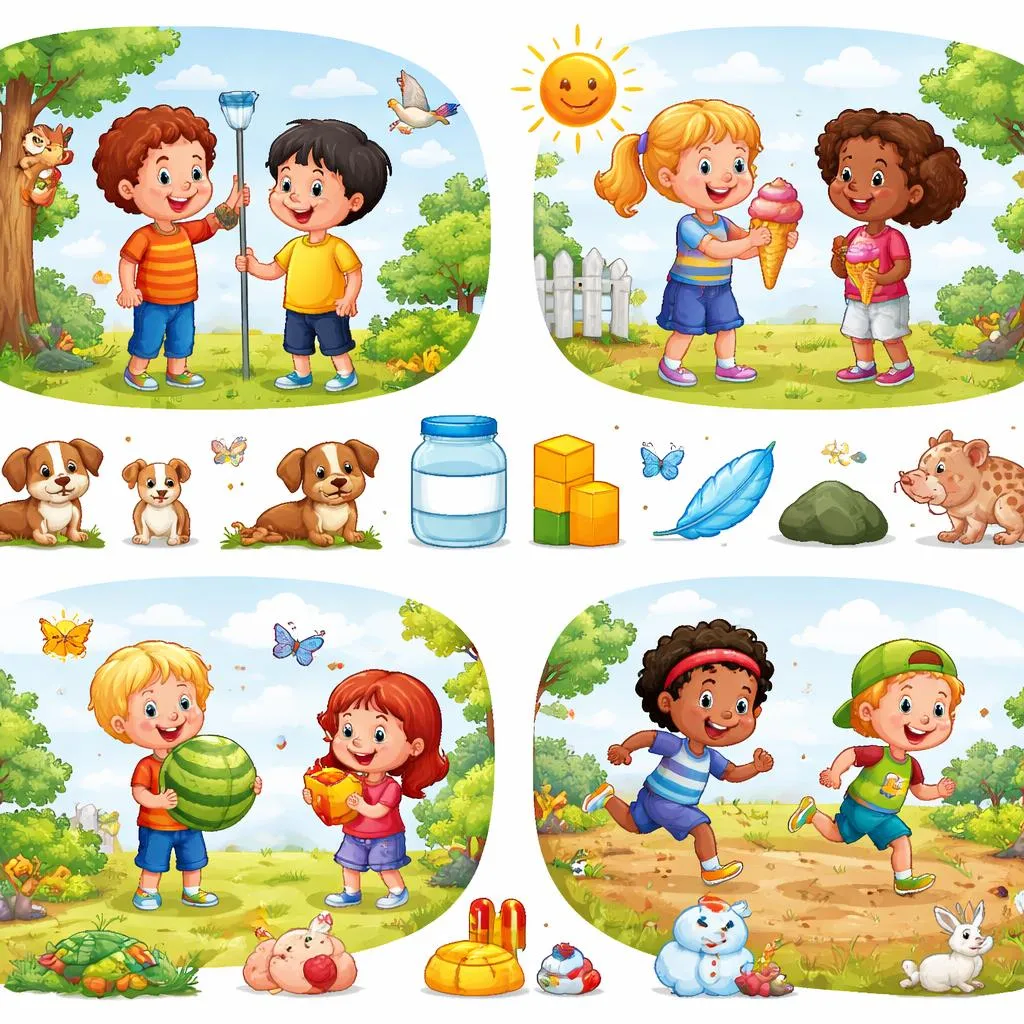

Comparatives and superlatives are words we use to compare things. Comparatives like bigger and smaller help us talk about how two things are different. Superlatives like biggest and smallest help us talk about how one thing stands out from all the rest. For a four-year-old, these words open up a whole new way of thinking about the world. Instead of just saying "that block is big," they can say "that block is bigger than mine" or "that is the biggest block of all." Learning the 50 most common comparatives and superlatives for 4-year-olds helps children describe differences, express preferences, and understand their world more deeply. These words give them the power to notice and talk about how things compare.
What Are Comparatives and Superlatives?
Comparatives and superlatives are special forms of adjectives and adverbs. We use them to show differences between people, animals, or things.
Comparatives compare two things. They show that one has more or less of a quality than the other. We often use the word than after a comparative. "My shoe is bigger than your shoe." "This cookie is smaller than that one." "I am taller than my little brother."
Superlatives compare three or more things. They show that one has the most or the least of a quality. We often use the word the before a superlative. "That is the biggest cookie on the plate." "She is the tallest in our family." "This is the smallest cup I could find."
For a four-year-old, these words help them make sense of their world. They notice that some things are bigger, some are smaller, and some are the biggest or smallest. They learn that they are taller than the baby but shorter than Mommy. These comparisons help them understand where they fit in the world around them.
When we talk about the 50 most common comparatives and superlatives for 4-year-olds, we mean the comparing words that children use most often in their daily lives. These are the words that help them describe what they see and how they feel about things.
Meaning and Explanation of Comparatives and Superlatives
Let us explore how we form comparatives and superlatives. The rules are simple, and most of the words children use follow regular patterns.
For short adjectives (one syllable), we add -er to make the comparative and -est to make the superlative.
big, bigger, biggest
small, smaller, smallest
tall, taller, tallest
fast, faster, fastest
old, older, oldest
For adjectives ending in y, we change the y to i and add -er or -est.
happy, happier, happiest
funny, funnier, funniest
silly, sillier, silliest
friendly, friendlier, friendliest
For longer adjectives (two or more syllables), we use the words more and most in front of them.
beautiful, more beautiful, most beautiful
careful, more careful, most careful
delicious, more delicious, most delicious
excited, more excited, most excited
Some words have special forms that do not follow the rules. Children learn these by hearing them.
good, better, best
bad, worse, worst
much/many, more, most
little, less, least
When children learn these patterns, they can start to describe the world in more precise ways. They can tell you which cookie they want, which tower is taller, and who is the fastest runner.
Categories or Lists: The 50 Most Common Comparatives and Superlatives
Here is a practical list of the 50 most common comparatives and superlatives for 4-year-olds. These are the words children use every day to compare things around them.
Size Comparisons
big, bigger, biggest
small, smaller, smallest
tall, taller, tallest
short, shorter, shortest
long, longer, longest
wide, wider, widest
deep, deeper, deepest
high, higher, highest
low, lower, lowest
fat, fatter, fattest
thin, thinner, thinnest
Age and Speed
12. old, older, oldest
13. young, younger, youngest
14. new, newer, newest
15. fast, faster, fastest
16. slow, slower, slowest
Temperature and Sensations
17. hot, hotter, hottest
18. cold, colder, coldest
19. warm, warmer, warmest
20. cool, cooler, coolest
21. soft, softer, softest
22. hard, harder, hardest
23. loud, louder, loudest
24. quiet, quieter, quietest
Feelings and Qualities
25. happy, happier, happiest
26. sad, sadder, saddest
27. funny, funnier, funniest
28. silly, sillier, silliest
29. nice, nicer, nicest
30. kind, kinder, kindest
31. brave, braver, bravest
32. smart, smarter, smartest
33. strong, stronger, strongest
34. weak, weaker, weakest
Amount and Value
35. many/much, more, most
36. little, less, least
37. good, better, best
38. bad, worse, worst
39. near, nearer, nearest
40. far, farther, farthest
Two-Syllable Words with More/Most
41. more careful, most careful
42. more peaceful, most peaceful
43. more playful, most playful
44. more helpful, most helpful
45. more gentle, most gentle
46. more quiet, most quiet
47. more simple, most simple
48. more clever, most clever
49. more friendly, most friendly
50. more patient, most patient
Daily Life Examples with Comparatives and Superlatives
The best way to teach comparatives and superlatives is to use them naturally throughout your day. Children learn these words best when they hear them in real situations that matter to them.
At snack time: "You have more crackers than I do." "This cookie is bigger than that one." "Which apple is the reddest?" "I think this is the yummiest yogurt."
During play: "Your tower is taller than mine." "This car is faster than that truck." "You have the most blocks." "My stuffed bear is softer than yours." "This is the funniest game ever."
Getting dressed: "These pants are warmer than shorts." "Which shirt is the softest?" "Your shoes are newer than mine." "This hat is too small now. You are bigger than last year."
At the park: "You are climbing higher than before." "This slide is longer than the other one." "Who can swing the highest?" "That is the biggest puddle I have ever seen."
Comparing family members: "Daddy is taller than Mommy." "The baby is younger than you." "Grandma gives the warmest hugs." "Our dog is faster than the cat."
At bedtime: "This story is longer than the one last night." "I want the softest blanket." "You were braver today than yesterday." "This is the best part of the day."
Printable Flashcards for Comparatives and Superlatives
Flashcards are a wonderful tool for helping children see and remember comparing words. You can make them together, which makes the learning even more meaningful.
To make comparative and superlative flashcards, you will need index cards or thick paper, markers, and maybe some stickers or magazine pictures. The key is to show the comparison visually.
For comparatives, you can draw or paste pictures that show the difference.
For "bigger," draw a small circle and a bigger circle next to each other.
For "taller," draw a short person and a tall person.
For "faster," draw a slow turtle and a fast rabbit.
For superlatives, you can show three things with one standing out.
For "biggest," draw three circles of different sizes and label the largest one.
For "tallest," draw three people of different heights and point to the tallest.
For "happiest," draw three faces with different expressions and point to the happiest.
Here are some fun ways to use your flashcards:
Matching pairs: For comparatives, you can make pairs of cards that go together. One card shows a small cookie and a big cookie. The other card has the word "bigger." Your child matches the picture to the word.
Three-card sequences: For superlatives, make sets of three cards. One shows a small, medium, and large cookie. Another shows the word "big," another "bigger," and another "biggest." Your child puts them in order.
I Spy with flashcards: Lay out several flashcards and describe one without pointing. "I see something that is bigger than the cat but smaller than the house." Your child finds the matching card.
Storytelling with cards: Pick a few flashcards and use them to tell a story. "Once there was a tiny mouse. He met a bigger cat. Then he met the biggest elephant he had ever seen."
Learning Activities or Games
Games make learning comparatives and superlatives fun and natural. Here are some games you can play with your child to practice these comparing words.
The Height Line-Up Game: Line up stuffed animals or toys by size. As you line them up, talk about them. "This bear is tall. This giraffe is taller than the bear. This elephant is the tallest of all." Then mix them up and have your child put them in order while describing them.
The Taste Test Game: During snack, give your child two or three similar foods to compare. Which cracker is saltier? Which grape is sweeter? Which cookie is the crunchiest? This uses real experiences to teach comparing words.
The Building Challenge: Build towers together and compare them. "My tower is high. Your tower is higher than mine. Let's see whose tower is the highest." Then have a contest to build the tallest tower possible.
The Race Game: Have races with toy cars or even just running across the room. "The blue car is fast. The red car is faster than the blue one. The green car is the fastest of all." Then let your child be the announcer and describe the race.
The Memory Game: Look at a room together, then close your eyes and ask questions. "What is the biggest thing in this room?" "What is the softest thing?" "What is smaller than the pillow?" This builds observation skills and language together.
The Growing Up Game: Look at baby pictures and talk about how your child has changed. "You were smaller then. Now you are bigger. You are the biggest you have ever been." This connects comparing words to their own life story.
By using these examples, flashcards, and games, you are helping your child master the 50 most common comparatives and superlatives for 4-year-olds in a natural and enjoyable way. These comparing words will become a comfortable part of their language. They will use them to talk about what they want, to understand differences, and to share their observations about the world. Every day brings new opportunities to compare and contrast. Your child will gain confidence as they learn to express these ideas clearly. The more they hear and use comparatives and superlatives, the more naturally these words will flow in their everyday speech. Soon they will be telling you all about which is bigger, which is better, and what makes something the best of all.