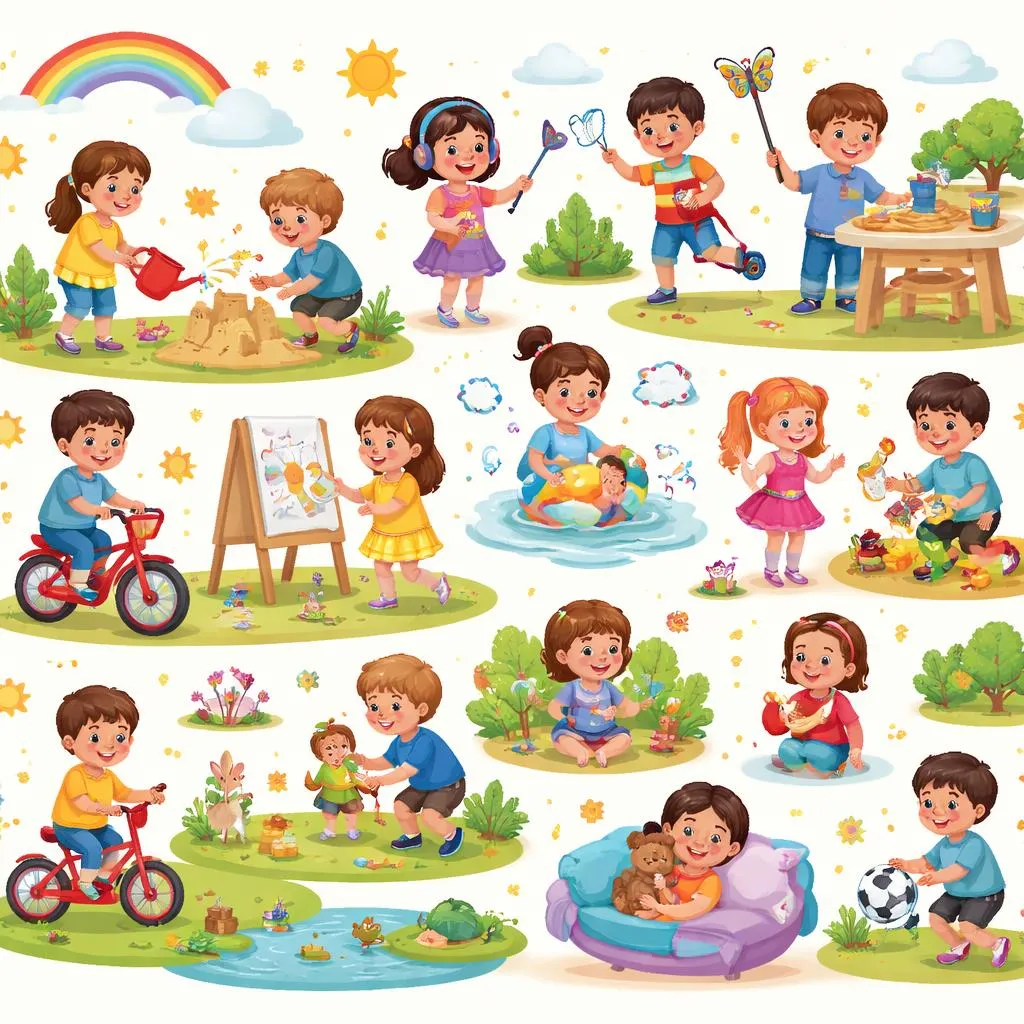

Gerunds are special words that look like verbs but act like nouns. They are formed by adding -ing to the end of a verb. Words like running, eating, and singing are gerunds. For a four-year-old, these words help them talk about activities they love to do. Instead of just saying "I play," they can say "Playing is fun." This small change opens up new ways to express themselves. Learning the 50 most common gerunds for 4-year-olds helps children name their favorite activities and talk about what they enjoy. These words become the names of the actions that fill their days with joy and discovery.
Meaning of Gerunds
A gerund is a verb that ends in -ing and works as a noun. It names an activity or action. Even though it looks like a verb because it shows action, it acts like a noun in the sentence. It can be the subject, the object, or the complement.
Think about your child's favorite things to do. They love jumping, drawing, and splashing. These -ing words name the activities themselves. When your child says "Jumping is my favorite," the word jumping is a gerund. It is the name of the activity they love.
Gerunds are everywhere in children's language. When your child says "I like swimming," the gerund is swimming. When they say "Cooking with Mommy is fun," the gerund is cooking. These -ing words help children talk about actions as things.
When we talk about the 50 most common gerunds for 4-year-olds, we mean the fifty action words that children turn into nouns to name their favorite activities. These are the words that help them describe what they do and what they love.
Conjugation of Gerunds
Gerunds are very easy to form. You simply take a verb and add -ing to the end. There are no changes for different people or different times. The gerund stays the same no matter what.
play becomes playing
eat becomes eating
sleep becomes sleeping
run becomes running
swim becomes swimming
Sometimes we need to make small spelling changes when we add -ing. If a verb ends in e, we usually drop the e before adding -ing. Dance becomes dancing. Bake becomes baking. If a short verb ends in consonant-vowel-consonant, we double the last letter. Run becomes running. Swim becomes swimming. These patterns come naturally as children hear and use the words.
The gerund does not change based on who is doing the action. We say "I like swimming" and "She likes swimming." The gerund swimming stays exactly the same. This consistency makes gerunds easy for young children to learn and use.
Present Tense with Gerunds
In the present tense, gerunds appear in many different places in sentences. They name activities that are happening now or that are generally true.
As the subject: The gerund comes at the beginning of the sentence as the main idea. " Swimming is fun." " Drawing makes me happy." " Jumping on the bed is not safe." Here the gerund names the activity and tells us what the sentence is about.
After the verb like: We often use gerunds after the verb like to talk about activities we enjoy. "I like singing." "She likes dancing." "We like reading books." This is one of the most common patterns for young children.
After the verb love: Love is stronger than like. "I love swimming in the pool." "He loves playing with his trucks." This expresses great enjoyment.
After the verb enjoy: Enjoy is another word for like. "We enjoy watching movies together." "They enjoy building with blocks."
Here are some present tense examples you might hear from a four-year-old:
" Coloring is my favorite thing to do."
"I like running fast."
"She loves cuddling with her teddy bear."
"We enjoy singing songs in the car."
Past Tense with Gerunds
In the past tense, we still use gerunds. The main verb changes to show the past, but the gerund stays the same. This pattern helps children talk about activities they did or enjoyed in the past.
Liked + gerund: "I liked swinging at the park yesterday." The liking happened in the past, but swinging stays the same.
Loved + gerund: "She loved playing in the leaves last fall." The loving happened in the past, but playing does not change.
Enjoyed + gerund: "We enjoyed watching the fireworks." The enjoying happened in the past, but watching is still a gerund.
Was/Were + gerund: This forms the past continuous tense. "I was jumping on the trampoline." "We were building a sandcastle." Here the gerund works with was/were to show an action in progress in the past.
Here are some past tense examples:
"I liked climbing the ladder at the playground."
"He loved splashing in puddles."
"We were eating lunch when you called."
"She was drawing a picture of our family."
Future Tense with Gerunds
In the future tense, gerunds also appear. We use them after verbs that express future intentions or with future forms of be.
Will like + gerund: "You will like playing with your new cousin." This predicts a future enjoyment.
Will be + gerund: This forms the future continuous tense. "I will be waiting for you after school." "We will be having a party on Saturday." This shows an action that will be in progress in the future.
Going to be + gerund: "We are going to be swimming at the beach tomorrow." This expresses a future plan for an ongoing activity.
Looking forward to + gerund: "I am looking forward to seeing Grandma." This expresses excitement about a future activity.
Here are some future tense examples:
"You will love meeting your new teacher."
"Tomorrow we will be celebrating your birthday."
"I am going to be painting a picture later."
"We are looking forward to playing with you."
Questions with Gerunds
Asking questions with gerunds helps children get information about activities and express their curiosity. These questions follow simple patterns.
Do you like + gerund?: "Do you like swimming?" "Do you like eating pizza?" These questions ask about general enjoyment.
What do you like + gerund?: "What do you like doing at the park?" "What do you like eating for breakfast?" These questions ask for specific information.
Is + gerund + fun?: "Is swimming fun?" "Is coloring your favorite?" These questions ask for opinions about activities.
Are you + gerund?: This asks about current actions. "Are you playing with your cars?" "Are you building a tower?" These questions check what is happening now.
Here are some question examples:
"Do you like singing?"
"What do you enjoy doing with your friends?"
"Is jumping on the trampoline safe?"
"Are you helping Mommy make cookies?"
Other Uses of Gerunds
Gerunds have many other uses in English. They appear in different places and serve different purposes. Learning these patterns helps children understand more complex language.
After prepositions: We often use gerunds after words like for, about, and of. "Thank you for helping." "I dream about flying." "She is afraid of sleeping alone." The gerund follows the preposition naturally.
As the object of a sentence: Gerunds can receive the action. "I enjoy reading." "He started crying." "She finished eating." Here the gerund is the thing that is enjoyed, started, or finished.
In compound nouns: Gerunds can combine with other words to name things. " Swimming pool" is a pool for swimming. " Dining room" is a room for dining. " Coloring book" is a book for coloring. These combinations are everywhere in children's lives.
After certain expressions: We use gerunds after expressions like "can't help" and "it's no use." "I can't help laughing." "It's no use crying." These are more advanced but children hear them in stories.
Here are some examples:
"Thank you for sharing your toys."
"I am thinking about building a fort."
"We have a new swinging door."
"She is excited about going to the zoo."
Learning Tips for Gerunds
Helping your child learn gerunds can happen naturally throughout your day. You do not need special lessons. You just need to use these -ing words in your conversations and gently guide your child to use them too.
Talk about activities: Use gerunds when you talk about what you and your child are doing. " Painting is so much fun." "I love reading stories with you." " Baking cookies makes the house smell good." This helps your child hear gerunds as names for activities.
Ask about favorites: Ask your child what they like doing. "What is your favorite thing doing at school?" "Do you like jumping or running better?" "What do you enjoy eating for snack?" This gives them practice using gerunds to answer.
Name activities during play: As your child plays, comment on what they are doing using gerunds. "You are building such a tall tower." " Driving the car is fun." " Feeding the baby doll is kind." This connects gerunds to real actions.
Expand their sentences: When your child says something simple, you can expand it with a gerund. If they say "I like park," you can say "You like going to the park." If they say "Swim fun," you can say "Yes, swimming is fun." This models the correct form gently.
Read books together: Children's books are full of gerunds. As you read, you can point them out. "Look, the bear is climbing a tree." "The children are dancing and singing." This helps children notice these words in stories.
Educational Games for Gerunds
Games make learning gerunds fun and memorable. Here are some games you can play with your child to practice these important -ing words.
The Name That Activity Game: Act out an activity without speaking and have your child guess what you are doing. They should answer with a gerund. "You are swimming!" "You are eating!" "You are sleeping!" Then switch roles and let your child act for you.
The I Like Game: Take turns saying things you like using gerunds. "I like singing." "I like dancing." "I like jumping." You can make it silly. "I like wiggling my nose." "I like flapping my arms." This practices the pattern naturally.
The What Are We Doing? Game: Look around the room or out the window and talk about what people or animals are doing. "Look, that dog is running." "The baby is crying." "The leaves are falling." This practices gerunds in the present continuous.
The Favorite Things Game: Ask your child questions about their favorites and encourage answers with gerunds. "What is your favorite thing doing outside?" " Riding my bike." "What is your favorite thing eating for dinner?" " Eating spaghetti." This connects gerunds to personal preferences.
The Story Time Game: Look at a picture book without words and make up a story together using gerunds. "This little bear is waking up. Now he is eating breakfast. Then he goes playing with his friends." This builds language and imagination.
By using these tips and games, you are helping your child master the 50 most common gerunds for 4-year-olds in a natural and enjoyable way. These -ing words will become a comfortable part of their language. They will use them to name their favorite activities, to talk about what they like, and to describe what is happening around them. Every day gives them more practice. Your child will gain confidence as they learn to express themselves using these action words that name the things they love to do. The more they hear and use gerunds, the more naturally these words will flow in their everyday speech.