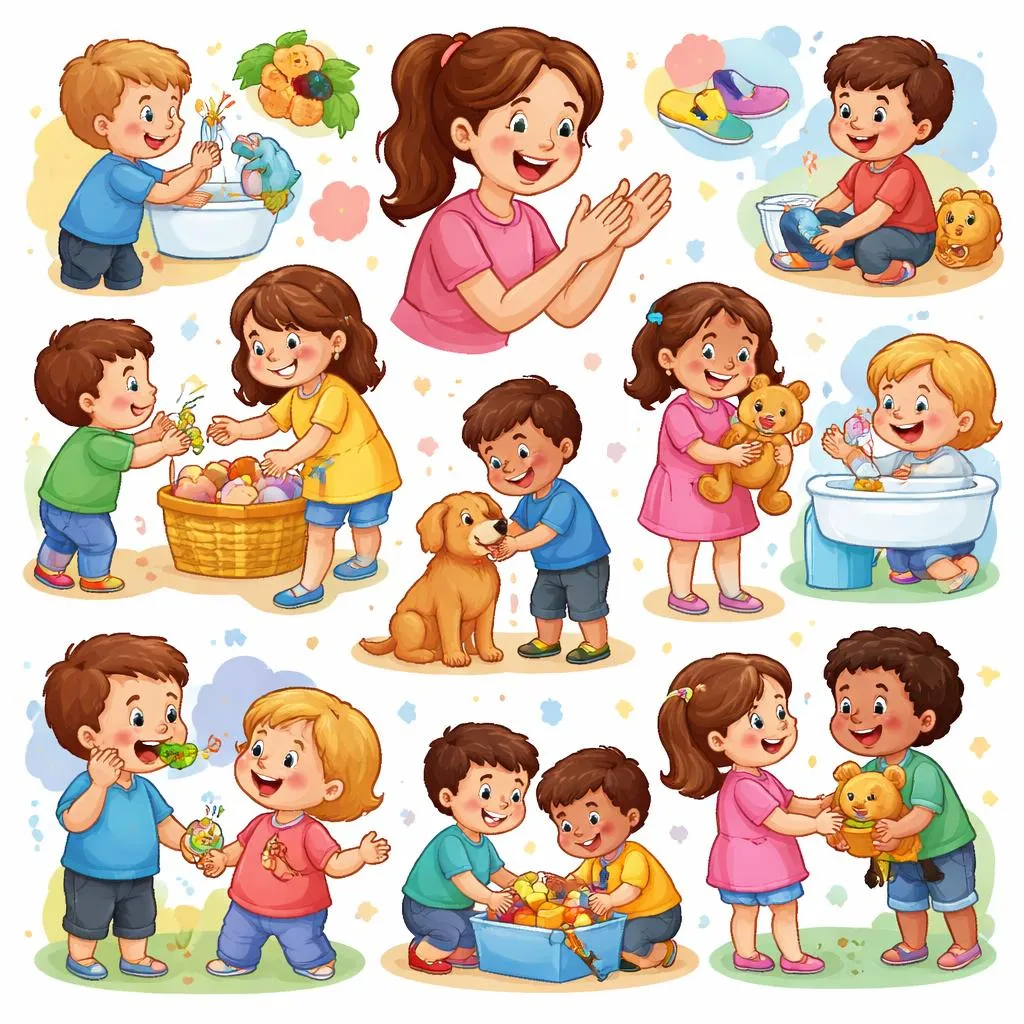

Four-year-olds know what they want. They tell you to do things. They give commands to friends. They ask for help. This is the imperative mood. Imperative mood gives commands or makes requests. It tells someone to do something. "Come here." "Give me that." "Please help me." These sentences have no subject because the subject "you" is understood. Teaching your child common imperative mood sentences helps them express their needs and direct others. This article shares the 50 most common imperative mood sentences for 4-year-olds. These will help your child make requests and give commands politely and effectively.
What Is Imperative Mood for a Four-Year-Old?
Imperative mood is the mood of commands. It tells someone to do something. The subject is always "you," but we do not say it. "Sit down." The understood subject is "you." Four-year-olds use imperative mood all the time. They say "Look at me!" and "Give me that!" Imperative mood helps children get what they need. It helps them direct play. It is a powerful part of language.
Meaning and Explanation of Imperative Mood
Imperative mood has one main job. It makes things happen. It asks others to act. It can be a soft request with "please." It can be a strong command with an exclamation point. "Please pass the milk." "Stop that now!" For young children, imperative mood is essential. They use it to ask for help. "Help me please." They use it to direct play. "You be the mommy." Learning to use imperative mood helps children interact with others and get their needs met.
Categories of Imperative Mood Sentences for Preschoolers
We group these imperative mood sentences into categories. This helps children understand different kinds of commands. Here are the main groups:
Movement Commands: Telling someone to move.
Attention Commands: Asking someone to look or listen.
Action Commands: Telling someone to do something.
Stopping Commands: Telling someone to stop.
Giving Commands: Asking for objects.
Help Commands: Asking for assistance.
Play Commands: Directing play activities.
Polite Requests: Using "please" to ask nicely.
Negative Commands: Telling someone not to do something.
Daily Life Examples of Imperative Mood Sentences
Imperative mood appears in every interaction. In the morning, a child says "Get up!" At breakfast, they say "Pour milk!" During play, they say "Watch me!" At the park, they say "Push me!" At bedtime, they say "Read story!" Parents use imperative mood too. "Brush your teeth." "Put on your shoes." These sentences keep the day moving.
Movement Commands
Come here.
Go away.
Sit down.
Stand up.
Lie down.
Get up.
Come back.
Move over.
Turn around.
Follow me.
Step aside.
Go outside.
Come inside.
Get down.
Climb up.
Slide down.
Run fast.
Walk slowly.
Stay there.
Come with me.
Attention Commands
Look at me.
Watch this.
Listen to me.
See that?
Look here.
Pay attention.
Watch out!
Look up.
Look down.
Listen!
Look both ways.
See what I made.
Watch me jump.
Hear that sound?
Look at the bird.
Watch the movie.
Listen to the music.
See the picture.
Look behind you.
Watch your step.
Action Commands
Eat your food.
Drink your milk.
Put on your shoes.
Brush your teeth.
Wash your hands.
Pick up your toys.
Close the door.
Open the door.
Turn on the light.
Turn off the TV.
Tie your shoes.
Zip your coat.
Button your shirt.
Put away your books.
Make your bed.
Set the table.
Pour the juice.
Cut the paper.
Glue the pieces.
Draw a picture.
Stopping Commands
Stop that.
Don't do that.
Be quiet.
No running.
Stop crying.
Don't touch.
Wait for me.
Hold on.
Calm down.
Be careful.
Stop fighting.
Don't shout.
No hitting.
Stop jumping.
Be still.
Don't move.
Freeze.
Stop the car.
Don't open it.
Wait your turn.
Giving Commands
Give me that.
Hand it to me.
Bring it here.
Put it there.
Show me.
Take this.
Hold this.
Get my ball.
Find my shoe.
Pass the crayon.
Throw it to me.
Catch the ball.
Share with me.
Save me some.
Leave it there.
Keep it safe.
Return it later.
Bring your cup.
Get your coat.
Take your plate.
Help Commands
Help me.
Come help.
Help please.
Catch me.
Hold my hand.
Lift me up.
Tie my shoe.
Open this.
Pour juice.
Cut this.
Carry this.
Push me.
Pull me.
Save me.
Wake me up.
Tuck me in.
Read to me.
Sing to me.
Stay with me.
Don't leave me.
Play Commands
Push me on the swing.
Throw the ball.
Chase me.
Hide and seek.
Read a book.
Sing a song.
Dance with me.
Build with me.
Draw with me.
Play with me.
Let's pretend.
You be the baby.
I be the mommy.
Make a castle.
Blow bubbles.
Catch me if you can.
Take turns.
Share the toys.
Come play outside.
Let's go fast.
Polite Requests with Please
Please come here.
Please help me.
Please give me that.
Please sit down.
Please be quiet.
Please read to me.
Please pour milk.
Please push me.
Please don't go.
Please stay with me.
Please open this.
Please tie my shoe.
Please sing a song.
Please play with me.
Please pass the ball.
Please hold my hand.
Please tell a story.
Please get my toy.
Please turn the page.
Please don't stop.
Negative Commands (Don't)
Don't touch that.
Don't run inside.
Don't shout.
Don't hit.
Don't bite.
Don't take that.
Don't go there.
Don't be mean.
Don't cry.
Don't worry.
Don't forget.
Don't spill it.
Don't break it.
Don't lose it.
Don't be scared.
Don't leave me.
Don't open it.
Don't touch me.
Don't say that.
Don't do that again.
Printable Flashcards for Imperative Mood Sentences
Flashcards help children recognize and use commands. Create cards with one imperative sentence on each. Use a bright color like red for commands. On the back, draw a simple picture showing the action. For "Sit down," draw a child sitting. For "Give me that," draw a hand reaching. Show the card and read the sentence. Have your child act it out. This connects words to actions.
Another idea is to make command cubes. Write different commands on each side of a small box. Roll the cube. Your child reads and does the command. This makes practice active and fun.
Learning Activities with Imperative Mood Sentences
Activities help children use imperative mood naturally. Try these at home:
Simon Says: Play Simon Says using imperative sentences. "Simon says touch your nose." "Simon says jump up." This teaches following and giving commands.
Follow the Leader: Take turns being the leader. The leader gives commands. "Walk slowly." "Turn around." Everyone follows.
Toy Commands: Give your child commands about their toys. "Put the doll in the bed." "Drive the car to me." This makes commands playful.
Cooking Together: Give simple commands while cooking. "Stir the batter." "Pour the milk." Your child practices following directions.
Clean-Up Time: Use imperative sentences during clean-up. "Put the blocks in the box." "Pick up the crayons." This makes routines learning moments.
Learning Activities for Specific Imperative Types
For movement commands, play "Freeze Dance." Play music and give commands. "Dance!" Then "Freeze!" This teaches listening and moving. For attention commands, play "I Spy" and give commands. "Look at the red car!" For action commands, make an obstacle course. Give commands for each part. "Crawl under the table." "Jump over the pillow." For polite requests, practice using "please." When your child gives a command without please, model it back. "Say 'Please pass the ball.'"
Educational Games Using Imperative Mood Sentences
Games make learning commands fun. Here are some favorites:
Command Bingo: Make bingo cards with actions. Call out imperative sentences. "Jump up and down." Your child covers the matching picture.
Charades with Commands: Act out a command without words. For "Sit down," pretend to sit. Your child guesses the command. Then switch roles.
Robot Game: One person is the robot. The other gives commands to make the robot move. "Take two steps forward." "Turn left." This builds language and listening.
Obstacle Course: Set up an obstacle course. Give commands to navigate it. "Go under the chair." "Go around the table." Your child follows.
Mother May I?: Play this classic game. One person is "Mother." Players ask "Mother, may I take three steps?" Mother says "Yes, you may" or gives a different command.
Game Ideas for Different Settings
In the car, play "Command Driver." Give commands about what to look for. "Find a red car." "Point to a big truck." At the park, play "Playground Commands." Give each other commands. "Go down the slide." "Swing high." At mealtime, play "Table Commands." Take turns giving commands. "Pass the salt." "Pour more water."
How to Teach Imperative Mood Naturally
You are the best model. Use imperative sentences throughout the day. Give gentle commands. "Please put your cup on the table." "Come eat lunch." Your child hears how commands work.
When your child wants something, help them form an imperative sentence. If they point to milk, you say "You can say 'Pour milk please.'" This gives them the words to use.
Why Imperative Mood Matters for Four-Year-Olds
Imperative mood helps children get their needs met. They can ask for what they want. They can direct others to help them. This builds independence. Instead of waiting for someone to guess, they can speak up.
Imperative mood also helps children in social situations. They can direct play with friends. "You be the mommy." "Let's build a tower." This builds cooperation and leadership.
Tips for Parents to Support Imperative Mood Learning
Use polite imperatives yourself. Say "Please sit down" instead of just "Sit down." Your child learns to use "please" too.
When your child gives a command without "please," model it back with "please." If they say "Give me milk," you say "Say 'Please give me milk.'" This teaches politeness gently.
Praise your child when they use polite imperatives. "I love how you said 'please'!" This encourages kind communication.
The Power of Repetition with Imperative Mood
Children learn commands through repetition. They will ask for the same things in the same way again and again. This is how they master the form.
Use songs with commands. "If you are happy and you know it, clap your hands." This song is full of imperative sentences. Singing makes commands fun.
Create routines around imperatives. At clean-up time, use the same commands each day. "Put the toys away." "Wipe the table." Repetition builds habit and language.
Connecting Imperative Mood to Books and Media
Choose books with lots of commands. Many interactive books say things like "Turn the page" or "Press here." Point these out. "The book is giving us a command."
Educational videos can also help. Look for shows where characters give commands. Watch together and do the commands. This builds active participation.
Making an Imperative Mood-Rich Environment
Label commands around your home. On the bathroom mirror, put "Brush your teeth." On the toy box, put "Put toys here." Read these with your child. They connect words to actions.
Create a command chart. List daily routines as imperative sentences. "Get dressed." "Eat breakfast." "Brush teeth." Check them off together.
Encouraging Your Child to Use Imperative Mood
Give your child opportunities to be in charge. Let them be the leader in games. They give commands, and you follow. This builds confidence.
When your child struggles to ask for something, prompt them. "What do you want me to do?" This invites an imperative sentence.
Celebrating Progress with Imperative Mood
Notice when your child uses a new imperative sentence. "You told me to 'Watch this' today! That was great directing!" This positive feedback encourages more.
Remember that every child develops at their own pace. Some use commands confidently early. Others are more hesitant. Both are normal. Your support and encouragement make the difference.
By teaching your child these 50 most common imperative mood sentences, you give them tools to direct their world. They can ask for help, direct play, and express needs. They can participate actively in family life. Enjoy each new command together. Every "Come here" and "Help please" is a step toward independence.