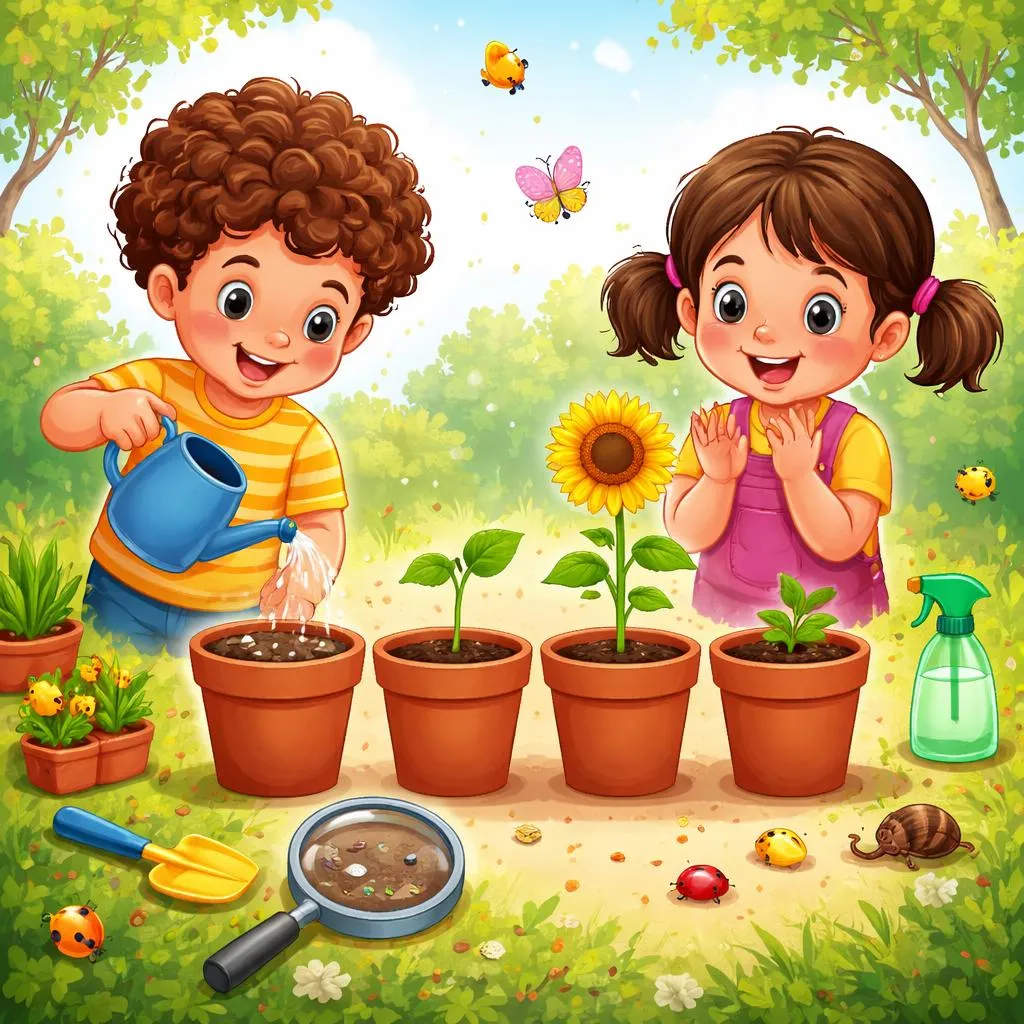

Hello, little plant watcher! Do you know how a plant grows? You plant a seed. Then you wait. The seed starts to grow. It grows and grows. It has been growing for days! You can see the growth now. Words can show this kind of growing action too. It is called the present perfect continuous tense. It is for an action that started in the past, has been happening for a while, and is either still happening now or just stopped. Today, we will watch sixty word-plants grow. Our guide is Percy the Patient Plant. Percy has been growing in his pot for a long time! He will show us this tense at home, the playground, school, and in the garden. Let's watch and learn!
What Is the Present Perfect Continuous?
The present perfect continuous is your word-plant growth chart. It shows an action that started in the past and has been continuing up until now. It often answers the question "How long?" The action might still be happening, or it might have just stopped, and we can see the result. At home, you say "I have been playing with my cars all morning." You started playing in the past, and you were just playing. Maybe you are still playing, or you just stopped and the cars are all over the floor! At the playground, you say "I have been swinging for ten minutes!" You started swinging ten minutes ago and were just doing it. At school, you say "We have been learning about shapes." We started learning before and are still learning now. In nature, Percy says "I have been growing since spring." He started in spring and is still growing now. Learning these must-know sentences helps you talk about activities that take time.
Why Do We Need a Growth Chart?
The present perfect continuous is your duration tool! It helps your ears listen. You can understand how long someone has been doing something. It helps your mouth speak. You can explain why you are tired or what you have been up to. "I have been running!" It helps your eyes read. You will see it in longer stories about ongoing projects. It helps your hand write. You can write about your activities over time. Using a growth chart makes you aware of time and effort.
What Are the Two Main Growth Types?
Our word-plants can show two main things. Each one is about an action over time.
First, an action that started in the past and is still happening now. We often use "for" (a period of time) or "since" (a starting point). "I have been waiting for you for five minutes."
Next, an action that was happening very recently and has just stopped. We can see the present result. "You are out of breath because you have been running."
For 5-year-olds, we will focus on simple, relatable examples, often with "all day" or "for a long time."
How Can You Spot a Growing Word-Plant?
Spotting the present perfect continuous is about looking for three parts. First, the helper: "have been" or "has been". Second, the main verb ending in "-ing". The formula is: have/has + been + verb-ing. Also, listen for time phrases about duration: "all day", "for hours", "since this morning", "how long". Look at Percy's growth. "Percy has been needing water." Helper: has been. Verb: needing. You found it! Another trick: It often explains a present situation. "Why are your hands dirty?" "Because I have been painting."
How Do We Chart the Growth?
Using this tense is about matching the helper to the subject. Use "have been" for I, you, we, they. "I have been drawing." Use "has been" for he, she, it. "She has been singing." Percy shows us. "The sun has been shining all day." Subject: The sun (it). Helper: has been. Verb: shining. Start by talking about what you have been doing for the last few minutes. "I have been listening to you."
Let's Fix Some Wilting Plants.
Sometimes our word-plants wilt a little. Let's fix them. A common wilt is forgetting the "been". A child might say "I have playing." This is wrong. The right way is "I have been playing." Another wilt is using the simple present continuous for a duration. "I am playing for two hours" is awkward. Better: "I have been playing for two hours." Also, this tense is for actions that can continue. We don't use it for state verbs like "know". "I have been knowing" is wrong. Say "I have known."
Can You Be a Growth Chart Helper?
You are a great helper! Let's play a game. The "How Long?" game. I will describe a situation. You make a sentence with "have been" or "has been". Situation: Your hands are covered in paint. You say: "I have been painting." Situation: Your friend is sweating. You say: "He has been running." Great! Here is a harder challenge. Look at a family member. Can you guess what they have been doing? "Dad has been cooking. I can smell the food!" You are using must-know present perfect continuous sentences.
Your Growth Chart of 60 Must-Know Sentences.
Ready to see the chart? Here are sixty growing sentences. Percy the Plant inspired them. They are grouped by scene. We'll use simple time phrases like "all morning" or "for a long time".
Home Growth (15).
- I have been sleeping all night.
- Mom has been cooking since noon.
- Dad has been working on the computer.
- The baby has been crying for an hour.
- I have been watching cartoons.
- We have been cleaning the house.
- I have been building with blocks.
- The dog has been barking at the mailman.
- I have been waiting for my turn.
- My sister has been talking on the phone.
- I have been looking for my toy.
- The oven has been beeping.
- I have been helping my mom.
- The clock has been ticking.
- We have been living here for five years.
Playground Growth (15).
- I have been swinging for a long time.
- We have been playing tag all recess.
- My friend has been climbing the monkey bars.
- I have been sliding down the slide again and again.
- We have been digging in the sandbox.
- I have been running around.
- The kids have been laughing non-stop.
- I have been pushing my friend on the swing.
- We have been sharing our toys.
- I have been trying to reach the top.
- The coach has been blowing his whistle.
- We have been having so much fun.
- I have been getting dizzy on the merry-go-round.
- We have been taking turns.
- I have been playing here since we arrived.
School Growth (15).
- I have been learning my ABCs.
- The teacher has been reading us a story.
- We have been singing songs.
- I have been writing my name over and over.
- We have been painting at the art station.
- I have been listening carefully.
- We have been working on a project.
- My friend has been raising her hand.
- We have been counting to one hundred.
- I have been practicing my cutting.
- We have been sitting in a circle.
- The class has been getting louder.
- I have been waiting for snack time.
- We have been learning about dinosaurs.
- I have been going to this school for a year.
Nature and Animal Growth (15).
- The sun has been shining all day.
- It has been raining since this morning.
- The flowers have been blooming for weeks.
- The bird has been singing in the tree.
- The river has been flowing fast.
- I have been walking in the park.
- The ants have been working hard.
- The wind has been blowing the leaves.
- I have been watching the clouds.
- The cat has been sleeping in the sun.
- The plant has been growing taller.
- We have been looking for four-leaf clovers.
- The bees have been buzzing around the flowers.
- I have been feeling the warm breeze.
- Day has been turning into night.
These sixty sentences are your must-know present perfect continuous examples. They are your word-plants. Use them to talk about actions that have been growing over time.
Talking About Ongoing Efforts and Time.
You did it! You are now familiar with the present perfect continuous. You know it is a word-plant growth chart for actions that started in the past and have been continuing. You know the formula: have/has + been + verb-ing. You can spot it and use it to explain how long or why. Percy the Patient Plant is proud of your growth. Now you can talk about your ongoing activities and efforts. Your sentences will show an understanding of time and process.
Here is what you can learn from our growing adventure. You will know what the present perfect continuous tense is. You will understand it is used for actions that started in the past and have continued. You can form the tense with "have been" or "has been" and an -ing verb. You can use it with simple time phrases like "all day". You have a growth chart of sixty essential present perfect continuous sentences.
Now, let's do some life practice! Your mission is today. Be a growth chart helper. Explain one thing you have been doing. Tell your grown-up: "I have been coloring this picture. I have been playing with my train. I have been waiting for you." You just used the present perfect continuous! Keep watching your word-plants grow. Have fun, little plant watcher!