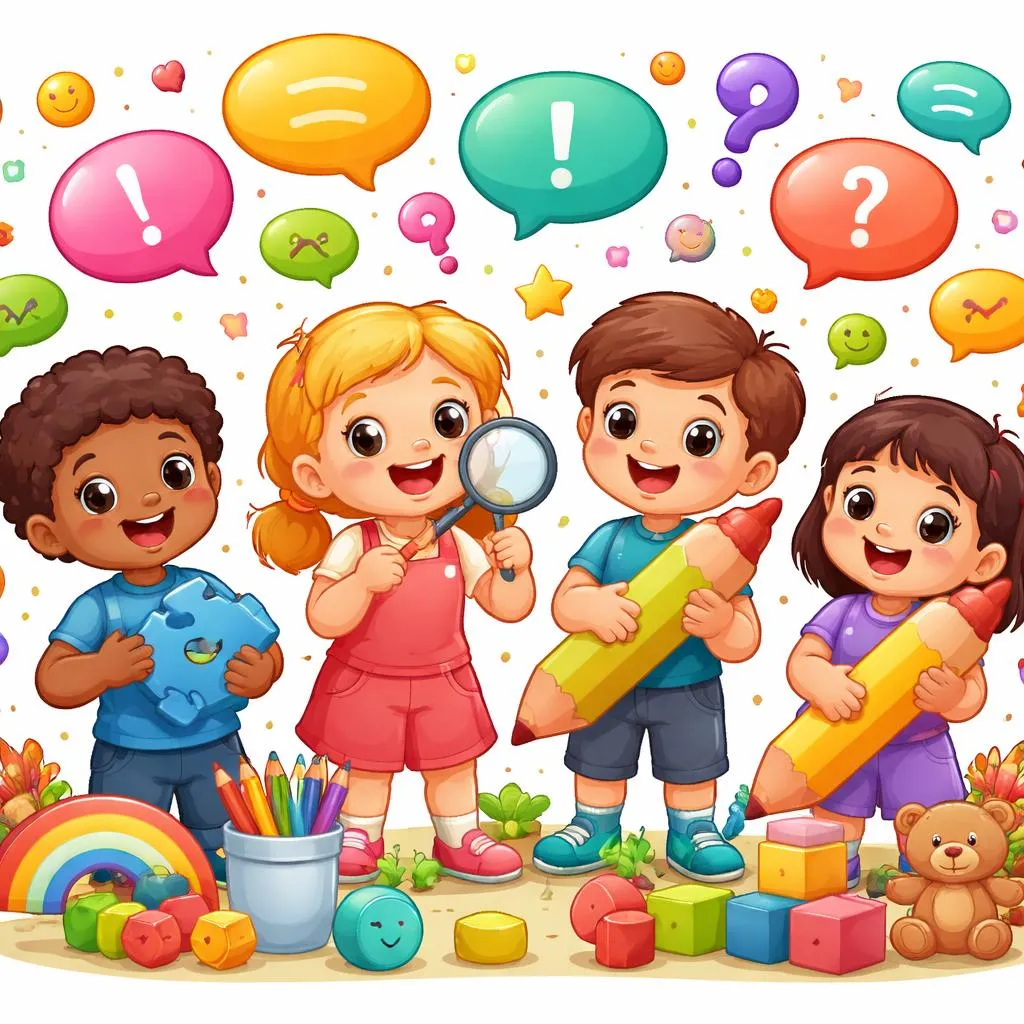

Hello, little word builder! Do you know about a toolbox? A toolbox has many tools. A hammer pounds nails. A screwdriver turns screws. A saw cuts wood. Each tool has a special job. Your words have different jobs too! We call these jobs "types of sentences." Each type of sentence does a different thing. Today, we will open a toolbox with sixty wonderful word tools. Our guide is Tommy the Toolbox. Tommy knows every tool! He will show us sentence types at home, the playground, school, and in the workshop. Let's get to work!
What Are Types of Sentences? Types of sentences are your word tools. They are different jobs a sentence can do. Some sentences tell. Some sentences ask. Some sentences shout. Some sentences tell you to do something. Just like you choose a hammer to pound, you choose a sentence type to share your idea. At home, you say "I have a toy." This sentence tells. It is a statement. At the playground, you say "Can I play?" This sentence asks. It is a question. At school, you say "Look at my picture!" This sentence shouts with joy. It is an exclamation. In nature, Tommy says "Please sit here." This sentence tells you to do something. It is a command. Learning these must-know sentence types helps you share all your ideas perfectly.
Why Do We Need Different Word Tools? Sentence types are your communication tools! They help your ears listen. You know if someone is telling, asking, or exclaiming. They help your mouth speak. You can do all the jobs: tell stories, ask for help, show excitement, and be polite. They help your eyes read. You will see different punctuation marks that show the sentence type. They help your hand write. You can write notes, stories, and lists that do different jobs. Having the right tool for the job makes you a master communicator.
What Are the Four Main Tools in the Box? Our word toolbox has four main tools. Each tool has a special name and a special end mark.
First, the telling tool. This is a statement. It tells information. It ends with a period. "My dog is brown."
Next, the asking tool. This is a question. It asks for information. It ends with a question mark. "What is your name?"
The exciting tool. This is an exclamation. It shows strong feeling. It ends with an exclamation mark. "I won the game!"
The telling-to-do tool. This is a command. It tells someone to do something. It often ends with a period. "Close the door, please." It can be strong and end with an exclamation mark. "Stop!"
How Can You Tell Which Tool Is Being Used? Spotting the sentence type is easy! Look at the end of the sentence. What punctuation mark is there? A period (.) means it's probably a statement or a calm command. A question mark (?) means it's a question. An exclamation mark (!) means it's an exclamation or a strong command. Also, listen to the speaker's voice. Does their voice go up at the end? It might be a question. Do they sound excited? It might be an exclamation. Tommy says, "The end mark is your biggest clue!"
How Do We Use the Right Tool? Using sentence types is about matching the job to the tool. Want to share a fact? Use a statement. Want to know something? Use a question. Want to show a big feeling? Use an exclamation. Want someone to do something? Use a command. Tommy shows us. To tell about his tools, he says: "I have many tools." (Statement). To ask for one, he says: "Can I use the hammer?" (Question). When he finds it, he says: "I found it!" (Exclamation). He might say: "Hand me the nail." (Command). Start by telling about your day with statements.
Let's Fix Some Tool Mix-ups. Sometimes we grab the wrong tool. Let's fix that. A common mix-up is using a period for a question. A child might write "You are my friend." But if you are asking, you need a question mark: "You are my friend?" Another mix-up is using an exclamation mark for everything. "I ate my sandwich!" is fine, but if it's just a normal fact, a period is better. Also, remember to start commands with a verb. "You sit down" is a statement. "Sit down" is a command. Listen to what job you want your sentence to do.
Can You Be a Tool Master? You are a great master! Let's play a game. The "What's the Job?" game. I will say a sentence. You tell me if it is a statement, question, exclamation, or command. "The sky is blue." You say: "Statement!" "Is it time for lunch?" You say: "Question!" "I love ice cream!" You say: "Exclamation!" "Please wash your hands." You say: "Command!" Great! Here is a harder challenge. Look at a toy. Say one sentence about it for each type. Statement: "This is a car." Question: "Is it red?" Exclamation: "It goes fast!" Command: "Push the car to me."
Your Toolbox of 60 Must-Know Sentence Examples. Ready to open the toolbox? Here are sixty wonderful sentences. Tommy the Toolbox has sorted them by their job. We have fifteen statements, fifteen questions, fifteen exclamations, and fifteen commands. Each group has examples from our four scenes: home, playground, school, and nature.
The Telling Tool: Statements (15 Examples). Home: I have two hands. My bed is soft. We eat dinner at six. Dad reads the paper. The cat sleeps on the couch. Playground: The sun is warm. My friend has a ball. The slide is silver. I can climb. Games are fun. School: My teacher is here. School starts in the morning. Books have words. I am learning. The room is big. Nature: Flowers need water. Birds have wings. The grass is green. A tree is tall. Day follows night.
The Asking Tool: Questions (15 Examples). Home: Where is my cup? What is for snack? Can I go outside? Is this your book? Do you like it? Playground: May I have a turn? Whose ball is this? How do you swing so high? Are you my friend? Can we play now? School: What is your name? Is this the right answer? May I use the bathroom? When is recess? Do you know this letter? Nature: What is that sound? Where is the butterfly? Why is the sky blue? Is that a bug? Do you see the bird?
The Exciting Tool: Exclamations (15 Examples). Home: I'm home! This is delicious! Look at that! I did it! What a mess! Playground: Watch me! This is awesome! I got it! We won! Yahoo! School: I know it! A gold star! We have art! I finished! Perfect! Nature: A rainbow! Look out! It's huge! How beautiful! Amazing!
The Telling-to-Do Tool: Commands (15 Examples). Home: Please come here. Eat your vegetables. Pick up your toys. Be quiet. Give me a hug. Playground: Throw the ball. Wait your turn. Share the swing. Line up. Be careful. School: Listen to the story. Raise your hand. Write your name. Sit down. Try again. Nature: Look at that. Listen to the birds. Don't touch. Walk slowly. Help me plant this.
These sixty sentences are your must-know word tools. They show the four key types of sentences. Practice using them all.
Building Your World with the Right Tools. You did it! You are now a sentence types expert. You know the four main jobs a sentence can do: tell, ask, exclaim, and command. You can spot them by their end marks and purpose. Tommy the Toolbox is proud of your building skills. Now you can choose the perfect tool for your idea. Your communication will be clear, polite, and full of expression.
Here is what you can learn from our toolbox adventure. You will know the four types of sentences. You will understand what job each type does. You can identify sentences by their punctuation and purpose. You can use different sentence types in your own talking and writing. You have a toolbox of sixty key sentence examples.
Now, let's do some life practice! Your mission is today. Be a word tool master. Use all four sentence types in the next hour. Tell your grown-up: "I am drawing. (Statement) Can you see it? (Question) I love colors! (Exclamation) Please pass the green. (Command)" You just used all four tools! Keep building with your word toolbox every day. Have fun, little builder!