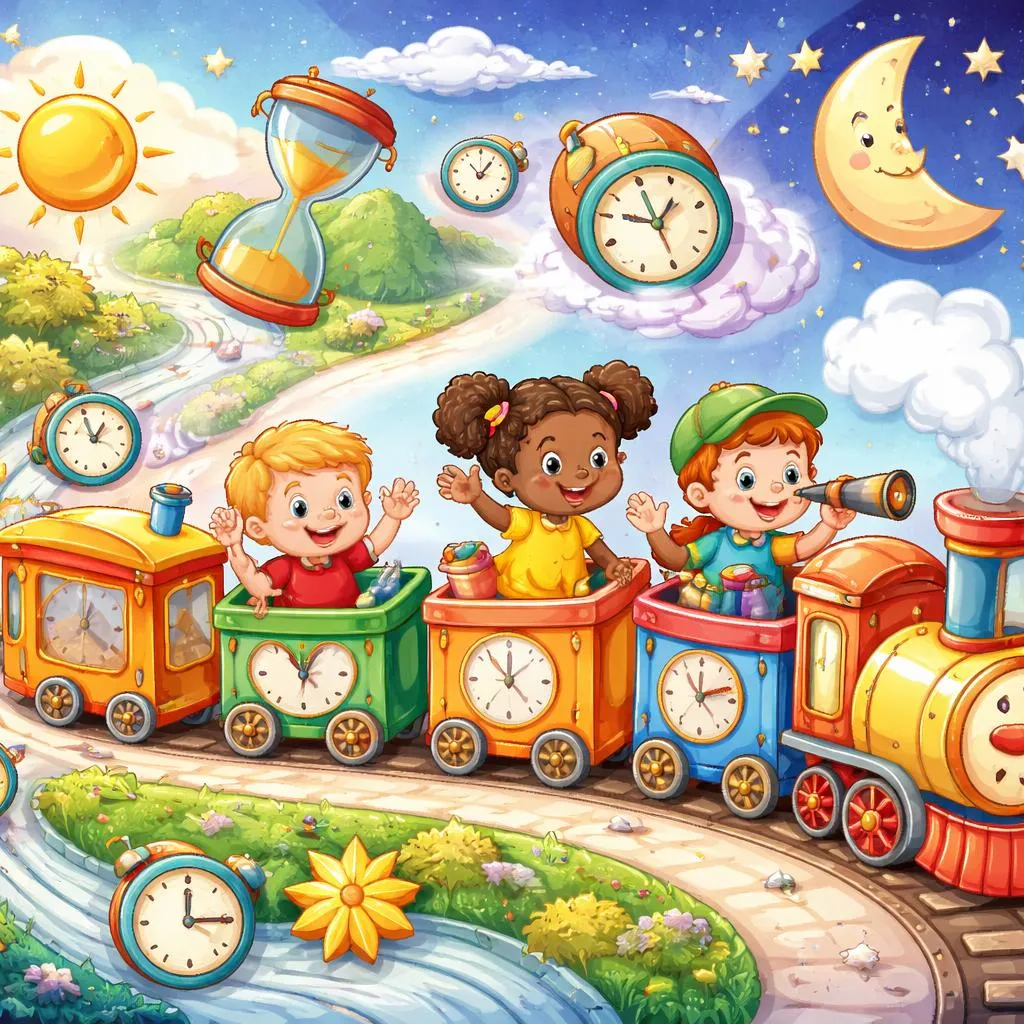

Hello, little time traveler! Do you know about a time machine? It can go to the past, the present, and the future. Your words have a time machine too! It is called verb tense. A verb tense tells us when an action happens. It shows if something is happening now, happened before, or will happen later. Today, we will take a ride on the Time Train and learn sixty wonderful time-traveling sentences. Our guide is Tilly the Time Train Conductor. Tilly drives a train with three special cars: the Past Car, the Present Car, and the Future Car. She will show us verb tenses at home, the playground, school, and all along the tracks of time. All aboard!
What Is a Verb Tense?
A verb tense is your word time machine. It is the form of a verb that tells us when the action happens. The verb is the action word. The tense is its time setting. We have three main time zones: past, present, and future. At home, you say "I eat my snack." (Present) That is happening now. You say "I ate my snack." (Past) That already happened. You say "I will eat my snack." (Future) That is going to happen. At the playground, you say "I slide." (Now) "I slid." (Before) "I will slide." (Later). In nature, Tilly says "The sun shines." (Now) "The sun shone." (Earlier) "The sun will shine." (Tomorrow). Learning these must-know verb tenses helps you tell stories about yesterday, today, and tomorrow.
Why Do We Need a Word Time Machine?
Verb tenses are your time-telling tools! They help your ears listen. You can understand when events in a story took place. They help your mouth speak. You can share your memories, your plans, and what you are doing right now. They help your eyes read. You will follow the order of events in books. They help your hand write. You can write diaries, plans, and exciting stories. Riding the Time Train makes you a master storyteller of all times.
What Are the Main Cars on the Time Train?
Our Time Train has three main cars. Each car has a simple and a continuous section, but we'll focus on the simple rides for now.
First, the Present Car. This car is for things that happen now, or things that happen all the time. The simple present tense often uses the base verb. "I walk." "He walks." (For he/she/it, add 's').
Next, the Past Car. This car is for things that already happened. The simple past tense often adds "-ed" to the verb. "I walked." "He walked." Some verbs are irregular and change in special ways. "I ate." "He ran."
Last, the Future Car. This car is for things that have not happened yet. The simple future tense uses "will" or "going to" with the base verb. "I will walk." "He is going to run."
These are the three simple trips we will take most often.
How Can You Tell Which Time Car You're In?
Spotting a verb tense is about looking for clues. Look at the verb itself. Does it have "-ed" or a special past form like "ate"? You're likely in the Past Car. Does it have "will" or "going to" in front? You're boarding the Future Car. Is it a simple action word, maybe with an 's'? You're in the Present Car. Also, listen for time words! Words like "yesterday", "now", and "tomorrow" are big signs. Tilly says, "Listen for the conductor's call: 'Now arriving in the Past!'"
How Do We Drive the Time Train?
Driving the Time Train is about changing the verb. For the Present Car (now): Use the base verb. For I/you/we/they: "I play." For he/she/it: add 's'. "She plays." For the Past Car (before): For regular verbs, add "-ed". "I played." For irregular verbs, learn the special form. "I ate." For the Future Car (later): Use "will" + base verb. "I will play." Tilly shows us. Present: "The train stops." Past: "The train stopped." Future: "The train will stop." Start by talking about what you are doing right now (present). Then, talk about what you did before (past). Then, talk about what you will do (future).
Let's Fix Some Time Travel Mix-ups.
Sometimes we get on the wrong time car. Let's fix that. A common mix-up is using the present tense for a past action. A child might say "I eat my lunch already." This mixes time. The right way is "I ate my lunch already." Another mix-up is forgetting the 's' for he/she/it in the present. "He run fast" should be "He runs fast." Also, don't use "will" with the past tense. "I will went" is wrong. Say "I will go" (future) or "I went" (past). Listen to the time words to stay on track.
Can You Be a Time Conductor?
You are a great conductor! Let's play a game. The "Time Switch" game. I will say a sentence in the present. You change it to the past. Present: "I jump high." You say: "I jumped high." Great! Now change it to the future. You say: "I will jump high." Here is a harder challenge. Take a verb like "draw". Say one sentence in the present, one in the past, and one in the future. "I draw a sun. I drew a house. I will draw a dragon." You are driving the Time Train with must-know verb tenses.
Your Time Travel Log of 60 Must-Know Sentences.
Ready to fill your travel log? Here are sixty wonderful sentences, organized by the Time Car and the scene. Tilly the Conductor uses them on her route. We'll show the verb in its three main tenses.
The Present Car (20 Sentences – Happening Now/Always).
Home: I eat breakfast. Mom cooks dinner. Dad drives the car. The baby sleeps. We love our home.
Playground: I swing high. My friend runs fast. We play tag. The dog barks. Children laugh.
School: I read a book. The teacher helps us. We sing songs. I write my name. We learn numbers.
Nature: The sun shines. Birds sing. Flowers grow. The river flows. Trees sway in the wind.
The Past Car (20 Sentences – Happened Before).
Home: I ate my cereal. Mom cooked pasta. Dad drove to work. The baby slept well. We loved the movie.
Playground: I swung on the swing. My friend ran fast. We played a game. The dog barked. Everyone laughed.
School: I read a story. The teacher helped me. We sang a song. I wrote my letters. We learned about shapes.
Nature: The sun shone brightly. A bird sang. A flower grew. The river flowed quickly. The tree swayed.
The Future Car (20 Sentences – Will Happen Later).
Home: I will eat a snack. Mom will cook lunch. Dad will drive us. The baby will sleep soon. We will love the party.
Playground: I will swing again. My friend will run a race. We will play tomorrow. The dog will bark at the mailman. We will laugh a lot.
School: I will read more books. The teacher will help us. We will sing later. I will write a story. We will learn new things.
Nature: The sun will shine tomorrow. Birds will sing in the morning. Flowers will bloom in spring. The river will flow to the sea. Trees will grow tall.
These sixty sentences are your must-know verb tense examples. They are your tickets for the Past, Present, and Future cars. Use them to tell stories about any time!
Telling Stories Across All of Time.
You did it! You are now a verb tense expert. You know that verb tense is a word time machine. The three main times are past, present, and future. You know how to form simple sentences for each time. You can spot clues like time words and verb endings. Tilly the Time Train Conductor is proud of your driving. Now you can tell stories about what you did, what you do, and what you will do. Your words can travel anywhere in time.
Here is what you can learn from our time travel adventure. You will know what a verb tense is. You will understand the three main tenses: past, present, and future. You can form the simple past, present, and future of common verbs. You can match the verb tense to time words like yesterday, now, and tomorrow. You have a travel log of sixty essential verb tense sentences.
Now, let's do some life practice! Your mission is today. Be a time conductor for your day. Say three sentences: one in the past, one in the present, and one in the future. Tell your grown-up: "I played with blocks. I am eating my grapes. I will read a book before bed." You just used three different verb tenses! Keep riding the Time Train with your words every day. Have fun, little time traveler!