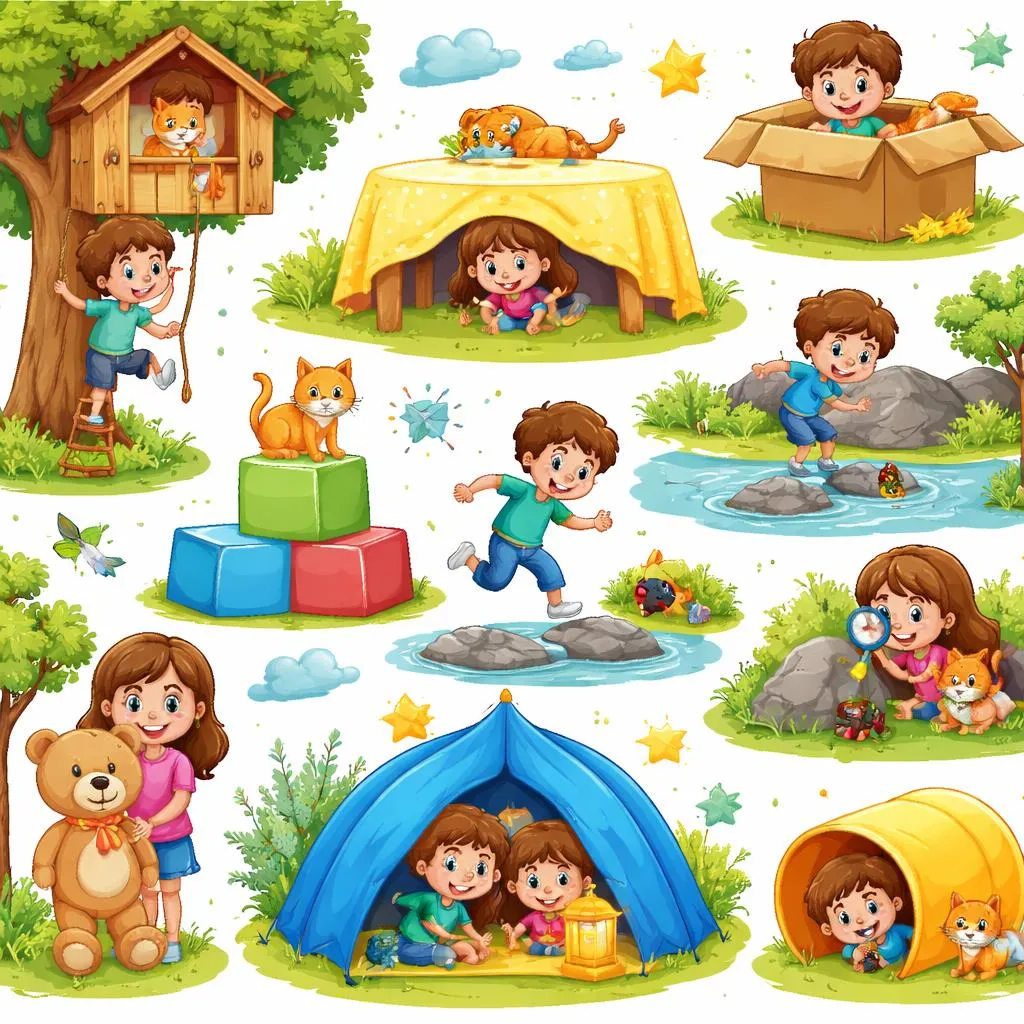

Prepositions are words that show relationships between other words. They tell us where something is, when something happens, or how things connect. Words like in, on, under, behind, before, and after are all prepositions. For a six-year-old, prepositions help them understand and describe where things are in the world. Learning the 70 most common prepositions for a 6-year-old gives children the tools to talk about location, time, and direction with accuracy. These small words do big jobs in sentences.
What Are Prepositions?
Prepositions are words that link nouns, pronouns, and phrases to other words in a sentence. They usually show position in space or time. They answer questions like: Where is it? When did it happen? How are things connected?
Think about a simple object like a ball. Where can it be? The ball can be in the box. The ball can be on the table. The ball can be under the chair. The ball can be behind the door. The preposition tells us exactly where the ball is.
Prepositions of place tell us where something is located. In, on, under, behind, next to, between. These are some of the first prepositions children learn.
Prepositions of time tell us when something happens. Before, after, during, until, since. These help children understand sequences and schedules.
Prepositions of direction tell us where something is going. To, toward, into, onto, through. These show movement from one place to another.
Prepositions can also show other relationships. With shows togetherness. Without shows absence. For shows purpose. About shows topic.
When we talk about the 70 most common prepositions for a 6-year-old, we mean the relationship words that children use and encounter most often in their daily lives and in the books they read.
Meaning and Explanation of Prepositions
Prepositions are usually small words, but they carry important meaning. They help us understand the connections between things.
Prepositions almost always come before a noun or pronoun. This noun or pronoun is called the object of the preposition. Together, they form a prepositional phrase.
in the box
on the table
under the bed
with my friend
before dinner
These phrases add important information to sentences. "The cat is sleeping on the bed." "We will eat after the movie." "She went to the store with her mom."
Some prepositions are single words. In, on, at, by, for, from. Others are compound words made of two or three words. Next to, in front of, because of, out of.
Children learn prepositions best through physical experience. They understand in when they climb into a box. They understand under when they crawl under the table. They understand behind when they hide behind the couch.
Many prepositions have opposites. Learning opposite pairs helps children understand the full range of positional words.
in and out
on and off
up and down
over and under
before and after
with and without
For a six-year-old, mastering prepositions helps them follow directions, understand stories, and describe their world accurately.
Categories or Lists: The 70 Most Common Prepositions
Here is a practical list of the 70 most common prepositions for a 6-year-old. These are the relationship words children use and encounter most often in speaking, reading, and writing.
Single-Word Prepositions of Place (20 words)
in
on
under
over
above
below
behind
in front of
beside
near
far from
inside
outside
between
among
around
through
across
against
onto
Single-Word Prepositions of Time (10 words)
21. before
22. after
23. during
24. until
25. since
26. at (at noon)
27. on (on Monday)
28. in (in July)
29. by (by bedtime)
30. from (from morning to night)
Single-Word Prepositions of Direction (10 words)
31. to
32. toward
33. into
34. onto
35. from
36. off
37. out of
38. through
39. past
40. along
Single-Word Prepositions of Other Relationships (10 words)
41. with
42. without
43. for
44. about
45. like
46. as
47. than
48. despite
49. except
50. including
Compound Prepositions (20 words)
51. next to
52. in front of
53. in back of
54. on top of
55. at the bottom of
56. in the middle of
57. out of
58. because of
59. instead of
60. in spite of
61. by means of
62. in addition to
63. in place of
64. in regard to
65. with respect to
66. on account of
67. apart from
68. aside from
69. as well as
70. along with
Daily Life Examples with Prepositions
The best way to teach prepositions is to use them naturally in everyday conversations. Children learn these words best when they hear them in context and experience their meanings physically.
Morning routine: "Your shoes are under the bed. Get in the car. We will eat breakfast after we get dressed. Put your backpack on the hook."
At breakfast: "The milk is in the fridge. Pour the cereal into the bowl. Sit next to your sister. Don't forget to wash your hands before you eat."
Getting dressed: "Put your arms through the sleeves. Your shirt is inside out. Stand in front of the mirror. Your socks are under the bed."
At the park: "Wait on the bench. Go down the slide through the tunnel. Swing beside your friend. Let's walk around the pond."
At the store: "Stand in line. Put the groceries into the cart. The candy is on the bottom shelf. Wait outside for me."
At dinner: "Sit at the table. Use your fork with your right hand. There is more food on the stove. We will have dessert after dinner."
At bedtime: "Get into your pajamas. Climb into bed. I will sit beside you. We will read a story before you sleep. Your teddy bear is under the covers."
Printable Flashcards for Prepositions
Flashcards are a wonderful tool for learning prepositions. You can make them together, which makes the learning even more meaningful.
To make preposition flashcards, you will need index cards or thick paper, markers, crayons, and maybe some small toys for demonstrations. On one side of the card, write the preposition. On the other side, draw a simple picture that shows the meaning.
For example:
"in" with a picture of a cat inside a box
"on" with a picture of a book on a table
"under" with a picture of a ball under a chair
"behind" with a picture of a child hiding behind a tree
"next to" with two animals sitting side by side
"between" with one animal in the middle of two others
Here are some fun ways to use your flashcards:
Act it out with toys: Use a small toy and a box or cup to act out each preposition. Place the toy in the box. Place it on the box. Place it under the box. Place it behind the box. Your child moves the toy according to the flashcard.
Simon says with prepositions: Play Simon Says using prepositional phrases. "Simon says put your hand on your head." "Simon says stand next to the chair." "Simon says hide under the table."
Matching game: Make pairs of cards with the same preposition or match prepositions with their opposites. Match "in" with "out." Match "on" with "off." Match "over" with "under."
Preposition hunt: Give your child a flashcard and have them find something in the house that matches that preposition. For "under," they might find something under the couch. For "behind," they might find something behind the curtain.
Sentence building: Pick a preposition card and a noun card and make a sentence. "The cat is under the table." "I put my book on the shelf." "We walked to the park."
Learning Activities or Games
Games make learning prepositions fun and memorable. Here are some games you can play with your child to practice these important relationship words.
The Hide and Seek Game: Hide a small toy somewhere in the room and give your child clues using prepositions. "It is under something soft." "It is behind something red." "It is between the books." Your child follows the clues to find it. Then switch roles and let your child hide the toy and give you clues.
The Obstacle Course Game: Set up a simple obstacle course using furniture and pillows. Give your child directions using prepositions. "Crawl under the table. Go around the chair. Jump over the pillow. Climb onto the couch. Go through the doorway." This gets them moving while learning.
The Where Is It? Game: Look around the room and take turns describing where things are using prepositions. "Where is the lamp?" "It is next to the sofa." "Where are your shoes?" "They are under the bed." "Where is the clock?" "It is above the door."
The Drawing Game: Give your child simple drawing instructions using prepositions. "Draw a sun in the sky. Draw a tree next to a house. Draw a bird on the tree. Draw a flower in front of the house. Draw a cloud above the tree."
The Story Time Preposition Hunt: When you read stories together, have your child raise their hand every time they hear a preposition. "The little bear went into the forest. He walked through the trees. He sat beside a stream. He saw a fish under the water." This builds listening skills and preposition awareness.
The Opposite Game: Call out a preposition and have your child say the opposite. "In" opposite is "out." "On" opposite is "off." "Over" opposite is "under." "Before" opposite is "after." "With" opposite is "without."
The I Spy Preposition Game: Play I Spy using prepositions in your clues. "I spy something on the table." "I spy something under the chair." "I spy something behind the curtain." Your child guesses what it is based on your preposition clue.
The Moving Toy Game: Give your child a small toy and give them a series of prepositional commands. "Put the toy in your pocket. Now take it out of your pocket. Put it on your head. Now put it under your chin. Hide it behind your back." This practices following directions with prepositions.
By using these examples, flashcards, and games, you are helping your child master the 70 most common prepositions for a 6-year-old in a natural and enjoyable way. These relationship words will become a comfortable part of their language. They will use them to understand where things are, when things happen, and how things connect. Every conversation gives them more practice. Your child will gain confidence as they learn to describe locations, follow directions, and understand the relationships between things in their world. The more they hear and use prepositions, the more naturally these small but mighty words will flow in their everyday speech. Soon they will be telling you exactly where everything is, using words like under, behind, and between with ease and accuracy.