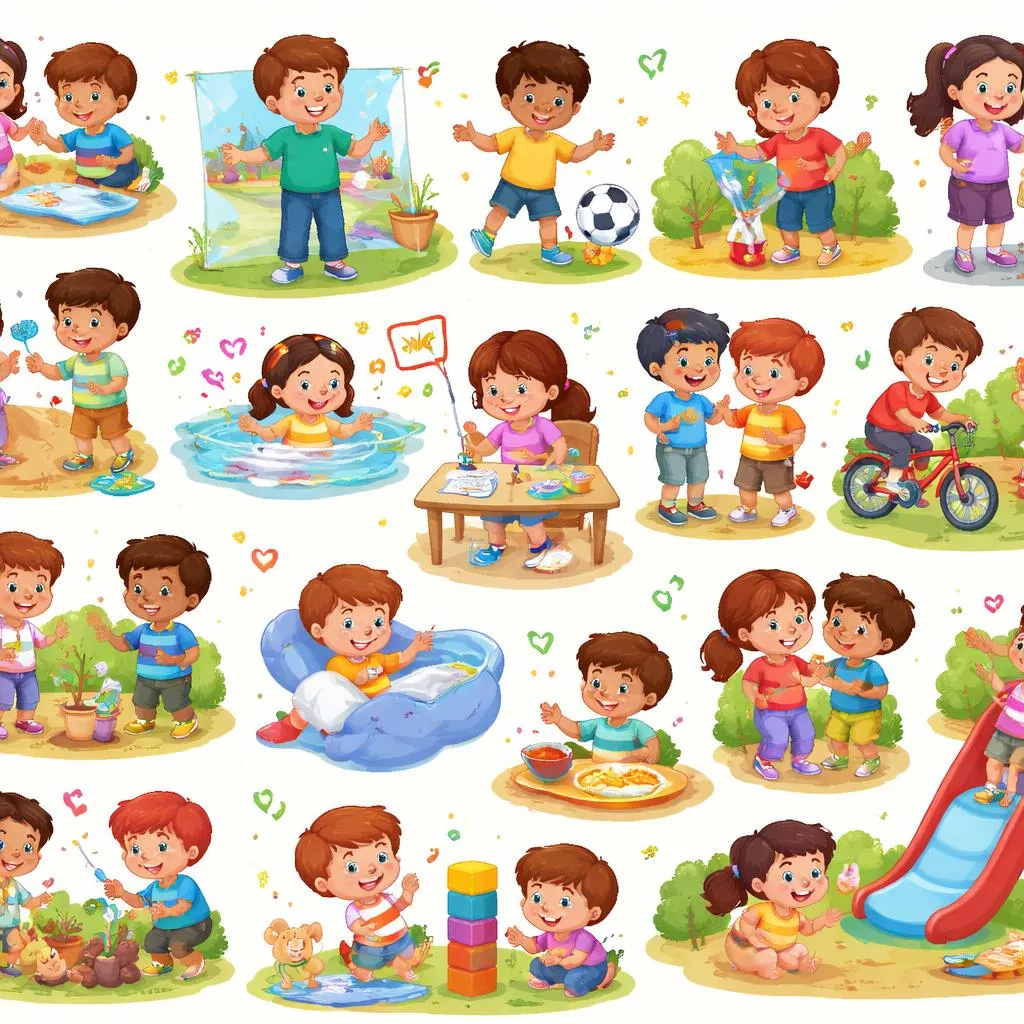

Simple present tense is the most basic way we talk about actions. It describes things that happen now, things that happen regularly, and things that are always true. Words like eat, sleep, play, like, and want are all simple present verbs. For a six-year-old, simple present is the foundation of all communication. Learning the 70 most common simple present verbs for a 6-year-old gives children the tools to express their daily lives, their feelings, and their world. These verbs are the building blocks of every sentence they will ever speak.
Meaning of Simple Present
Simple present tense has three main uses. It tells us about things happening now, habits and routines, and facts that are always true.
Things happening right now use simple present for state verbs and feelings. These are things that are true at this moment.
I want a cookie.
She feels happy.
He needs help.
We see the cat.
Habits and routines describe things we do regularly.
I eat breakfast every morning.
She walks to school.
He brushes his teeth twice a day.
We play outside after dinner.
Facts and general truths are things that are always true.
The sun shines.
Dogs bark.
Water freezes when it is cold.
Birds fly.
For a six-year-old, simple present is the tense they use most often. They use it to ask for things, to share feelings, and to talk about their daily lives.
When we talk about the 70 most common simple present verbs for a 6-year-old, we mean the action and state words that children use most frequently in their everyday conversations.
Conjugation of Simple Present
Simple present verbs change form depending on who is doing the action. This is called conjugation. The pattern is simple once children learn it.
For I, You, We, They we use the base form of the verb.
I play .
You play .
We play .
They play .
For He, She, It we add -s to the base form.
He play s.
She play s.
It play s.
Special spelling rules for he, she, and it:
For verbs ending in s, sh, ch, x, or o, we add -es.
He kiss es.
She wash es.
It reach es.
He fix es.
She go es.
For verbs ending in consonant + y, we change y to i and add -es.
He cry becomes He cri es.
She fly becomes She fli es.
But if the verb ends in vowel + y, we just add -s.
He play becomes He play s.
She enjoy becomes She enjoy s.
The verb be is irregular and has special forms.
I am
You are
He/She/It is
We are
They are
The verb have is also irregular for he, she, it.
I have
You have
He/She/It has
We have
They have
For a six-year-old, the most important thing is learning to add -s for he, she, and it. They will master the special rules through practice.
Present Tense Examples
Here are examples of simple present verbs in action. These are the kinds of sentences six-year-olds use every day.
Action verbs in simple present:
I jump on the bed.
You run fast.
He climbs the tree.
She dances beautifully.
It moves slowly.
We build towers.
They paint pictures.
State verbs in simple present:
I like pizza.
You want a turn.
He needs a hug.
She loves her doll.
It belongs to me.
We know the answer.
They understand the game.
The verb be in simple present:
I am six years old.
You are my best friend.
He is funny.
She is nice.
It is cold outside.
We are at school.
They are playing.
The verb have in simple present:
I have a new toy.
You have blue eyes.
He has a bike.
She has long hair.
It has four legs.
We have a dog.
They have a big house.
Questions with Simple Present
Asking questions in simple present helps children get information and express their needs. Questions follow special patterns with helping verbs.
Yes/No questions with do and does:
Do I look funny?
Do you like ice cream?
Does he play soccer?
Does she want a turn?
Do we have time?
Do they live nearby?
Yes/No questions with be:
Am I your friend?
Are you hungry?
Is he your brother?
Is she at home?
Is it raining?
Are we there yet?
Are they coming?
Wh- questions with do and does:
What do you want ?
Where does she live ?
When do we eat ?
Why do they cry ?
How do you make pancakes?
Wh- questions with be:
Who is that?
What is your name?
Where are my shoes?
When is lunch?
Why is he sad?
How are you?
Here are some question examples children ask every day:
" Do you love me?"
" Where does the sun go at night?"
" What is for dinner?"
" Why do I have to go to bed?"
" Are we there yet?"
Other Uses of Simple Present
Simple present has several other important uses in English. Learning these helps children understand more complex language.
Telling stories and jokes: We often use simple present to make stories feel more exciting and immediate.
"So this man walks into a store..."
"The bear sees the honey and runs toward it."
Giving directions and instructions:
"First, you mix the flour and sugar."
"You turn left at the corner."
"Then you wait for the light to change."
Talking about scheduled events in the near future:
"School starts at eight o'clock."
"The movie begins in ten minutes."
"Our plane leaves tomorrow morning."
After words like when, if, before, after for future meaning:
"I will call you when I get home."
"If it rains , we will stay inside."
"Before you go , say goodbye."
For a six-year-old, these uses will become more important as they grow and encounter more complex language.
Categories or Lists: The 70 Most Common Simple Present Verbs
Here is a practical list of the 70 most common simple present verbs for a 6-year-old. These are the verbs children use most often in their daily conversations.
Everyday Action Verbs (20 words)
go
come
run
jump
sit
stand
eat
drink
sleep
wake
play
build
draw
paint
sing
dance
read
write
watch
listen
Daily Routine Verbs (10 words)
21. brush
22. wash
23. dress
24. comb
25. clean
26. help
27. wait
28. share
29. take
30. put
State and Feeling Verbs (10 words)
31. like
32. love
33. want
34. need
35. feel
36. hope
37. wish
38. care
39. prefer
40. enjoy
Thinking Verbs (8 words)
41. know
42. think
43. believe
44. remember
45. forget
46. understand
47. wonder
48. mean
The Verb Be (5 forms)
49. am
50. is
51. are
52. be
53. being
The Verb Have (2 forms)
54. have
55. has
Communication Verbs (8 words)
56. say
57. tell
58. ask
59. answer
60. call
61. talk
62. speak
63. whisper
Sensory Verbs (5 words)
64. see
65. hear
66. smell
67. taste
68. touch
Possession Verbs (2 words)
69. belong
70. own
Daily Life Examples with Simple Present
The best way to teach simple present is to use it naturally in everyday conversations. Children learn these verbs best when they hear them in context.
Morning routine: "I wake up. I get out of bed. I brush my teeth. I wash my face. I eat breakfast. I put on my shoes. I go to school."
At breakfast: "I like cereal. You prefer pancakes. The milk is cold. This spoon belongs to me. We eat together as a family."
At school: "The teacher reads a story. We listen carefully. My friend sits next to me. I draw a picture. We play at recess."
At the park: "I run fast. You swing high. He climbs the ladder. She slides down. We have fun together."
At dinner: "I want more potatoes. This chicken tastes good. Dad cooks dinner. We say thank you. The baby drops his spoon."
At bedtime: "I feel tired. I need my blanket. Mommy reads a story. I close my eyes. I dream about animals."
Printable Flashcards for Simple Present
Flashcards are a wonderful tool for learning simple present verbs. You can make them together, which makes the learning even more meaningful.
To make simple present flashcards, you will need index cards or thick paper, markers, crayons, and maybe some old magazines for pictures. On one side of the card, write the verb. On the other side, draw a simple picture that shows the action.
For example:
"run" with a picture of a person running
"eat" with a picture of someone eating
"sleep" with a picture of someone sleeping
"like" with a happy face and a heart
"have" with a picture of someone holding a toy
Here are some fun ways to use your flashcards:
Act it out: Pick a card and act out the verb without speaking. Your child guesses the word. Then switch roles.
Sentence building: Pick a card and use it in a sentence. "I run fast." "She eats an apple." "We like pizza."
He/She/It practice: Pick a card and practice changing it for different subjects. "I run . He run s. They run ."
Sorting game: Sort the cards into action verbs and state verbs. Talk about the difference.
Matching game: Make pairs of cards with the same verb or match verbs with opposite meanings.
Learning Activities or Games
Games make learning simple present verbs fun and memorable. Here are some games you can play with your child to practice these important words.
The Simon Says Game: Play Simon Says using simple present verbs. "Simon says jump . Simon says sit down. Run in place!" This practices action verbs in a fun way.
The Daily Routine Game: Take turns describing your daily routine using simple present. "First, I wake up. Then I get dressed. Then I eat breakfast." Your child adds the next part. This builds sequencing and verb use.
The I Spy with Verbs Game: Play I Spy using verbs. "I spy something that flies ." (a bird) "I spy something that bark s." (a dog) "I spy something that shine s." (the sun)
The Verb Charades Game: Take turns acting out verbs without speaking while the other person guesses. This is fun and gets children moving.
The What Do You Like? Game: Ask each other questions about likes and dislikes using simple present. "What do you like to eat?" "I like pizza." "What does your friend like ?" "She likes ice cream."
The Story Time Verb Hunt: When you read stories together, have your child raise their hand every time they hear a simple present verb. "The bear walk s through the forest. He see s a bee hive. He want s the honey." This builds listening skills.
The Morning Circle Game: Sit in a circle with family members or stuffed animals. Take turns saying what each person does using simple present. "Mommy work s . Daddy cook s . I play . Teddy sleep s ."
The Question Chain Game: Take turns asking and answering questions in simple present. You ask: "What do you like to play?" Child answers: "I like to play blocks." Child asks: "What does Daddy like to eat?" You answer: "He likes to eat pizza."
By using these examples, flashcards, and games, you are helping your child master the 70 most common simple present verbs for a 6-year-old in a natural and enjoyable way. These verbs will become the foundation of their language. They will use them to talk about their daily lives, to express their feelings, and to share their world with others. Every conversation gives them more practice. Your child will gain confidence as they learn to use verbs correctly for different subjects. The more they hear and use simple present verbs, the more naturally these words will flow in their everyday speech. Soon they will be telling you all about what they like , what they want , and what they do , and you will hear their language growing stronger every day.