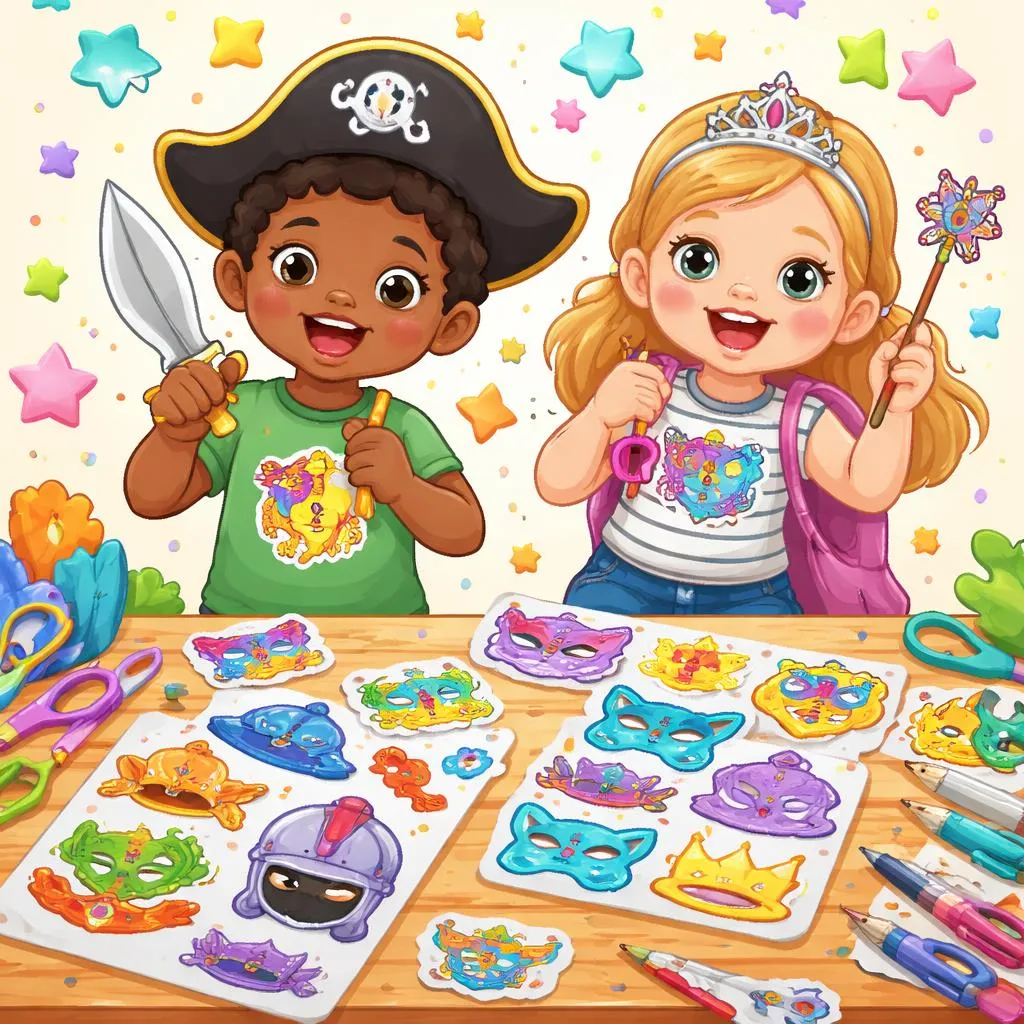

Stickers are magical tools in early childhood education. They capture children's attention instantly. They offer endless possibilities for creativity. Today, we are going to explore how costume stickers can become powerful learning tools in the classroom. We will look at different types of costume stickers and discover activities that build language, creativity, and social skills.
What Are Costume Stickers? Costume stickers are stickers that depict different types of clothing and accessories. They might show hats, shirts, pants, dresses, shoes, and costumes for various professions and characters. Some costume stickers come as complete outfits. Others are mix-and-match sets where children can combine different pieces.
These stickers come in many themes. Community helper costumes like police officers, firefighters, and doctors. Animal costumes like cats, dogs, and rabbits. Fantasy costumes like princesses, superheroes, and monsters. Seasonal costumes for holidays and special events.
Costume stickers are usually sold in sheets. Each sheet contains multiple stickers. Children can peel them off and stick them onto paper, cards, or other surfaces. The stickers are often reusable if placed on special surfaces.
Meaning and Explanation of Costume Stickers How do we explain costume stickers to children? We start with what they already know about dressing up. Many children love pretend play. They love putting on different hats and pretending to be someone else.
Costume stickers let children do this same kind of play, but on paper. They can dress up a paper person in different outfits. They can mix and match to create new looks. They can tell stories about the characters they create.
We can explain that costumes help us pretend. When we wear a firefighter hat, we can pretend to put out fires. When we wear a princess dress, we can pretend to live in a castle. Costume stickers let us create these pretend characters on paper.
Categories or Lists of Costume Stickers Costume stickers come in many different categories. Understanding these categories helps us choose the right stickers for different learning goals.
Community Helper Costumes: These stickers show what people wear for different jobs. Police officer uniforms with badges and hats. Firefighter gear with helmets and coats. Doctor scrubs with stethoscopes. Chef hats and aprons. Construction worker vests and hard hats.
Animal Costumes: These stickers show animal outfits. A child might wear a bunny costume with long ears. A puppy costume with floppy ears and a tail. A lion costume with a mane. A butterfly costume with colorful wings.
Fantasy Costumes: These stickers show imaginary characters. Princess dresses with crowns and wands. Superhero costumes with capes and masks. Pirate outfits with eye patches and swords. Fairy costumes with wings and magic dust.
Career Costumes: Beyond community helpers, we have other careers. Astronaut suits with helmets. Ballet tutus and slippers. Soccer uniforms with cleats. Painter smocks with brushes.
Seasonal Costumes: These relate to holidays and seasons. Halloween costumes of all kinds. Winter snowman outfits. Spring flower costumes. Summer beach wear.
Daily Life Examples of Costume Stickers Costume stickers connect to children's daily experiences in many ways. Throughout the year, we have opportunities to use them.
During a community helpers theme, children use costume stickers to create workers. They can make a firefighter, a police officer, and a doctor on one page. They can talk about what each person does.
During Halloween time, children use costume stickers to design their ideal costume. They can try different combinations on paper before choosing a real costume.
During imaginative play, children use costume stickers to create characters for stories. They can make a princess, a dragon, and a knight on the same page and tell a story about them.
During career exploration, children use costume stickers to show what they want to be when they grow up. They can create a self-portrait wearing the costume of their dream job.
Printable Flashcards for Costume Stickers While actual stickers are wonderful, we can also create printable resources that work with them. Flashcards help build vocabulary before or after sticker activities.
Create flashcards showing different costume pieces. A hat card, a dress card, a mask card, a cape card. Children can match their stickers to these cards.
Create flashcards showing different characters. A firefighter card, a princess card, a cat card. Children find the stickers that match each character.
Create flashcards with the vocabulary words. "Firefighter hat" written clearly. Children see the written word while they play with the sticker. This builds early literacy connections.
Learning Activities or Games with Costume Stickers Costume stickers can be the center of many engaging activities. Here are some ways to use them in the classroom.
Dress the Person Activity: Provide simple outlines of people on paper. These can be blank figures with just a head and body shape. Children use costume stickers to dress their person. They can create a firefighter, a princess, or any character they choose.
Mix and Match Fun: Provide costume stickers that are mix-and-match. Different hats, shirts, pants, and accessories. Children create silly combinations. A firefighter hat with a princess dress and bunny slippers. This builds creativity and laughter.
Story Starters: After children create a character with costume stickers, they tell a story about that character. Where does the character live? What does the character do? Who are the character's friends? This builds narrative skills.
Costume Sorting: Provide a variety of costume stickers. Ask children to sort them into categories. Hats go together. Shoes go together. Community helpers go together. Fantasy characters go together. This builds classification skills.
Pattern Making: Use costume stickers to create patterns. Hat, dress, hat, dress. What comes next? Firefighter, doctor, firefighter, doctor. Children extend the patterns and create their own.
Costume Bingo: Create bingo cards with different costume pieces. Call out descriptions. "Someone who puts out fires." Children cover the firefighter sticker. This builds listening and vocabulary.
Printable Materials for Costume Stickers Printable materials can extend the learning from sticker activities. Here are some resources to create.
Blank Figure Templates: Create simple outlines of people. These can be children, adults, or even animals. Children add costume stickers to dress them. The templates can be photocopied for repeated use.
Scene Backgrounds: Create backgrounds for sticker play. A fire station scene for firefighter stickers. A castle scene for princess stickers. A farm scene for animal costume stickers. Children place their stickers in the appropriate setting.
Vocabulary Cards: Create cards with pictures and words for different costume pieces. Children can match stickers to these cards. This builds reading readiness along with vocabulary.
Costume Design Sheets: Create sheets where children can plan their costume designs. They can draw or write what stickers they will use. This adds a planning step to the creative process.
Educational Games with Costume Stickers Games make sticker activities even more engaging. Here are some games to try.
Who Am I? Game: One child creates a character with costume stickers but does not show the class. The class asks yes or no questions to guess the character. "Do you fight fires? Do you live in a castle? Do you have wings?" This builds questioning skills.
Costume Memory Game: Place several costume stickers on a tray. Children look at them for one minute. Then cover the tray. Children try to remember all the stickers they saw. This builds memory and observation.
Costume Match Game: Create pairs of identical costume stickers. Place them face down. Children take turns flipping two stickers to find matches. This builds memory and concentration.
Costume Bingo: Create bingo cards with different costume stickers. Call out descriptions or names. Children cover the matching sticker. The first to cover a row wins.
Costume Sorting Race: Give each child a mix of costume stickers. Call out a category. "Find all the hats!" Children race to find and place all the hat stickers. This builds quick thinking and categorization.
Building Language with Costume Stickers Costume stickers are excellent for vocabulary development. Each sticker is an opportunity to learn and use new words.
As children play with costume stickers, we introduce the names. "That is a firefighter helmet. That is a stethoscope. That is a magic wand." We repeat the words naturally during play.
We encourage children to use the words themselves. "What is that called? Can you say firefighter? What does a firefighter do?" This builds both receptive and expressive vocabulary.
We introduce descriptive words. "The princess dress is sparkly. The superhero cape is red. The bunny ears are soft and fluffy." This expands language beyond simple labels.
We ask questions that require language use. "Why did you choose that hat for your character? What will your character do next?" This builds narrative and reasoning skills.
Social Skills Through Sticker Play Costume stickers also build social skills when children play together. Sharing stickers requires negotiation. Creating stories together requires cooperation.
When children share a sticker sheet, they learn to take turns. "Can I use the firefighter hat now? You can have the princess dress." This builds patience and consideration.
When children create characters together, they learn to collaborate. "Let's make a fire station. You can be the firefighter. I'll be the person who needs help." This builds teamwork and imagination.
When children show their creations to each other, they learn to appreciate others' work. "I like your princess. What is her name?" This builds positive social interaction.
Connecting to Real Life Costume stickers can connect to real-life experiences and learning. We can use them to explore different topics.
During a community helpers unit, we use costume stickers to learn about different jobs. We talk about what each helper does and how they help us.
During a careers unit, we explore different professions. Children use stickers to show what they might want to be when they grow up. This builds aspirations and vocabulary.
During holidays, we use themed costume stickers. Halloween costume stickers let children explore different costume ideas. This builds excitement and creativity.
During story time, we connect stickers to books we read. After reading a book about a firefighter, children use stickers to create their own firefighter characters. This deepens comprehension.
Creating Sticker Books A wonderful project is creating individual sticker books for each child. Give each child a small blank book made of folded paper. Over time, they add costume stickers to create characters on each page.
They can create a community helpers book with a different helper on each page. They can create a fantasy book with princesses, dragons, and fairies. They can create a careers book showing what they want to be.
These books become treasured keepsakes. Children can "read" them to family and friends. They can add more pages throughout the year. The books document their creativity and learning.
As we explore costume stickers with young learners, we discover their power as educational tools. They build vocabulary through meaningful play. They spark creativity and imagination. They develop fine motor skills through peeling and placing. They create opportunities for social interaction and storytelling. These小小 stickers, so simple and inexpensive, open up a world of learning possibilities in the classroom.