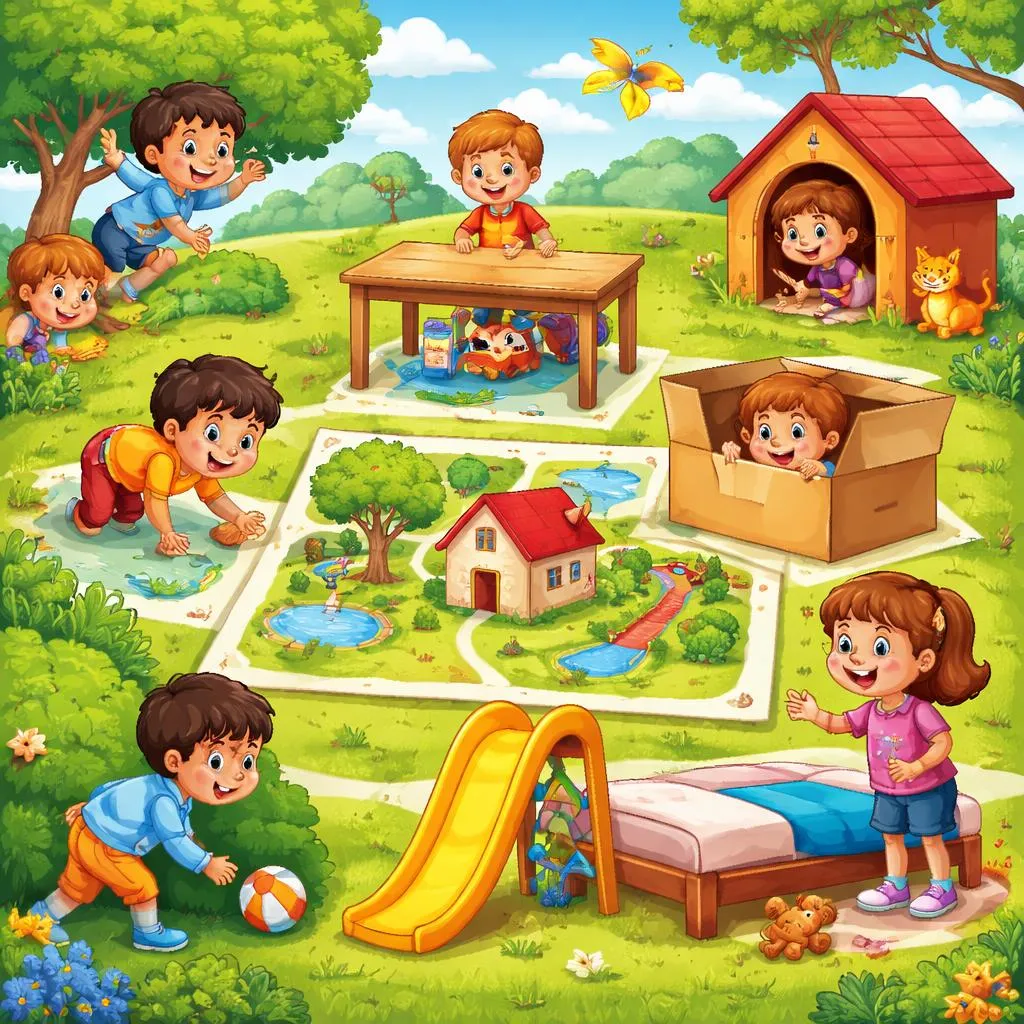

The world is full of places. Children move through them every day. They wake up in a bedroom. They eat in a kitchen. They learn in a classroom. They play in a park. Understanding place words helps children describe where things are and where they go. These words appear in every conversation. "Where is my book?" "Let's go to the park." "I am at school." Teaching examples of place gives children vocabulary they use constantly. Let us explore how to guide young learners through this essential topic with clear explanations and engaging activities.
What Are Place Words? Place words tell us where something or someone is located. They answer the question "Where?" These words include nouns that name specific locations and prepositions that describe position.
Place nouns name specific locations: Home, school, park, store, library Kitchen, bedroom, bathroom, living room City, town, country, neighborhood Beach, mountain, forest, river
Place prepositions describe position: In, on, under, behind, in front of Next to, between, above, below Inside, outside, upstairs, downstairs
Place adverbs give location information: Here, there, everywhere, somewhere Inside, outside, upstairs, downstairs
For young learners, start with common place nouns they encounter daily. Home, school, park, and store are good beginning words. Add prepositions gradually as children understand the nouns.
Meaning and Explanation of Place Words Each place word has a specific meaning. Understanding these meanings helps children use them correctly.
Home: The place where someone lives. It can be a house, apartment, or other dwelling. I go home after school. My home is near the park.
School: A place where children learn. It has classrooms, a playground, and teachers. We read books at school. The school has a big gym.
Park: An outdoor place with grass, trees, and places to play. Children play on the swings at the park. We had a picnic at the park.
Store: A place where people buy things. There are many kinds of stores. Mom buys food at the grocery store. We get toys at the toy store.
Library: A place with books to borrow. People can read and study there. We borrowed five books from the library. The library has story time on Tuesdays.
Kitchen: A room where food is prepared and often eaten. We eat breakfast in the kitchen. The kitchen has a refrigerator and stove.
Bedroom: A room where people sleep. It has a bed and often other furniture. My bedroom has blue walls. I keep my toys in my bedroom.
Bathroom: A room with a toilet, sink, and often a shower or bathtub. We wash our hands in the bathroom. The bathroom has a mirror.
City: A large place with many buildings and many people. New York is a big city. The city has tall buildings.
Beach: A place near water with sand. We build sandcastles at the beach. The beach has waves and seashells.
Use these explanations during daily routines. When children go to different places, name the place and talk about what happens there.
Categories of Place Words Organizing place words into categories helps children understand relationships between different locations.
Places in a home: Kitchen - where food is made Bedroom - where people sleep Bathroom - where people wash Living room - where people relax Dining room - where people eat meals Basement - below the main floor Attic - above the main floor Garage - where cars are parked
Places in a community: School - where children learn Library - where books are kept Park - where people play Store - where people shop Hospital - where doctors work Fire station - where firefighters work Police station - where police officers work Post office - where mail is sent
Places in nature: Beach - sand and water Forest - many trees Mountain - tall landform River - flowing water Lake - still water Ocean - large sea Desert - dry, sandy place Jungle - dense forest with many plants
Places in a city: Street - where cars drive Sidewalk - where people walk Building - where people work or live Bridge - connects two places over water Parking lot - where cars are parked Market - where people buy fresh food Restaurant - where people eat out Movie theater - where films are shown
Position words (prepositions): In - inside something On - touching the surface Under - below something Behind - at the back of In front of - before something Next to - beside Between - in the middle of two things Above - higher than Below - lower than
Use these categories in sorting activities. Children learn that places belong to different groups based on their function or location.
Daily Life Examples of Place Words The best place word learning happens in everyday moments. Here are examples of place words in daily routines.
Morning routine: I wake up in my bedroom. I eat breakfast in the kitchen. I brush my teeth in the bathroom. I put on my coat at the front door. I wait for the bus on the sidewalk.
Going to school: The bus takes me to school. I put my backpack in my cubby. I sit at my desk in the classroom. We play outside on the playground. I eat lunch in the cafeteria.
After school: I go home on the bus. I do homework at the kitchen table. I play with friends at the park. I help mom at the grocery store. I take a bath in the bathroom.
Weekend activities: We go to the library on Saturday. I borrow books from the children's section. We have a picnic at the park. We visit grandma at her house. We watch a movie at the theater.
Position words in daily life: The book is on the table. My shoes are under the bed. The cat is behind the couch. I sit next to my friend. The teacher stands in front of the class. The pencil is between the books.
Use these examples throughout the day. Name places as children experience them. "We are in the classroom." "Now we are going to the playground." This connects vocabulary to real experiences.
Printable Flashcards for Place Words Flashcards provide visual support for learning place words. Here are ideas for creating and using them.
Place noun cards: Create cards with clear pictures of different places. A picture of a school, a park, a kitchen, a beach. Write the name below each picture.
Preposition cards: Create cards showing the position of an object. A ball in a box. A cat on a chair. A dog under a table. Write the preposition on the card.
Place matching cards: Create two sets of cards. One set has pictures of places. One set has the names. Children match the picture to the word.
Where am I? cards: Create cards with simple clues. "You sleep here." "You read books here." "You swim here." Children guess the place.
Position word cards: Create cards with simple drawings showing prepositions. Children practice saying "The ball is under the table" when shown the card.
Community place cards: Create cards for places in your local community. Include photos of your school, the nearby park, the local library. This makes learning personal.
Laminate the cards for durability. Keep them in a pocket chart for easy access. Use them for games, sorting, and daily review.
Learning Activities for Place Words Active learning helps children remember place words. Here are activities that work well in the classroom.
Place Walk: Take a walk around the school or neighborhood. Point to different places and name them. "This is the library." "This is the playground." "This is the parking lot." Children repeat the names.
Where Does It Go?: Gather pictures of different items. A toothbrush, a book, a ball, a plate. Children sort them onto place cards. Toothbrush goes with bathroom. Book goes with library. Ball goes with park.
Classroom Map: Draw a simple map of the classroom. Label different areas. The reading corner, the block area, the art table. Children find each place on the map.
Build a Community: Use blocks to build a small community. Add paper labels for school, park, store, house. Children place toys in different locations.
Place Bingo: Create bingo cards with pictures of different places. Call out place names. Children cover the matching picture. First to cover a row wins.
I Spy Places: Play I Spy with places. "I spy a place where we sleep." Children guess "bedroom!" "I spy a place where we check out books." Children guess "library!"
Preposition Practice: Give each child a small object like a block. Give instructions. "Put your block on the table." "Put your block under your chair." "Put your block next to your friend's block." This builds understanding of position words.
Educational Games for Place Words Games make learning about places joyful. Here are games for practicing place words.
Place Memory Match: Create pairs of place picture cards. Place them face down. Children take turns flipping two cards, trying to find matches. When they make a match, they name the place.
Where Am I? Guessing Game: Describe a place without naming it. "In this place, there are many books. People sit quietly and read. You can borrow books to take home. Where am I?" Children guess "library!"
Place Charades: Act out being in a place without speaking. Pretend to swim at the beach. Pretend to cook in the kitchen. Pretend to sleep in a bedroom. Children guess the place.
Place Sorting Relay Race: Place two hoops on the floor. Label one "places in my home" and one "places in my community." Children run to a pile of place cards, grab one, and place it in the correct hoop.
Preposition Simon Says: Play Simon Says using prepositions. "Simon says put your hand on your head." "Simon says put your pencil under your book." "Put your foot behind your chair" (if Simon didn't say it, children shouldn't move).
Place Pictionary: Draw a place on the board without using words. Children guess what place it is. The person who guesses correctly draws the next place.
Where Is the Toy?: Hide a small toy somewhere in the classroom. Give clues using prepositions. "It is under something red." "It is behind the books." Children search based on the clues.
Connecting Place Words to Writing Writing activities reinforce place vocabulary. Here are writing ideas.
My Favorite Place: Children draw and write about their favorite place. "My favorite place is the park. I play on the swings." Display these around the room.
Where I Live: Children draw a picture of their home. They write "I live in a house" or "I live in an apartment." Add details about their neighborhood.
Classroom Labels: Create labels for different areas of the classroom. "Reading Corner" "Block Area" "Art Table" "Coat Rack" Children help place the labels.
Place Sentences: Provide sentence frames. "I go to the _______ on _______." Children complete with a place and a day. "I go to the library on Tuesday."
Place Books: Create a class book about places in the community. Each child contributes one page about a different place. "This is the fire station. Firefighters work here." Bind the pages together.
Position Word Book: Create a simple book showing an object in different positions. "The cat is on the mat." "The cat is under the chair." Children illustrate each page.
Using Stories to Teach Place Words Children's books provide wonderful examples of place words in context. Here are ways to use books for place learning.
Read and Find: Read a story and have children identify all the places mentioned. Make a list on the board. Discuss what happened in each place.
Story Maps: After reading a story, draw a simple map showing where the story took place. Label the different locations. Retell the story using the map.
Place Hunt in Books: Give children sticky notes. Ask them to mark place words they find in a familiar book. Count how many different places appear.
Create a Story Setting: Choose a place from a story. Have children draw that place with as many details as possible. Label the parts of the place.
Compare Places: Read two stories that take place in different settings. Compare the places. How is the forest different from the beach? How is the city different from the farm?
Examples of place words give children the language to navigate their world. They can describe where they are going. They can ask where things are. They can understand directions. These words appear in every conversation about location. Teaching place vocabulary well gives children confidence to talk about their environment. With pictures, games, and daily practice, place words become natural. Children use them without thinking. And that is the goal of all vocabulary teaching.