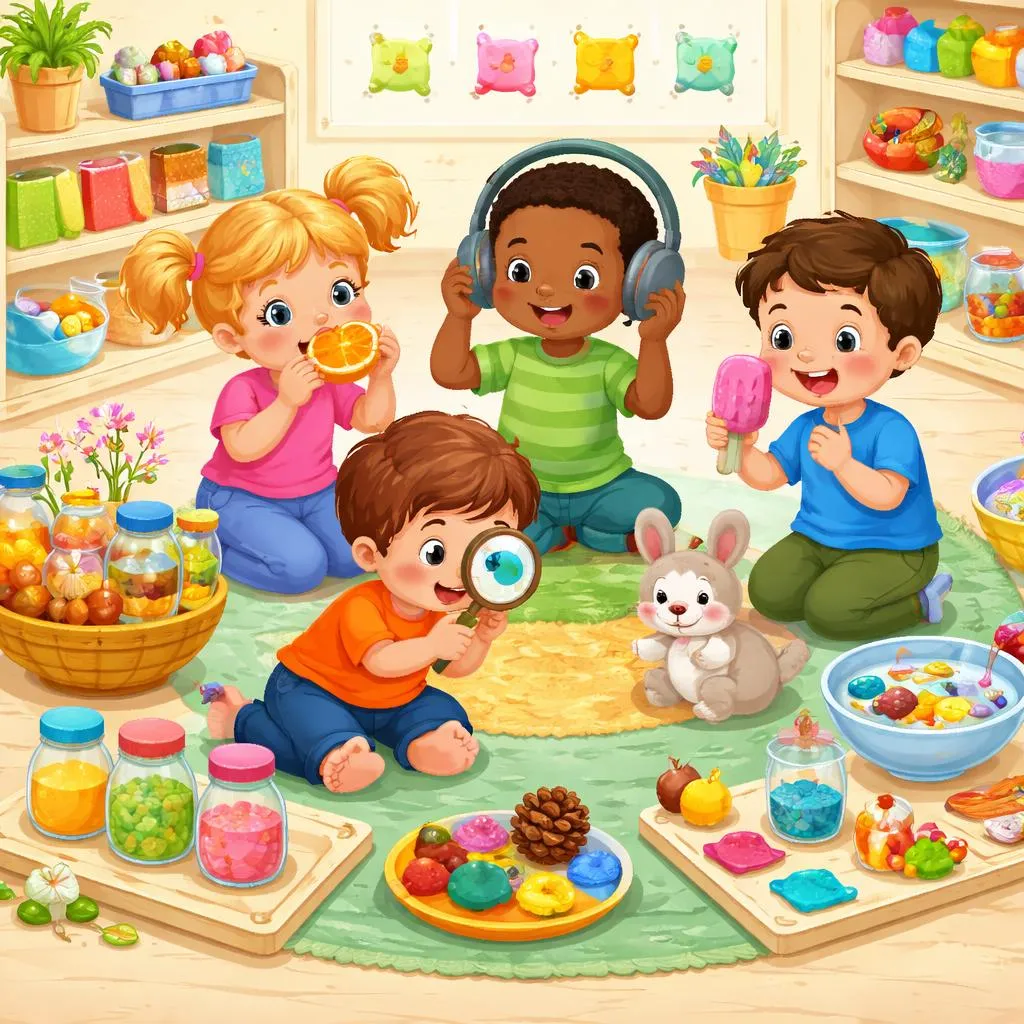

Hello, wonderful teachers and parents! Welcome to our early learning classroom. Today we explore a fascinating topic for young children. We discover five senses preschool activities that make learning come alive.
Young children learn best through hands-on experiences. They need to touch, see, hear, taste, and smell the world around them. Using their senses helps them understand new words and ideas.
Let us open our minds to creative teaching. Let us plan activities that engage every sense. By the end of this lesson, planning sensory learning will feel natural and exciting.
What are the Five Senses? The five senses are how young children explore their world. Each sense gives them information about their environment. Learning the names and functions of the senses builds foundational knowledge.
Sight comes from the eyes. Children see colors, shapes, and movements. They see faces, toys, and books. Sight helps them recognize people and things.
Hearing comes from the ears. Children hear voices, music, and sounds. They hear birds singing and cars passing. Hearing helps them understand language and warnings.
Touch comes from the skin. Children feel textures, temperatures, and pressures. They feel soft blankets and rough sand. Touch helps them learn about physical properties.
Taste comes from the tongue. Children taste sweet, sour, salty, and bitter. They taste favorite foods and new flavors. Taste helps them enjoy eating and learn about safety.
Smell comes from the nose. Children smell flowers, food, and fresh air. They smell cookies baking and rain falling. Smell helps them identify things and remember experiences.
Meaning and Explanation When we talk about five senses preschool activities, we mean games and tasks designed for young children. These activities use sight, hearing, touch, taste, and smell to teach concepts.
Preschoolers learn best when multiple senses are involved. A child learning the word "apple" understands better when seeing, touching, tasting, and smelling a real apple. The word becomes connected to real experience.
These activities also develop important skills. Fine motor skills improve through touching and manipulating objects. Language skills grow as children describe what they sense. Social skills develop during group sensory play.
The activities should be simple and safe. Young children need supervision, especially with taste and smell activities. Materials should be age-appropriate and non-toxic.
Categories or Lists Let us look at different types of five senses preschool activities by category. Each sense has its own special activities.
Sight Activities Color matching games use sight. Children sort objects by color. I Spy games use sight to find hidden objects. Looking at picture books builds visual skills. Light tables with translucent objects fascinate young eyes.
Hearing Activities Listening walks use hearing. Children listen for birds, cars, and wind. Sound matching games use containers with different fillings. Musical instruments let children explore sounds. Following verbal directions builds listening skills.
Touch Activities Sensory bins use touch. Children dig in rice, beans, or sand. Feely bags contain mystery objects to identify by touch. Play dough and clay build fine motor skills. Texture boards let children feel rough, smooth, soft, and bumpy.
Taste Activities Taste test parties use taste. Children sample sweet, sour, salty, and bitter foods. Cooking activities let children taste ingredients. Fruit and vegetable tasting builds healthy habits. Blindfolded taste guessing games are fun and educational.
Smell Activities Scent jars use smell. Children guess scents like lemon, vanilla, or coffee. Scratch and sniff stickers engage the nose. Smelling herbs and spices during cooking builds vocabulary. Scented play dough adds an olfactory element.
Combination Activities These use multiple senses together. Apple tasting uses sight, touch, smell, and taste. Nature walks use all five senses. Sensory stations let children rotate through different sense experiences.
Daily Life Examples Let us see how five senses preschool activities work in daily preschool life. These examples show real learning moments.
At the sensory table, children explore colored rice. They see the bright colors. They hear the rice fall. They feel the grains on their hands. They might even smell a scented addition like cinnamon. They learn words like pour, scoop, and soft.
During snack time, children try a new fruit. They see its yellow color. They feel its smooth skin. They smell its sweet scent. They taste its juicy flesh. They learn the fruit's name and describing words like sweet and juicy.
On a nature walk, children collect leaves and pinecones. They see different colors and shapes. They hear birds and wind. They touch rough bark and smooth stones. They smell fresh grass and flowers. Nature vocabulary grows naturally.
During music time, children explore instruments. They see the shapes of drums and bells. They hear the different sounds. They feel the vibrations. They learn words like loud, soft, high, and low.
Printable Flashcards Flashcards for five senses preschool activities work best with real photos and simple words. Here are ideas for making them.
Make a set of cards for each sense. One card has a picture of an eye with the word "sight" or "see." One card has an ear with "hearing" or "hear." One card has a hand with "touch." One card has a mouth with "taste." One card has a nose with "smell."
Make another set of cards with objects. Lemon, bell, blanket, flower, cookie, drum, apple, sandpaper. Children match each object to the sense they use most. Lemon goes with taste and smell. Bell goes with hearing. Blanket goes with touch.
Make cards with action words. See, hear, touch, taste, smell. Use these to build sentences. "I see the flower." "I smell the flower." "I touch the flower."
Laminate the cards for durability in the preschool classroom. Young children handle cards roughly, so lamination helps them last longer.
Learning Activities or Games Here are many five senses preschool activities for the classroom or home. Each activity engages young learners in meaningful exploration.
Activity 1: Mystery Sound Game Collect several objects that make sounds. A bell, shaker, crinkly paper, squeaky toy. Hide them behind a screen or cloth. Make one sound at a time. Children guess what makes each sound. They learn words like bell, paper, and squeak.
Activity 2: Feely Box Cut a hole in a shoebox. Place objects inside without showing them. A feather, pinecone, piece of fur, smooth stone. Children reach in and feel. They describe how it feels. Soft, rough, smooth, bumpy. Then they guess what it is.
Activity 3: Scent Jars Fill small containers with different scents. Coffee grounds, lemon peel, vanilla extract on cotton, cinnamon sticks. Cover with cloth so children cannot see inside. They smell each one and guess the scent. Talk about smells they like and dislike.
Activity 4: Taste Test Party Prepare small samples of different foods. Sweet like apple slices. Sour like lemon wedges. Salty like pretzels. Bitter like dark chocolate. Children taste each one. They describe the flavor. They say whether they like it.
Activity 5: Color Hunt Give children a color word. Red. They search the room for red objects. They bring them to a circle. Name each object together. "A red apple." "A red crayon." This builds color words and object names.
Activity 6: Texture Walk Create a path with different textures. A soft towel, bumpy bubble wrap, smooth foil, rough sandpaper. Children walk barefoot or feel with hands. They describe how each feels. Soft, bumpy, smooth, rough.
Activity 7: Five Senses Scavenger Hunt Make a simple picture checklist. Find something soft to touch. Find something that makes a sound. Find something yellow. Find something that smells good. Children search and share what they found.
Activity 8: Sound Memory Game Make sounds with different objects. Shake rice in a container. Tap two spoons. Crumple paper. Ring a bell. Children listen carefully. Then they try to remember and name each sound in order.
Activity 9: Texture Collage Provide materials with different textures. Felt, sandpaper, cotton balls, foil, bubble wrap, fur fabric. Children glue them onto paper. They describe each texture as they work. Rough, soft, shiny, bumpy.
Activity 10: Five Senses Chart Make a large chart with five columns. See, Hear, Touch, Taste, Smell. Take children around the room or outside. Find things for each column. Draw or write them on the chart. Discuss findings together.
Activity 11: Mystery Food Tasting Have children close their eyes. Give small tastes of different foods. Apple, banana, cracker, cheese. They guess what they are eating. They describe the taste and texture. Sweet, crunchy, soft, salty.
Activity 12: Five Senses Nature Walk Go outside with a simple checklist. Look for things to see. Listen for things to hear. Find safe things to touch. Notice things to smell. If possible, taste something like a clean herb. Talk about everything afterward.
Activity 13: Sound Sorting Collect objects that make sounds. Shakers, bells, drums, whistles. Children explore the sounds. Then they sort them by type. Loud and quiet. High and low. Fast and slow. This builds comparison words.
Activity 14: Sensory Bottles Fill clear plastic bottles with different materials. Water with blue food coloring. Oil and water together. Rice with small toys inside. Glitter in water. Children shake and look. They describe what they see. Swirling, sinking, floating, sparkling.
Activity 15: Five Senses Art Give children paper divided into five sections. In each section, they draw or collage something for one sense. An eye with things they like to see. An ear with things they like to hear. This connects senses to personal experience.
Activity 16: Simple Cooking Make no-bake cookies or fruit salad. Children see ingredients change. They hear mixing sounds. They touch and shape the food. They smell it cooking. They taste the final product. They learn action words like mix, pour, and stir.
Activity 17: Sensory Bin Exploration Fill a bin with rice, beans, or sand. Add scoops, cups, and small toys. Children play and explore. They feel the texture. They hear pouring sounds. They see colors. They learn words like pour, scoop, bury, and find.
Activity 18: Five Senses Bingo Make simple bingo cards with pictures. A bell for hearing, a flower for smell, a cookie for taste. Call out descriptions. "Something you smell." Children cover the flower. This builds understanding of each sense.
Activity 19: Sound Patterns Create simple patterns with sounds. Clap, stomp, clap, stomp. Children repeat the pattern. Then they create their own patterns. This builds listening and pattern recognition.
Activity 20: Scented Play Dough Make play dough with different scents. Add peppermint extract to one batch. Add lemon extract to another. Children play and smell. They describe the scents. They learn that smell adds to the experience.
Activity 21: Mirror Play Give children small mirrors. They look at their own faces. They point to eyes, ears, nose, mouth. They make different expressions. Happy, sad, surprised. They learn body parts and emotions.
Activity 22: Feely Feet Fill shallow bins with different materials. Dry leaves, sand, water, soft fabric. Children take off shoes and socks. They step into each bin. They describe how it feels on their feet. Cool, tickly, soft, wet.
Activity 23: Listening Headphones Make simple headphones from paper. Children wear them and listen carefully. They whisper what they hear. Clock ticking, birds outside, children playing. This focuses attention on hearing.
Activity 24: Smelly Painting Add flavored drink mix powder to finger paint. Children paint and smell. The paint has fruity scents. They describe the smell while they create. This combines art and smell.
Activity 25: Five Senses Song Sing a simple song about the five senses. To the tune of "Head, Shoulders, Knees, and Toes." Eyes to see, ears to hear, nose to smell, mouth to taste, hands to touch. Sing and point to each body part.
Activity 26: Texture Matching Gather pairs of identical textured items. Two pieces of sandpaper, two pieces of fur, two smooth stones. Place one of each in a feely box. Children feel and find the matching texture outside the box.
Activity 27: Taste Sorting Provide small samples of foods. Children taste each one. Then they sort into groups. Sweet, sour, salty, bitter. Talk about favorite tastes. Which group has the most favorites?
Activity 28: Sound Walk Recording Take a recording device on a walk. Record different sounds. Birds, traffic, wind, footsteps. Play back in the classroom. Children identify each sound. This extends the learning beyond the walk.
Activity 29: Five Senses Book Staple five pages together. Label each page with a sense. Children draw or paste pictures of things they experience with that sense. Page one "I see..." Page two "I hear..." This becomes a personal book.
Activity 30: Sense Sorting Game Gather many objects. A bell, flower, apple, feather, lemon, fabric square. Children sort them by which sense they use most. Some objects may go in multiple categories. Discuss why.
Five senses preschool activities make learning joyful and meaningful. Young children understand the world through their senses. Using these activities builds vocabulary, develops observation skills, and creates lasting memories.
Every day offers opportunities for sensory learning. During meals, on walks, at play, during routines. Point out what children see, hear, touch, taste, and smell. Name these things in English. The world becomes a classroom.
Keep exploring with all the senses. Keep introducing new words for everything children experience. English comes alive through sight, hearing, touch, taste, and smell.
Happy sensing and learning, everyone