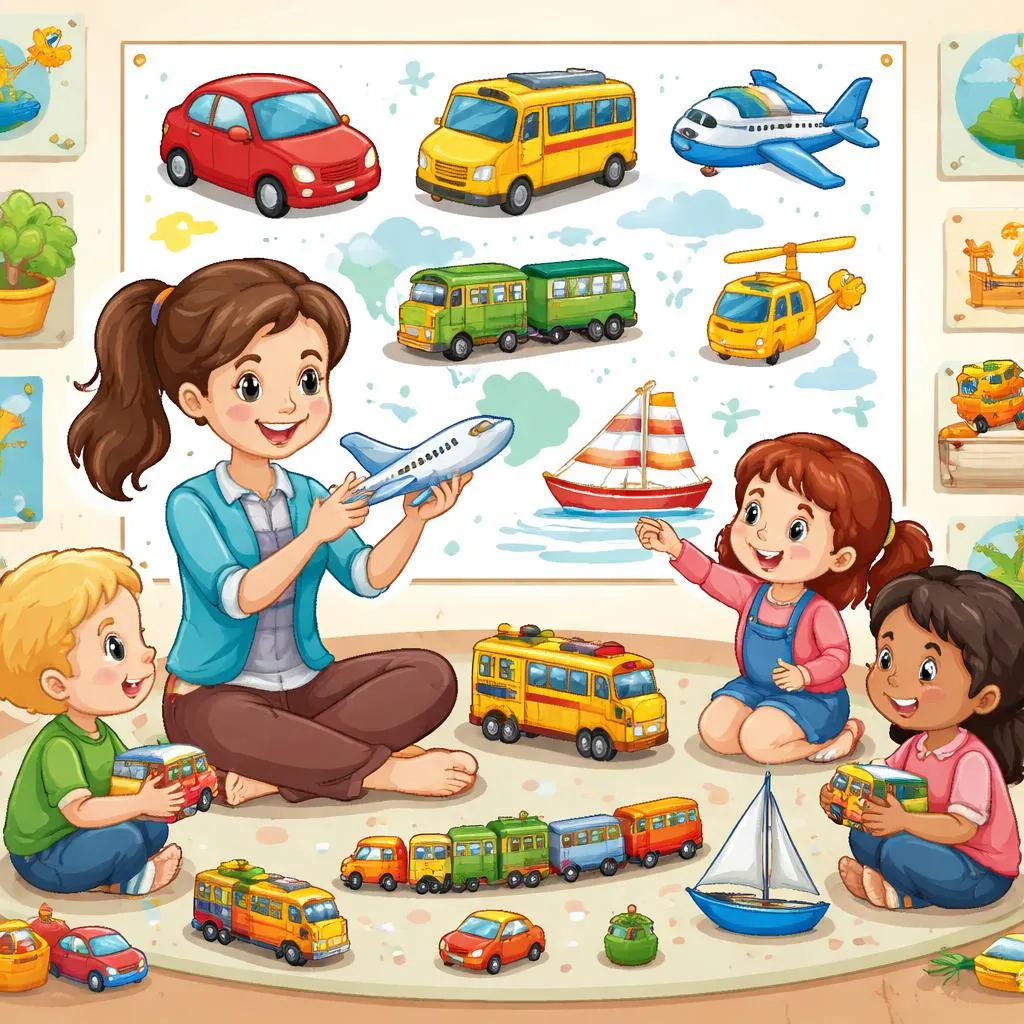

What Is The Rhyme? Many engaging nursery rhymes introduce transportation and means of transportation. A classic example is “The Wheels on the Bus.” This song is a joyful, repetitive journey. It describes different parts of a bus and the actions of its passengers. Another popular rhyme is “Row, Row, Row Your Boat,” which focuses on water travel. These songs are more than just fun melodies. They are structured lessons about movement and machines. The transportation and means of transportation theme in music makes learning dynamic. It connects vocabulary to sound, rhythm, and motion in a child’s mind.
The Lyrics of Nursery Rhymes The lyrics of nursery rhymes about transport are wonderfully descriptive. “The Wheels on the Bus” goes: “The wheels on the bus go round and round… The wipers go swish, swish, swish… The horn goes beep, beep, beep.” Each verse introduces a new part and its associated sound or action. This pattern is perfect for learning. “Row, Row, Row Your Boat” uses simple, imperative verbs: “Row, row, row your boat, gently down the stream.” The lyrics pair the means of transportation (bus, boat) with verbs (go, row) and prepositions (on, down). This creates a complete, usable language chunk.
Vocabulary Learning Learning about transportation and means of transportation builds a rich, practical vocabulary. We start with common vehicles: car, bus, train, truck, airplane, boat, bicycle, scooter. We can categorize them. Land vehicles: car, bus, train, bike. Air vehicles: airplane, helicopter. Water vehicles: boat, ship, submarine. We then learn action verbs: drive, ride, fly, sail, pedal, stop, go. We learn associated nouns: wheel, door, window, track, wing, road, sky, sea. Descriptive words are also key: fast, slow, big, small, loud, quiet. We can build sentences like, “The big, yellow bus drives on the road.”
Phonics Points Vehicle names are fantastic for phonics. We practice the /k/ sound in car. The /b/ sound in bus and boat. The /tr/ blend in train and truck. We focus on the long ‘a’ sound in plane and train. We can highlight digraphs like the ‘sh’ in ship. Many transport words are compound words, ideal for breaking down. “Air-plane” has two parts. “Bi-cycle” has two parts. “Skate-board” has two parts. We can also explore rhyming words within the theme. Boat and float. Train and plane. Clapping syllables in “he-li-cop-ter” builds phonological awareness in a fun context.
Grammar Patterns Songs and stories about transportation and means of transportation teach core grammar. We practice the preposition “by” to describe how we travel. “I go to school by bus.” “She travels by plane.” We use the present simple for routines. “The train arrives at the station.” We learn the “-ing” form with actions. “The bus is stopping.” “The plane is flying.” We can ask and answer “How?” questions. “How do you get to the park?” “I ride my bicycle.” We also practice “I see…” sentences for observation. “I see a red fire truck.” These patterns are essential for daily conversation.
Learning Activities Hands-on activities make the vocabulary stick. “Sort the Transport” is a great game. Have a large chart with three columns: Land, Air, Water. Children place picture cards of vehicles in the correct column and say, “A car goes on land.” Another is “Act It Out.” One child mimics the sound and motion of a vehicle. Others guess, “You are an airplane!” Also, create a “Class Travel Survey.” Ask each child, “How do you come to school?” Chart the results using words and pictures, practicing “by car,” “by bus,” “on foot.”
Printable Materials Printable resources offer visual and tactile reinforcement. Create “Transportation Flashcards” with a picture on one side and the word on the back. Design a “My Journey to School” mini-book. Each page has a sentence starter: “I see a __ on my way.” Children draw and write the vehicle. A “Matching Wheels” worksheet is fun. Have different vehicle bodies and separate wheels with numbers or letters. Children match them while saying the vehicle name. “Color-by-Transport” sheets, where a color key corresponds to different vehicles, combine art and vocabulary.
Educational Games Games turn practice into playful learning. “Red Light, Green Light” is a classic adapted for verbs. When the leader says “green light,” children move like a vehicle (e.g., chug like a train). When they say “red light,” everyone stops. “Transportation Bingo” is always popular. Use picture bingo cards. The caller gives a clue: “This vehicle flies in the sky.” Players mark the airplane. For a building game, use blocks to create a “city.” Children add toy vehicles, describing their actions. “The blue car is driving on the road.”
Exploring transportation and means of transportation is a journey into a child’s everyday world. It provides a tangible, exciting context for learning English. The sounds, movements, and images associated with vehicles are inherently captivating. By channeling this natural interest through songs, categorization, and play, we build a robust and active vocabulary. Children learn not just to name a truck, but to describe how it moves, where it goes, and what sound it makes. This holistic approach moves words from a static list into dynamic language for storytelling, questioning, and imagining. It fuels curiosity about the wider world while building the English skills to describe it, one vehicle at a time.