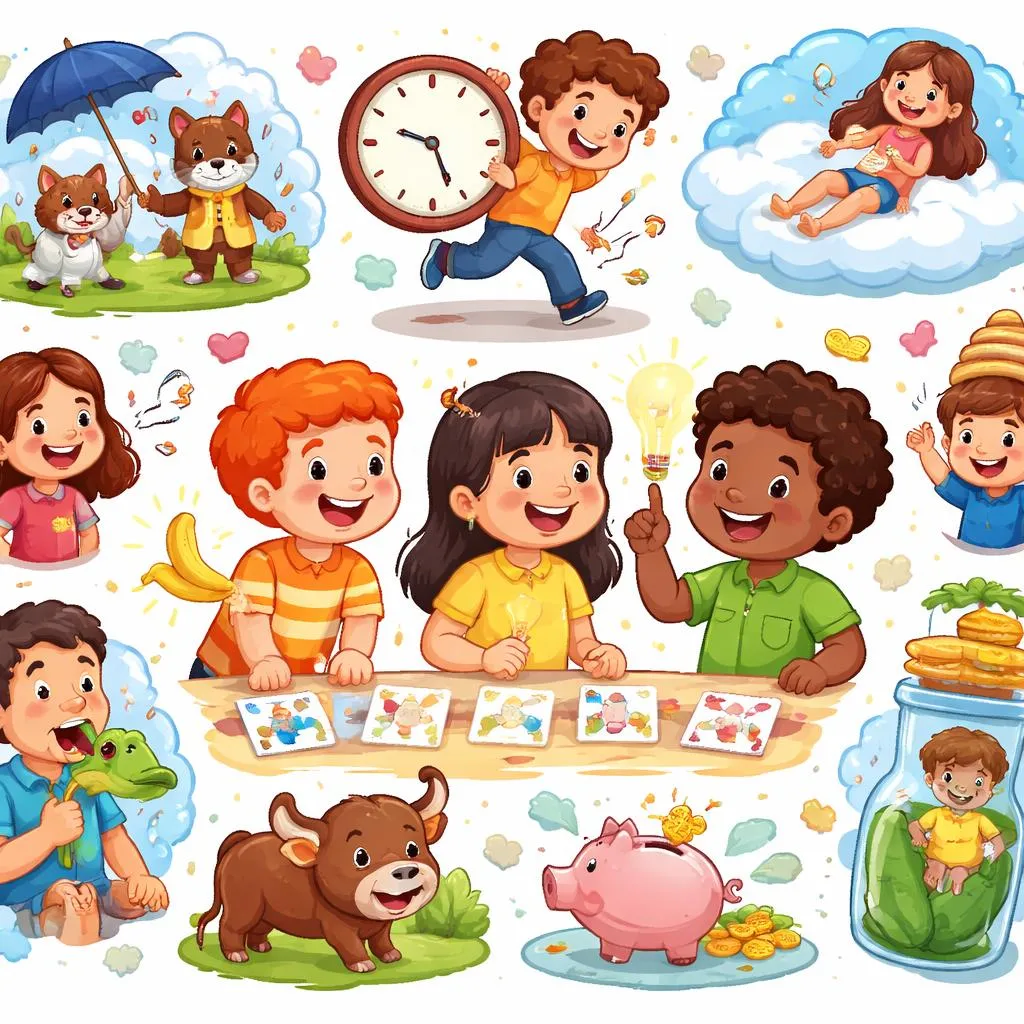

Teaching language to young learners is always an adventure. We start with simple words like cat, run, and happy. But soon, we encounter phrases that do not mean what they say. These are idioms. Today, we are going to explore how to introduce idioms for kids in a way that makes sense and brings laughter to the classroom. We will break down these tricky phrases into fun, understandable lessons.
What Are Idioms? Let us start with the basic question. An idiom is a phrase or expression. It has a figurative meaning. This meaning is different from the literal meaning of the words. When we say "it is raining cats and dogs," we do not mean animals are falling from the sky. We mean it is raining very hard.
For children, this concept can be confusing at first. They are used to words meaning exactly what they say. Our job is to guide them into this new world of colorful language. We show them that idioms add fun and flavor to English. They make our speech more interesting and expressive.
Meaning and Explanation of Idioms How do we explain this idea to a child? I like to use a simple comparison. I tell my students that idioms are like secret codes. The words give us one picture in our heads. But the real meaning gives us a different picture. It is like a puzzle we solve together.
We can start with a very common idiom. Take "hold your horses." Literally, it means to stop horses from moving. But when we say it to a friend, we mean "wait a minute" or "slow down." We ask the children to imagine someone pulling on reins to stop horses. Then we connect that image to stopping ourselves from rushing. The picture helps them remember the meaning.
Categories or Lists of Easy Idioms To make learning manageable, we can group idioms by theme. This helps children see patterns. Here are some categories that work well for young learners.
Animal Idioms: These are very popular. We have "cry wolf" meaning to call for help when not needed. We have "let the cat out of the bag" meaning to tell a secret. We have "butterflies in my stomach" meaning feeling nervous.
Body Part Idioms: These use parts of the body. "Cost an arm and a leg" means something is very expensive. "Keep an eye on" means to watch carefully. "Pull someone's leg" means to joke or tease.
Food Idioms: These are fun and relatable. "Spill the beans" means to tell a secret. "Piece of cake" means something is very easy. "Apple of my eye" means someone is very special to you.
Weather Idioms: These use weather words. "Under the weather" means feeling sick. "Chase rainbows" means to pursue impossible dreams. "Storm in a teacup" means making a big deal over something small.
Daily Life Examples of Idioms The best way to learn idioms is to hear them in context. We can use them naturally in our daily classroom talk. When a child finishes a puzzle quickly, we can say, "Wow, that was a piece of cake for you!" When someone is rushing, we can say gently, "Hold your horses, we have plenty of time."
During story time, we can point out idioms in books. Many children's books use idioms for humor. We pause when we find one. We ask the children what they think it means. Then we explain the real meaning. We connect it to the story. This shows how idioms bring characters and situations to life.
Printable Flashcards for Idioms Flashcards for idioms need to be special. A simple word card will not work. We need pictures that show both the literal and figurative meanings. This helps children see the contrast.
On one side of the card, we can draw the literal meaning. For "it is raining cats and dogs," we draw cats and dogs falling from clouds. On the other side, we write the meaning: "It is raining very hard." On the back, we can also include a simple sentence example. "We cannot play outside because it is raining cats and dogs."
When we show these cards, children laugh at the silly literal pictures. That laughter helps the meaning stick in their memory. They remember the joke and the real meaning together.
Learning Activities or Games for Idioms Games make idiom learning active and social. Here are some activities that work well in the classroom.
Idiom Charades: This is a favorite game. We write idioms on small slips of paper. A child picks a slip and acts out the literal meaning. For "hold your horses," they might pretend to pull on reins. The other children guess the idiom. Then we discuss what it really means. This physical connection helps memory.
Draw the Idiom: Give each child an idiom. Ask them to draw the literal meaning on paper. For "butterflies in my stomach," they draw a tummy with butterflies inside. For "cry wolf," they draw a boy shouting at sheep. Then we display the drawings. Everyone guesses the idiom from the picture. This combines art with language learning.
Idiom Matching Game: Create cards in two colors. On one color, write the idioms. On the other color, write the meanings. Mix them up. Children take turns flipping two cards. They try to match the idiom with its correct meaning. When they find a match, they keep the pair. The child with the most pairs wins.
Story Building: Start a story using an idiom. "Yesterday, I had butterflies in my stomach because..." Then we go around the circle. Each child adds one sentence. They must include an idiom in their part. This builds creative thinking and idiom use together.
Why Idioms Matter in Language Learning Teaching idioms for kids is about more than just funny phrases. Idioms are a big part of real English. Native speakers use them all the time in conversation, TV shows, and books. If children only know literal language, they will feel lost when they hear these expressions.
Learning idioms also builds cultural understanding. Many idioms come from history or old stories. When we explain where an idiom comes from, we share a piece of culture. For example, "let the cat out of the bag" comes from an old market trick. Sellers would put a cat in a bag and pretend it was a pig. When someone let the cat out, the trick was revealed. These stories fascinate children.
Common Challenges and How to Help Children will face some challenges with idioms. The biggest one is taking them literally. A child might hear "break a leg" before a performance and feel scared. We need to prepare them for these situations.
We can create a safe space for questions. We tell children that if they hear a strange phrase, they should ask. "What does that mean?" We can make this a class rule. No question is silly. Every idiom is a chance to learn something new.
Another challenge is remembering the meanings. There are so many idioms in English. We do not need to teach them all at once. We introduce a few each week. We review them often. We use them in our daily talk. Repetition is the key to mastery.
Using Stories to Teach Idioms Stories are the perfect vehicle for idiom learning. In a story, idioms have context. They belong to characters and situations. This makes them easier to understand and remember.
We can find books that specifically feature idioms. "Amelia Bedelia" books are wonderful for this. The main character takes everything literally. She "dresses the chicken" by putting clothes on it. Children laugh at her mistakes. But through laughter, they learn the difference between literal and figurative language.
We can also write our own class stories. We challenge ourselves to include as many idioms as possible. "Once upon a time, a girl who was feeling under the weather went to the market. There, she saw something that cost an arm and a leg. She wanted to buy it, but she remembered her mother's words about saving money..." The children love creating these silly stories together.
As we explore the colorful world of idioms for kids, we remember that patience and fun are our best tools. Some idioms will be easy for children to grasp. Others will take time. We provide rich examples, playful games, and lots of laughter. Gradually, these secret codes of English will become familiar friends in their language journey.