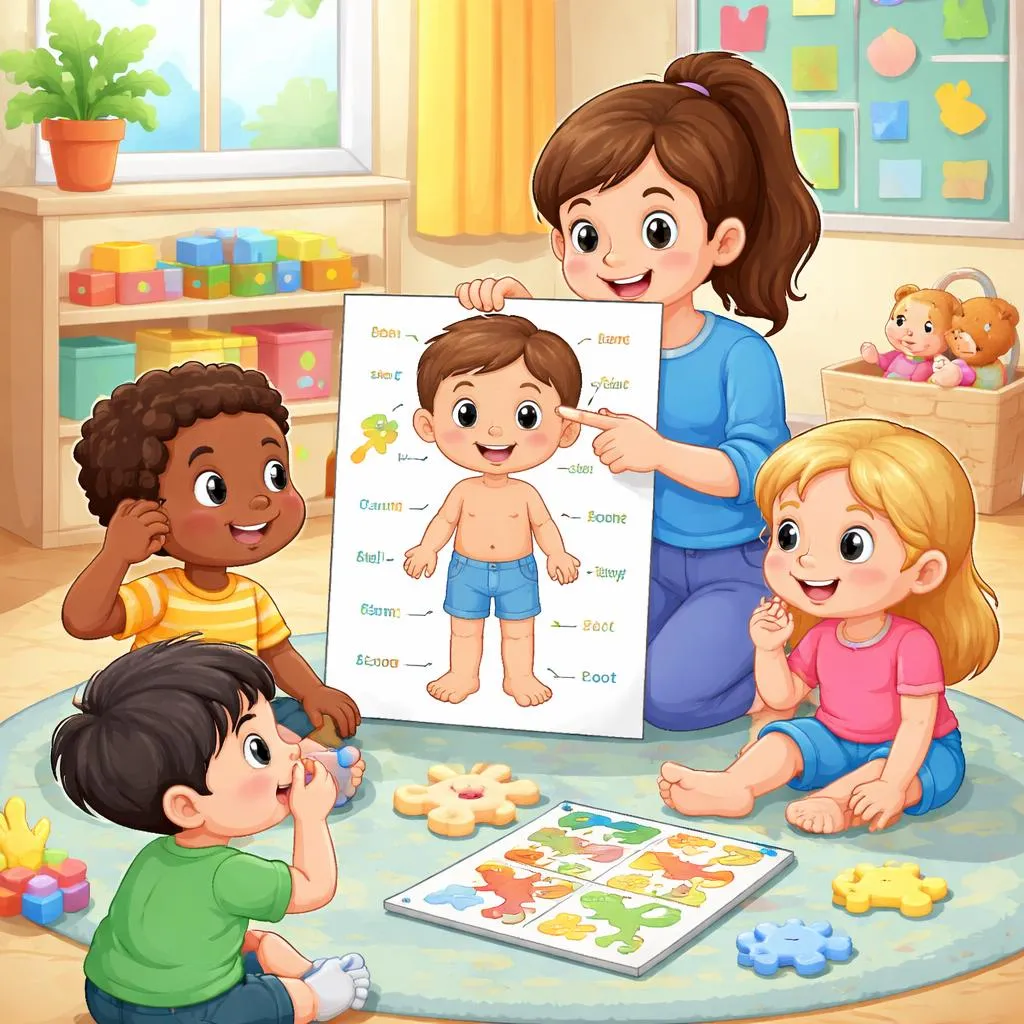

Teaching children about their own bodies is one of the most natural and engaging topics in early education. Every child has a body. Every child uses their body all day long. This makes body parts the perfect subject for language learning. Today, we are going to explore how to help children learn body parts in English using methods that are fun, memorable, and effective.
What Are Body Parts? Let us start with the basic question. Body parts are the different pieces that make up our physical selves. We have external parts we can see like arms and legs. We have parts on our face like eyes and nose. We have internal parts we cannot see like the heart and lungs.
Learning body parts gives children words to talk about themselves. They can say where something hurts. They can follow instructions like "raise your hand" or "close your eyes." They can describe what they see on others. This vocabulary is essential for daily life.
The topic also connects to other learning areas. We can count body parts for math. We can sing about body parts for music. We can draw body parts for art. Body parts become a theme that runs through many subjects.
Meaning and Explanation of Body Parts How do we explain body parts to young children? We start with what they can see and touch. We point to our own nose and say "nose." We touch a child's arm and say "arm." The connection between the word and the body part becomes clear through direct experience.
We can explain that each body part has a job. Eyes help us see the beautiful world. Ears help us hear music and voices. Hands help us hold things and clap. Feet help us stand and walk. This functional explanation makes the vocabulary meaningful.
We can also talk about how many of each part we have. We have one nose. We have two eyes. We have ten fingers. This connects body parts to counting and numbers.
Categories or Lists of Body Parts To make learning organized, we can group body parts into categories. This helps children build their vocabulary step by step.
Head and Face Parts: These are the parts on top of our body. Hair covers our head. Eyes help us see. Ears help us hear. Nose helps us smell. Mouth helps us eat and speak. Teeth help us chew. Tongue helps us taste. Cheeks are the sides of our face. Chin is below our mouth.
Upper Body Parts: These are parts from our shoulders to our waist. Shoulders connect our arms to our body. Arms hang from our shoulders. Elbows bend in the middle of our arms. Wrists connect arms to hands. Hands have fingers. Fingers have knuckles and nails. Chest is the front of our upper body. Back is the rear of our upper body.
Lower Body Parts: These are parts from our waist down. Hips connect our legs to our body. Legs support us when we stand. Knees bend in the middle of our legs. Ankles connect legs to feet. Feet have toes. Toes have nails. Heels are the back of our feet.
Full Body Parts: Some parts span the whole body. Skin covers everything. Bones give us structure. Muscles help us move. Blood flows through our body. These are more advanced concepts for older children.
Daily Life Examples of Body Parts The best way to learn body parts is to use them throughout the day. Every routine offers opportunities to name and talk about body parts.
During morning dressing, we talk about what we put on each part. "Pants go on your legs. Shirt goes on your arms and chest. Socks go on your feet. Hat goes on your head."
During meals, we talk about the parts we use. "We use our hands to hold the spoon. We use our mouth to eat the food. We use our teeth to chew. We use our tongue to taste."
During bath time, we wash each part. "Wash your arms. Wash your legs. Wash your feet. Wash your tummy." This makes the learning practical and routine.
During play, we notice what parts we use. "You are using your legs to run. You are using your arms to throw the ball. You are using your eyes to watch the game."
Printable Flashcards for Body Parts Flashcards are a classic tool for vocabulary building. For body parts, we want clear images that show exactly one part at a time.
A good body parts flashcard shows the part highlighted. For "nose," we see a face with the nose circled or pointed to. For "hand," we see a hand with fingers spread. The word is written clearly below the image.
We can use these cards in many ways. Hold up a card and ask children to point to that part on themselves. "Where is your nose?" Hold up a card and ask children to say the word. Point to a part on your own body and ask children to find the matching card.
Learning Activities or Games for Body Parts Games make learning about bodies active and joyful. Here are some activities that work well in the classroom or at home.
Simon Says with Body Parts: This classic game is perfect for body part vocabulary. Give commands like "Simon says touch your nose" or "Simon says wiggle your fingers." If you do not say "Simon says," children should not move. This builds listening skills along with body awareness.
Body Part Dance: Play some fun music. When the music stops, call out a body part. Children must freeze and point to that part. "Elbow!" Everyone freezes with a hand on their elbow. This adds physical response to vocabulary practice.
Mr. Potato Head Game: Use a Mr. Potato Head toy or a similar build-a-face toy. Children take turns adding parts. "Put on the eyes. Put on the nose. Put on the ears." This teaches the names in a playful, hands-on context.
Body Part Song: Sing "Head, Shoulders, Knees, and Toes" together. Touch each part as you sing it. Sing it slowly at first, then faster and faster. The physical movement helps cement the words in memory.
Draw a Friend: Pair up children with large paper. One child lies down while the other traces around them. Then together they draw in the details. They add eyes, nose, mouth, hair, fingers, and toes. Then they can label the parts together.
Body Part Bingo: Create bingo cards with pictures of different body parts. Call out the names. Children cover the matching picture. This builds listening and recognition skills.
Teaching One-to-One Correspondence When learning body parts, children also learn about numbers. We have one nose, one mouth, one head. We have two eyes, two ears, two arms, two legs. We have ten fingers and ten toes.
We can practice counting body parts. "Let us count your fingers. One, two, three, four, five, six, seven, eight, nine, ten." "How many eyes do you have? Two!" This connects body vocabulary with early math skills.
We can also talk about symmetry. Many body parts come in pairs. Our left and right sides match. This introduces concepts of left and right along with body parts.
Songs and Rhymes for Body Parts Music is a powerful memory tool for body parts. Many children's songs focus on this topic.
"Head, Shoulders, Knees, and Toes" is the most famous. It names eight body parts in sequence. Children touch each part as they sing. The song can go faster and faster for fun.
"If You're Happy and You Know It" can be adapted. "If you're happy and you know it, touch your nose." "If you're happy and you know it, wiggle your toes." This adds variety to body part practice.
"Hokey Pokey" teaches right and left along with body parts. "You put your right hand in. You put your right hand out." This adds direction words to body vocabulary.
We sing these songs often. The combination of music, movement, and repetition creates strong learning connections.
Books About Body Parts Picture books are wonderful for reinforcing body part vocabulary. Many books focus on the body in engaging ways.
"From Head to Toe" by Eric Carle is a perfect choice. Animals do different movements, and children copy them. "I am a penguin and I turn my head. Can you do it?" Children respond, "I can do it!" This builds vocabulary through action.
"Parts" by Tedd Arnold is a funny book about a boy who thinks his body is falling apart. It introduces body parts in a humorous context that older children enjoy.
"We're Different, We're the Same" by Bobbi Kates celebrates diversity while teaching body parts. Children see that everyone has the same parts, but they look different.
While reading, we pause and point to parts in the illustrations. We ask children to point to the same part on themselves. This connects the book to their own bodies.
Learning Through Movement Young children learn best when they move. Body parts vocabulary is perfect for kinesthetic learning. We can create movement activities that reinforce the words.
Give simple movement instructions. "Wave your hands. Stamp your feet. Shake your head. Wiggle your fingers. Bend your knees. Roll your shoulders." Children follow along, connecting the words to actions.
Create a body part freeze dance. Play music while children move around. When the music stops, call out a body part. Children must freeze and touch that part with their hand.
Play follow the leader with body movements. The leader does an action like touching their elbow. Everyone copies and says, "I am touching my elbow." This builds both receptive and expressive vocabulary.
Making It Personal The most powerful learning happens when children connect vocabulary to themselves. We create opportunities for this personal connection.
We use mirrors. Children look at themselves and name what they see. "I see my brown eyes. I see my curly hair. I see my small ears." This self-observation makes the learning deeply personal.
We trace hands and feet. Children place their hands on paper while we trace around them. They count the fingers. They compare hand sizes. They label the parts: palm, fingers, thumb, nails.
We make life-size body outlines. Children lie on large paper while we trace them. Then they fill in the details. They draw eyes, nose, mouth, and hair. They add clothes. They label the parts they know.
These personal projects become treasured keepsakes. Children return to them again and again, reinforcing the vocabulary each time.
As we help children learn body parts, we remember that this knowledge is fundamental. It gives them words to talk about themselves. It helps them understand instructions. It builds body awareness and confidence. Through songs, games, books, and daily routines, we make this learning natural and joyful. The body becomes not just something they have, but something they can talk about, understand, and appreciate.