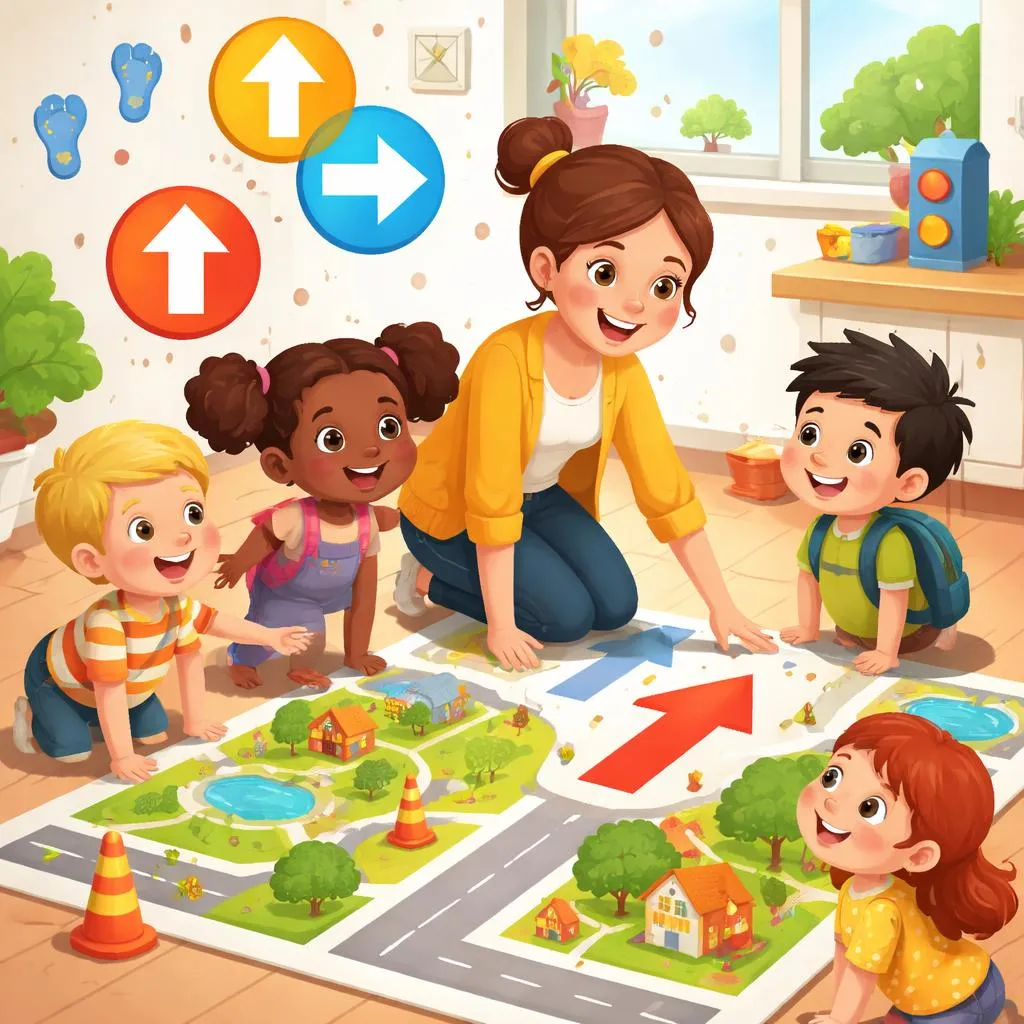

Teaching children how to give and understand directions is an essential life skill. Knowing how to describe where things are helps children navigate their world. It also builds important language skills they will use throughout their lives. Today, we are going to explore how to teach directions in English using methods that are clear, practical, and fun for young learners.
What Are Directions? Let us start with the basic concept. Directions are instructions that tell us how to get from one place to another. They also describe where things are located. When someone says "turn left at the corner," they are giving a direction. When someone says "the book is on the table," they are describing location.
Learning directions involves several types of language. We use position words like in, on, under, and behind. We use movement words like go, turn, walk, and stop. We use location words like left, right, straight, and corner. Together, these words help us describe and understand space.
Directions are important for daily life. Children need to follow directions at school. They need to understand where to find things. As they grow, they need to give directions to others. This vocabulary builds independence and confidence.
Meaning and Explanation of Directions How do we explain directions to young children? We start with their own bodies. We teach left and right by having them hold up their hands. We put a sticker on their right hand to help them remember. We practice by asking them to raise their left hand or wiggle their right foot.
We teach position words with real objects. We put a toy on a table and say "on." We put it under the table and say "under." We put it behind a book and say "behind." The child sees the relationship between the words and the actual positions.
We teach movement words through action. We walk forward and say "straight." We turn and say "left" or "right." We stop and say "stop." Children learn by doing the actions themselves while hearing the words.
Categories or Lists of Direction Words To make learning organized, we can group direction words into categories. This helps children build their vocabulary step by step.
Position Words: These words describe where something is in relation to something else. In, on, under, over, behind, in front of, next to, between, above, below, inside, outside. These are essential for describing locations.
Movement Words: These words describe how to move from one place to another. Go, come, walk, run, turn, stop, continue, enter, exit, cross, follow. These tell us what action to take.
Direction Words: These words specify which way to go. Left, right, straight, forward, backward, up, down, north, south, east, west. These give the specific path to follow.
Landmark Words: These words describe things we see along the way. Corner, traffic light, intersection, bridge, tunnel, sidewalk, road, street, building, park. These help identify where to make changes.
Daily Life Examples of Directions The best way to learn directions is to use them in daily life. Every day offers opportunities to practice giving and following directions.
During classroom transitions, we give directions. "Please line up by the door." "Walk quietly to the library." "Put your backpack in your cubby." Children follow these directions throughout the day.
During play, we give directions for games. "Run to the tree and come back." "Hide behind the slide." "Stand next to your friend." Children learn through movement and play.
During clean-up time, we give location directions. "Put the blocks in the blue bin." "Place the books on the shelf." "Put the crayons in the box." This connects directions to real tasks.
During snack time, we give position directions. "Put your cup on the table." "Place your napkin under your chin." "Sit next to your friend." These are simple but meaningful practice.
Printable Flashcards for Directions Flashcards are excellent for teaching direction vocabulary. For position words, we need cards that clearly show the relationship.
A card for "on" shows a ball on a table. A card for "under" shows the same ball under the table. A card for "behind" shows a child behind a chair. The contrast between cards helps children understand the meaning.
For movement words, we use arrows and simple figures. A card for "left" shows an arrow pointing left. A card for "right" shows an arrow pointing right. A card for "straight" shows an arrow pointing forward.
For landmark words, we use clear pictures. A corner where two streets meet. A traffic light with red, yellow, and green lights. A bridge over water. These help children recognize these features in their environment.
Learning Activities or Games for Directions Games make learning directions active and engaging. Here are some activities that work well in the classroom.
Simon Says with Directions: This classic game is perfect for direction practice. "Simon says turn to the left. Simon says take two steps forward. Simon says point to the right." This builds listening and movement skills together.
Treasure Hunt: Hide a small treasure somewhere in the room. Give children directions to find it. "Start at the door. Take three steps forward. Turn left. Look under the red chair." Children follow the directions step by step to find the treasure.
Map Making: Create a simple map of the classroom or playground. Mark important spots like the door, the teacher's desk, and the bookshelf. Ask children to trace paths on the map. "Show me how to get from the door to the bookshelf." This builds spatial thinking.
Follow the Leader: One child is the leader and gives directions. "Turn right. Walk straight. Stop. Turn left." The other children follow exactly. Then switch leaders. This builds confidence in giving and following directions.
Direction Obstacle Course: Set up an obstacle course with chairs, tables, and other objects. Give children directions to navigate through it. "Go under the table. Go around the chair. Go over the cushion." Children move through the course following the directions.
Blindfold Game: One child wears a blindfold. Another child gives directions to guide them to a target. "Take two steps forward. Stop. Turn right. Take one step." This builds trust and careful communication.
Teaching Left and Right Left and right are often the most challenging direction words for children. They require consistent practice over time.
We start by labeling their hands. We put a sticker on the right hand. We practice raising right hands throughout the day. "Show me your right hand. Wave your right hand. Point with your right hand."
We sing songs that use left and right. The "Hokey Pokey" is perfect for this. "You put your right hand in. You put your left hand in." The song reinforces the words with movement.
We play games that require left and right decisions. "Hop on your left foot. Tap your right knee. Look over your left shoulder." The more children use the words, the more automatic they become.
Teaching Prepositions of Place Prepositions like in, on, under, and behind are fundamental for describing location. These words appear constantly in directions.
We teach these through hands-on activities. Give each child a small object like a toy car. Give directions for where to place it. "Put the car on your head. Put the car under your chair. Put the car behind your back." The physical action reinforces the meaning.
We play "Where Is It?" games. Hide an object while children cover their eyes. Then give clues using prepositions. "It is under something red. It is behind something tall." Children search based on the clues.
We use books with clear position language. Many children's books use prepositions repeatedly. As we read, we point out the words and ask children to demonstrate. "The cat is under the table. Can you show me under?"
Teaching Cardinal Directions For older children, we can introduce north, south, east, and west. These are more abstract but useful for understanding maps.
We start with the sun. The sun rises in the east and sets in the west. We can observe this pattern over several days. We put signs on the classroom walls showing north, south, east, and west.
We teach a memory trick. "Never Eat Soggy Waffles" helps remember the order: North, East, South, West going clockwise. Or "Naughty Elephants Squirt Water" for the same order.
We use compasses if available. Children love seeing the needle point north. They can walk in different directions and watch the needle move.
Giving and Following Multi-Step Directions As children become proficient with single directions, we combine them into sequences. This builds working memory and attention.
Start with two-step directions. "Touch your nose and then turn around." "Pick up the book and put it on the shelf." Gradually increase to three and four steps.
Use games that require remembering sequences. "Simon says touch your head, turn left, and clap three times." Children must remember and perform all steps in order.
In daily routines, give multi-step directions. "Please wash your hands, get your lunch box, and sit at the table." Following these sequences prepares children for classroom expectations.
Map Skills Introducing simple maps brings all direction skills together. Children love seeing their world represented on paper.
Start with a map of the classroom. Draw simple shapes for desks, tables, and doors. Mark where different things are. Ask children to find things on the map. "Where is the reading corner? Point to it on the map."
Create maps of the playground or school. Take a walk and draw what you see. Then use the map to plan routes. "Show me the way from the classroom to the playground on our map."
Let children create their own maps. They can draw their bedroom, their house, or their neighborhood. They can explain their map to others. This builds pride and deepens understanding.
As we teach directions in English to young learners, we are giving them tools for navigating the world. They learn to understand where things are and how to get where they want to go. They learn to give clear instructions to others. Through games, songs, and daily practice, these skills become natural and automatic. The ability to give and follow directions builds independence, confidence, and a foundation for future learning about maps, geography, and spatial relationships.