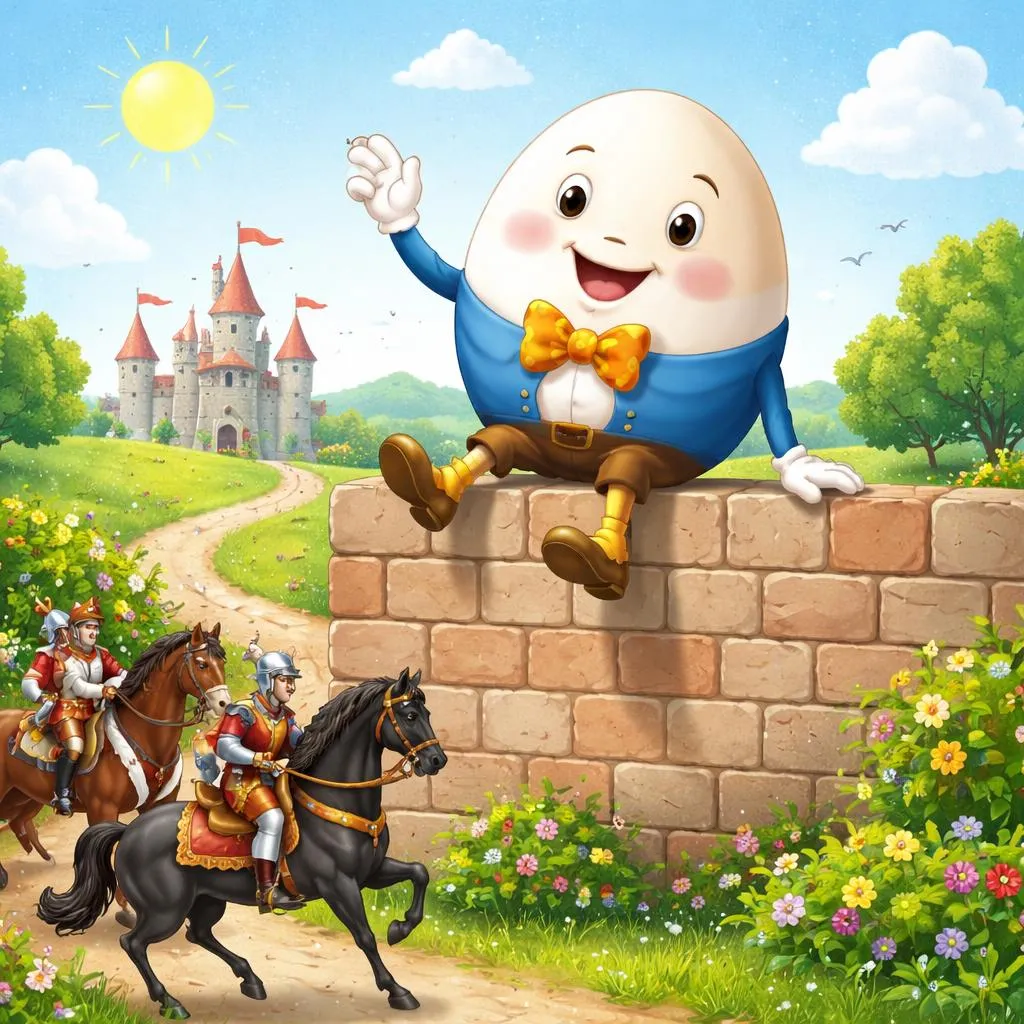

Humpty Dumpty is one of the most beloved characters in nursery rhyme history. For centuries, children have recited the tale of the egg-shaped character who had a great fall. Today, we are going to explore the classic humpty dumpty sat on a wall lyrics and discover how this simple rhyme teaches language, sequencing, and problem-solving to young learners.
What Is the Humpty Dumpty Sat on a Wall Nursery Rhyme? "Humpty Dumpty" is a traditional English nursery rhyme. It first appeared in print around 1797, but it was likely passed down orally for many years before that. The rhyme tells the story of an egg-shaped character who falls off a wall and cannot be put back together.
The rhyme is short and simple, making it perfect for even the youngest children. Its rhythm and rhyme make it easy to memorize. Children love the dramatic story of the fall and the failed attempts to fix Humpty.
Over the years, Humpty Dumpty has appeared in many stories, poems, and illustrations. He is often depicted as an egg, though the original rhyme never actually says he is an egg. This connection came later through illustrations.
The Lyrics of Humpty Dumpty Sat on a Wall Let us look at the standard humpty dumpty sat on a wall lyrics. Here is the most common version:
Humpty Dumpty sat on a wall, Humpty Dumpty had a great fall. All the king's horses and all the king's men Couldn't put Humpty together again.
That is the complete traditional rhyme. Some versions add a second verse:
Humpty Dumpty sat on the ground, Humpty Dumpty looked all around. All the king's horses and all the king's men, Tried to fix him, but failed again.
The simplicity of the rhyme is part of its charm. Four lines tell a complete story with a beginning, middle, and end.
Vocabulary Learning from the Song The humpty dumpty sat on a wall lyrics introduce several important vocabulary words.
Character Words: Humpty Dumpty is the main character. Children learn this fun name.
Action Words: Sat, had, fall, put. These simple verbs tell the story.
Place Words: Wall, ground. Children learn these location words.
People Words: King's horses, king's men. Children learn about horses and people associated with royalty.
Problem Words: Couldn't, together again. Children learn words for describing failure and repair.
Phonics Points in the Song We can use this rhyme to practice specific sounds. The repetition helps children hear and produce these sounds correctly.
The /h/ sound appears in "Humpty" and "had." This is a gentle breath sound. Children put their hands in front of their mouths and feel the air.
The /d/ sound appears in "Dumpty" and "had." This voiced sound requires the tongue behind the teeth.
The /w/ sound appears in "wall." This sound requires rounded lips.
The /g/ sound appears in "great." This sound comes from the back of the mouth.
The /f/ sound appears in "fall." This sound requires teeth on the bottom lip.
Grammar Patterns in the Lyrics The rhyme contains several important grammar patterns that children absorb naturally.
Past Tense: "Sat," "had," and "couldn't" are past tense forms. Children learn to talk about completed actions.
Proper Noun: Humpty Dumpty is a name. Children learn that special characters have special names.
Possessive Form: "King's horses" and "king's men" show possession. Children learn that adding 's shows ownership.
Negative Contraction: "Couldn't" is a contraction of "could not." Children learn this common contraction.
Prepositional Phrase: "On a wall" and "on the ground" teach prepositions of location.
Learning Activities with the Rhyme The rhyme can be the center of many engaging activities. Here are some ways to extend the learning.
Humpty Dumpty Art: Children create their own Humpty Dumpty characters. They can draw an egg with a face, arms, and legs. They can add a wall for Humpty to sit on.
Eggshell Craft: Use clean, crushed eggshells to create mosaic art. Children glue the shells onto paper to make Humpty Dumpty pictures. This connects to the egg theme.
Wall Building: Use blocks to build walls. Children place a Humpty figure on top. They knock it down and try to put Humpty back together. This builds fine motor skills.
Egg Experiment: Bring a real egg. Talk about how fragile it is. Drop it gently into a bowl to show what happens. (Do this over a bowl to avoid mess.) Children see that broken eggs cannot be fixed.
Sequencing Cards: Create cards showing the story sequence. Humpty on the wall, Humpty falling, Humpty broken, horses and men trying to fix him. Children put them in order.
Printable Materials for the Rhyme Printable resources can enhance the learning experience. Here are some materials to create.
Humpty Dumpty Puppet: Create a simple Humpty Dumpty puppet on a craft stick. Children act out the rhyme with their puppet.
Story Sequencing Cards: Create cards showing each part of the story in order. Children arrange them and retell the rhyme.
Coloring Page: Create a coloring page showing Humpty on the wall. Children color while reciting the rhyme.
Mini Song Book: Create a simple foldable book with the humpty dumpty sat on a wall lyrics and pictures. Children can "read" their book at home.
Wall Craft Template: Create a template for a brick wall. Children cut and assemble it. They can add a Humpty figure.
Educational Games with the Rhyme Games make the rhyme even more engaging. Here are some games to try.
Humpty Says: Play a version of Simon Says with Humpty. "Humpty says sit down." "Humpty says stand up." "Humpty says fall down." This builds listening and following directions.
What's Missing? Game: Recite the rhyme but leave out a word. Children guess the missing word. "Humpty Dumpty sat on a ___." What word is missing? This builds listening and memory.
Humpty Memory Match: Create pairs of Humpty-related pictures. Place them face down. Children take turns flipping two to find matches.
Build a Wall Relay: Divide children into teams. Give each team blocks. They race to build a wall tall enough for Humpty. This builds cooperation and fine motor skills.
Fix Humpty Game: Create a large Humpty puzzle. Children work together to put the pieces back together. This teaches problem-solving.
The Mystery of Humpty Dumpty The rhyme leaves many questions unanswered. Who is Humpty Dumpty? Why was he on the wall? What happened to him?
We can encourage children to think about these questions. "Why do you think Humpty was on the wall?" "How do you think he felt when he fell?" "What could have helped fix him?"
These questions build critical thinking and inference skills. Children create their own theories about the story.
Humpty Dumpty in History Humpty Dumpty may have been more than just a nursery rhyme character. Some historians think it might have been a nickname for a cannon used in the English Civil War. The cannon fell off a wall and could not be repaired.
This historical connection might be too complex for young children, but older children might find it interesting. It shows that nursery rhymes sometimes come from real events.
Egg Science The rhyme naturally leads to learning about eggs. What is inside an egg? Why are eggs fragile? How do we keep eggs safe?
We can explore egg science. Carefully examine an egg. Feel its shell. Learn that the shell protects what is inside. Talk about how baby chicks grow in eggs.
We can do an egg drop experiment. Try to protect an egg from breaking when dropped. This connects to the rhyme's theme of Humpty's fall.
Creating New Verses Children love creating new verses for familiar rhymes. This builds creativity and language skills.
What if Humpty sat somewhere else? "Humpty Dumpty sat on a chair, Humpty Dumpty fell in the air."
What if other things happened? "Humpty Dumpty sat on a bed, Humpty Dumpty bumped his head."
What if different people tried to help? "All the little children came to play, Helped Humpty have a better day."
Writing new verses together builds confidence. Children see that they can play with language.
Humpty Dumpty Books Picture books based on the rhyme reinforce the story and add new dimensions.
"Humpty Dumpty" by Daniel Kirk is a beautifully illustrated version of the classic rhyme.
"After the Fall" by Dan Santat tells the story of what happened to Humpty after his great fall. He learns to overcome his fear of heights.
"Humpty Dumpty Climbs Again" by Dave Horowitz shows Humpty getting back up after his fall.
While reading, connect to the original rhyme. "Remember the rhyme? What happened to Humpty?"
Humpty Dumpty Songs Music helps children remember the rhyme. Here is a simple tune to sing.
Humpty Dumpty Song (to the tune of "Twinkle, Twinkle"):
Humpty Dumpty sat on a wall, Humpty Dumpty had a great fall. All the king's horses and all the king's men, Couldn't put Humpty together again. Humpty Dumpty sat on a wall, Poor old Humpty had a great fall.
As we explore the humpty dumpty sat on a wall lyrics with young children, we discover a rhyme rich with learning potential. It builds vocabulary through its simple story. It teaches grammar through its repetitive structure. It develops phonemic awareness through rhyme. Most importantly, it sparks imagination and curiosity. Children wonder about Humpty, his fall, and why he couldn't be fixed. This classic rhyme will continue to delight and educate for generations to come.