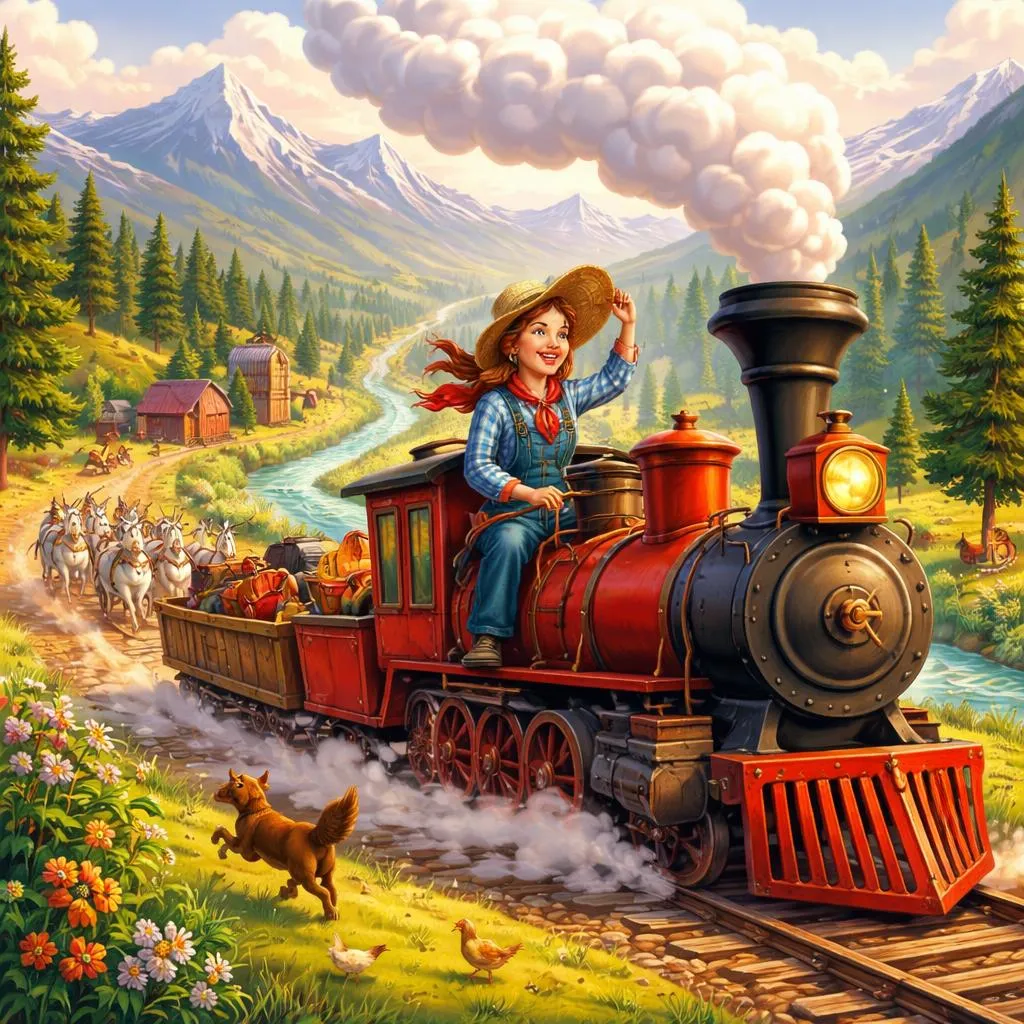

"She'll Be Coming Round the Mountain" is one of the most beloved American folk songs of all time. Children have been singing it for over a century. Its energetic rhythm and fun sound effects make it a classroom favorite. Today, we are going to explore the classic she'll be coming round the mountain lyrics and discover how this lively tune teaches language, rhythm, and cultural history.
What Is the She'll Be Coming Round the Mountain Song? "She'll Be Coming Round the Mountain" is a traditional American folk song. It dates back to the late 1800s. The song originally celebrated the coming of railroads to isolated mountain communities. People would sing about the train bringing supplies, news, and visitors from far away.
The song has a call and response structure. One person sings a line, and everyone joins in on the chorus and sound effects. This makes it perfect for group singing. Children love the repetitive pattern and the opportunity to add actions and sounds.
Over time, many verses have been added. Each verse introduces a new event or action. Children can act out each verse as they sing. This combination of music and movement makes the song unforgettable.
The Lyrics of She'll Be Coming Round the Mountain Let us look at the standard she'll be coming round the mountain lyrics. Here is the most common version:
She'll be coming round the mountain when she comes (Toot, toot!) She'll be coming round the mountain when she comes (Toot, toot!) She'll be coming round the mountain, She'll be coming round the mountain, She'll be coming round the mountain when she comes (Toot, toot!)
She'll be driving six white horses when she comes (Whoa back!) She'll be driving six white horses when she comes (Whoa back!) She'll be driving six white horses, She'll be driving six white horses, She'll be driving six white horses when she comes (Whoa back!)
Oh, we'll all go out to meet her when she comes (Hi there!) Oh, we'll all go out to meet her when she comes (Hi there!) Oh, we'll all go out to meet her, Oh, we'll all go out to meet her, Oh, we'll all go out to meet her when she comes (Hi there!)
Additional traditional verses include: Oh, we'll kill the old red rooster when she comes (Chop, chop!) Oh, we'll all have chicken and dumplings when she comes (Yum, yum!) She will have to sleep with Grandma when she comes (Snore, snore!) Oh, we'll all be singin' hallelujah when she comes (Amen!)
Each verse follows the same pattern with new words and a new sound effect.
Vocabulary Learning from the Song The she'll be coming round the mountain lyrics introduce rich vocabulary through a fun, historical context.
Transportation Words: The song is about travel. Children learn words like coming, round, mountain, driving, horses, and train-related concepts. These words build understanding of movement and transportation from an earlier time.
Animal Words: White horses and red rooster introduce animal vocabulary. Children learn to visualize these animals and connect them to the song's story.
Food Words: Chicken and dumplings introduce food vocabulary from American folk culture. This verse creates a fun image of a celebration meal.
Action Words: Coming, driving, meet, kill, sleep, sing are all action words. Children learn these verbs through the song's narrative.
Sound Effect Words: Toot, toot! Whoa back! Hi there! Chop, chop! Yum, yum! Snore, snore! Amen! These sound words are fun to say. They add excitement and help children remember each verse.
Phonics Points in the Song We can use this song to practice specific sounds. The repetition helps children hear and produce these sounds correctly.
The /sh/ sound appears in "she'll" and "she." This is a digraph where two letters make one sound. Children practice making the sound with rounded lips.
The /k/ sound appears in "coming" and "kill." This is a voiceless sound made at the back of the mouth. Children can feel the difference between /k/ and /g/.
The /h/ sound appears in "horses" and "her." This is a gentle breath sound. Children put their hands in front of their mouths and feel the air.
The /ch/ sound appears in "chicken" and "chop." This is a digraph that requires combining /t/ and /sh/. Children practice this more advanced sound.
The /m/ sound appears in "mountain" and "meet." This nasal sound requires closed lips.
Grammar Patterns in the Lyrics The song contains several important grammar patterns that children absorb naturally.
Future Tense with "Will": "She'll be coming" is a contraction of "She will be coming." This introduces the future continuous tense. Children learn to talk about actions that will happen in the future.
Contractions: "She'll" and "we'll" appear throughout. Children learn that these are shortened forms of "she will" and "we will." This builds understanding of informal English.
Present Continuous: "Coming" and "driving" are present participles. Children learn this -ing form through repetition.
Repetitive Structure: The repeated pattern "She'll be ___ when she comes" teaches sentence structure. Children internalize this pattern and can create their own verses.
Prepositional Phrases: "Round the mountain" and "out to meet her" teach prepositions of movement and location.
Learning Activities with the Song The song can be the center of many engaging activities. Here are some ways to extend the learning.
Action Verse Creation: Children create new verses for the song. What else might happen when she comes? "She'll be bringing us some presents when she comes" (Presents! Presents!) "She'll be playing us some music when she comes" (La la la!) This builds creativity and language skills.
Mountain Art: Children draw or paint pictures of mountains. They add the train coming around the mountain. They can add the six white horses. They can add the people waiting to meet her. This connects art to the song.
Train Line-Up: Children line up like a train. They chug around the room while singing. The leader makes train sounds. When they come to a curve, everyone shouts "Toot, toot!" This adds physical movement to the music.
Sound Effect Orchestra: Assign different sound effects to different groups. One group does "toot, toot!" Another does "whoa back!" Another does "yum, yum!" Another does "snore, snore!" Children listen for their part and perform at the right time.
Story Sequencing: Create picture cards for each verse. Children put them in order as the song progresses. What happens first? What happens next? This builds sequencing skills.
Printable Materials for the Song Printable resources can enhance the learning experience. Here are some materials to create.
Lyrics Poster: Create a colorful poster with the she'll be coming round the mountain lyrics. Add pictures next to key words. A mountain next to "mountain." A train whistle next to "toot, toot!" Six white horses next to that verse. Display during song time.
Verse Picture Cards: Create cards showing each verse. Six white horses, people meeting her, a red rooster, chicken and dumplings, Grandma sleeping. Children use these cards to follow along with the song.
Sound Effect Cards: Create cards with each sound effect written out. Toot, toot! Whoa back! Hi there! Chop, chop! Yum, yum! Snore, snore! Children hold up the right card when that sound effect occurs.
Mini Song Book: Create a simple foldable book with all the verses. Children can "read" their book at home. This builds pride and extends learning beyond the classroom.
Educational Games with the Song Games make the song even more engaging. Here are some games to try.
Verse Memory Game: Sing the song but leave out a word. Children guess the missing word. "She'll be coming round the ___ when she comes." What word is missing? This builds listening and memory.
Sound Effect Freeze: Sing the song. When children hear their assigned sound effect, they freeze in a pose. "Toot, toot!" might be holding a train whistle pose. "Yum, yum!" might be rubbing their tummy. "Snore, snore!" might be pretending to sleep. This builds listening and response.
Verse Sort: Write each verse on a separate strip. Mix them up. Children work together to put them in the traditional order. This builds cooperation and sequencing.
Action Charades: One child acts out a verse without singing. The others guess which verse it is. Are they driving horses? Killing a rooster? Eating chicken and dumplings? Sleeping? This builds observation and inference.
Mountain Movement: Create a path around the room with chairs and tables representing the mountain. Children follow the path while singing. When they come to a curve, they shout "Toot, toot!" This adds physical play to the music.
History and Culture Connection The song offers an opportunity to talk about American history. We can explain that long ago, trains were new and exciting. When people heard a train coming, it meant news, supplies, and visitors from far away.
Mountain communities were often isolated. The train connected them to the wider world. This is why the song celebrates the coming of the train. It brought people and things they had been waiting for.
We can show pictures of old trains. We can talk about how transportation has changed. Now we have cars and airplanes. But the excitement of someone coming to visit remains the same.
We can also discuss why the song says "she." In early train history, locomotives were often referred to as "she" in a loving way, like people refer to ships. This is a charming piece of language history.
Adding Instruments The song is perfect for adding simple instruments. Rhythm sticks can tap along with the beat. Bells can ring on the sound effects. Drums can boom on the chorus.
Children love making music with instruments. It builds rhythm skills and coordination. It also makes the song more exciting and memorable.
We can create a classroom band. Different children play different instruments at different times. This builds listening and cooperation.
Creating a Performance The song is wonderful for a class performance. Children can dress up as characters from the song. Someone can be the visitor coming on the train. Others can be the mountain community waiting.
We can create simple props. A cardboard train. Paper horses. A rooster puppet. Chicken and dumplings drawn on paper plates. A sleeping Grandma with a blanket.
Parents love seeing their children perform. The performance builds confidence and pride. It also shows families what children are learning.
As we explore the she'll be coming round the mountain lyrics with young children, we discover a song rich with learning potential. It builds vocabulary through its many verses. It teaches grammar through repetition. It develops phonics through sound effects. It connects children to American folk culture. Most importantly, it brings joy through music and movement. This old song, passed down through generations, continues to delight and educate children today.