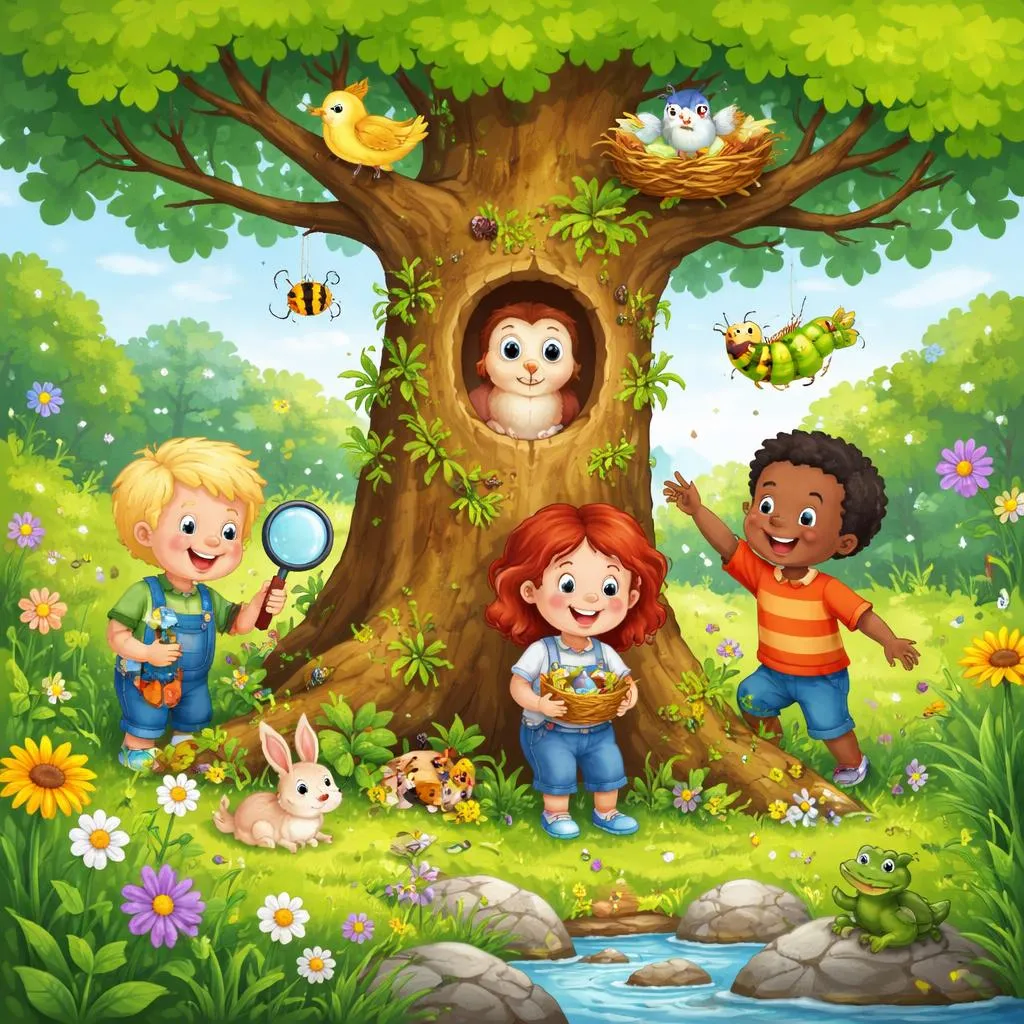

"The Green Grass Grew All Around" is a delightful cumulative folk song that has entertained children for generations. Its playful structure builds verse by verse, adding new elements to the story. Today, we are going to explore the the green grass grew all around lyrics and discover how this charming song teaches sequencing, nature vocabulary, and the joy of cumulative storytelling.
What Is The Green Grass Grew All Around Song? "The Green Grass Grew All Around" is a traditional folk song and children's favorite. It is a cumulative song, meaning each verse adds a new element while repeating all the previous ones. This structure builds anticipation and helps children remember the sequence.
The song tells the story of a tree growing in a hole in the ground. On the tree is a branch. On the branch is a twig. On the twig is a nest. In the nest is an egg. In the egg is a bird. On the bird is a feather. The song continues adding details.
Cumulative songs are wonderful for developing memory and sequencing skills. Children love the challenge of remembering all the parts in order. The repetition builds confidence as they successfully recall each verse.
The Lyrics of The Green Grass Grew All Around Let us look at the classic the green grass grew all around lyrics. Here is the standard version:
There was a hole (in the middle of the ground) The prettiest hole (that you ever did see) Well, the hole in the ground, And the green grass grew all around, all around, And the green grass grew all around.
And in that hole (there was a tree) The prettiest tree (that you ever did see) Well, the tree in the hole, And the hole in the ground, And the green grass grew all around, all around, And the green grass grew all around.
And on that tree (there was a branch) The prettiest branch (that you ever did see) Well, the branch on the tree, And the tree in the hole, And the hole in the ground, And the green grass grew all around, all around, And the green grass grew all around.
The pattern continues with:
And on that branch (there was a twig)
And on that twig (there was a nest)
And in that nest (there was an egg)
And in that egg (there was a bird)
And on that bird (there was a feather)
And on that feather (there was a bug - in some versions)
Each verse adds a new element while repeating all the previous ones in reverse order.
Vocabulary Learning from the Song The the green grass grew all around lyrics introduce rich vocabulary about nature.
Nature Words: Hole, ground, grass, tree, branch, twig, nest, egg, bird, feather, bug. Children learn the names of natural objects and living things.
Descriptive Words: Prettiest, green, all around. These adjectives add detail to the song.
Position Words: In, on, around. Children learn prepositions of location through the song's structure.
Action Words: Grew, was, see. These verbs describe what happens in the song.
Cumulative Structure Words: Well, and. These connecting words build the sequence.
Phonics Points in the Song We can use this song to practice specific sounds. The repetition helps children hear and produce these sounds correctly.
The /g/ sound appears in "grass," "green," and "grew." This voiced sound comes from the back of the mouth.
The /h/ sound appears in "hole" and "ground." This gentle breath sound requires air from the lungs.
The /t/ sound appears in "tree," "twig," and "prettiest." This quick sound requires the tongue behind the teeth.
The /b/ sound appears in "branch" and "bird." This voiced sound requires lips together.
The /f/ sound appears in "feather." This sound requires teeth on the bottom lip.
Grammar Patterns in the Lyrics The song contains several important grammar patterns that children absorb naturally.
Past Tense: "Grew" is the past tense of "grow." Children learn this irregular past tense form.
There Was/Were: "There was a hole" introduces existence. Children learn this common structure for describing what exists.
Prepositional Phrases: "In the ground," "on the tree," "in the nest" teach prepositions of location.
Superlative Adjectives: "The prettiest" teaches the superlative form. Children learn to describe something as the most of its kind.
Cumulative Structure: The repeated pattern builds sequencing skills. Children learn to organize information in order.
Learning Activities with the Song The song can be the center of many engaging activities. Here are some ways to extend the learning.
Build the Tree: Use craft materials to build each element of the song. Start with a paper ground with a hole. Add a tree, then a branch, then a twig, then a nest, then an egg, then a bird, then a feather. Children add each element as they learn the verses.
Story Sequencing Cards: Create cards showing each element of the song. Children arrange them in order from the ground up. This builds sequencing skills.
Nature Walk: Take a walk outside and look for things from the song. Can we find a tree? A branch? A nest? A feather? This connects the song to the real world.
Tree Art: Create a large tree mural. Add all the elements from the song as children learn them. The tree grows throughout the unit.
Act It Out: Children act out each part of the song. Some children are the ground. Some are the tree. Some are the branch. They build the scene together.
Printable Materials for the Song Printable resources can enhance the learning experience. Here are some materials to create.
Story Sequence Cards: Create cards showing each element in order. Ground, hole, tree, branch, twig, nest, egg, bird, feather. Children arrange them in sequence.
Coloring Pages: Create coloring pages showing the tree with all its elements. Children color while listening to the song.
Mini Song Book: Create a simple foldable book with one element on each page. Children can "read" their book at home, adding each new element.
Song Lyrics Poster: Create a colorful poster with the the green grass grew all around lyrics. Add pictures next to key words.
Element Cards: Create cards with each element name and picture. Children use them to follow along with the song.
Educational Games with the Song Games make the song even more engaging. Here are some games to try.
What's Missing? Game: Place all the element cards in order. Children close their eyes. Remove one card. They guess which element is missing.
Memory Match: Create pairs of element cards. Place them face down. Children take turns flipping two to find matches. When they find a match, they name that element.
Cumulative Memory Game: Go around the circle, each child adding one element. The first child says, "There was a hole." The second says, "There was a hole and a tree." The third says, "There was a hole, a tree, and a branch." See how long the chain can grow.
Element Scavenger Hunt: Hide pictures of the elements around the room. Children search for them and put them in order.
Build the Tree Relay: Divide children into teams. Give each team a set of element cards. They race to put them in the correct order.
The Cumulative Structure Cumulative songs are excellent for developing memory and sequencing skills. Children must remember what came before while adding something new.
The pattern in this song is especially satisfying. Each verse adds one new element at the beginning of the list. Then it repeats all the previous elements in reverse order, ending with the grass.
This structure builds anticipation. Children wait to hear their favorite parts again. They feel successful when they can recall the whole sequence.
Nature Connections The song connects beautifully to science learning about trees and habitats.
Trees have many parts. The trunk is the main stem. Branches grow from the trunk. Twigs are small branches. Nests are built by birds in trees. Eggs are laid in nests. Birds hatch from eggs. Feathers cover birds.
We can learn about real trees in our neighborhood. What kind of trees do we have? Can we see nests in them? Do we find feathers on the ground?
This connects the song to real-world observation.
Creating New Verses Children love creating new verses for cumulative songs. This builds creativity and language skills.
What else could be on the tree? A leaf, a flower, a squirrel, a caterpillar. Children suggest new elements.
What would come after the feather? In some versions, a bug is on the feather. What would the bug do? What would be on the bug?
Writing new verses together builds confidence. Children see that they can extend patterns and create new stories.
The Green Grass Grew All Around in Other Cultures Similar cumulative songs exist in many cultures. "The House That Jack Built" is another English cumulative tale. "I Know an Old Lady Who Swallowed a Fly" follows a similar pattern.
Sharing these other cumulative songs shows children that this pattern is used in many stories. They can compare how they are similar and different.
Tree Study The song can be part of a larger study of trees. What do trees need to grow? Sun, water, soil. What lives in trees? Birds, squirrels, insects. What do trees give us? Wood, shade, oxygen, fruit.
Children can learn about the parts of a tree. Roots hold the tree in the ground. Trunk carries water and nutrients. Branches reach out. Leaves make food from sunlight.
This science learning connects to the song's vocabulary.
As we explore the the green grass grew all around lyrics with young children, we discover a song rich with learning potential. It builds vocabulary through its nature words. It develops sequencing through its cumulative structure. It teaches prepositions through its position words. Most importantly, it brings joy through its playful repetition. Children chant along, build the tree in their imaginations, and feel pride in remembering the whole sequence. This classic folk song will continue to delight and educate for generations to come.