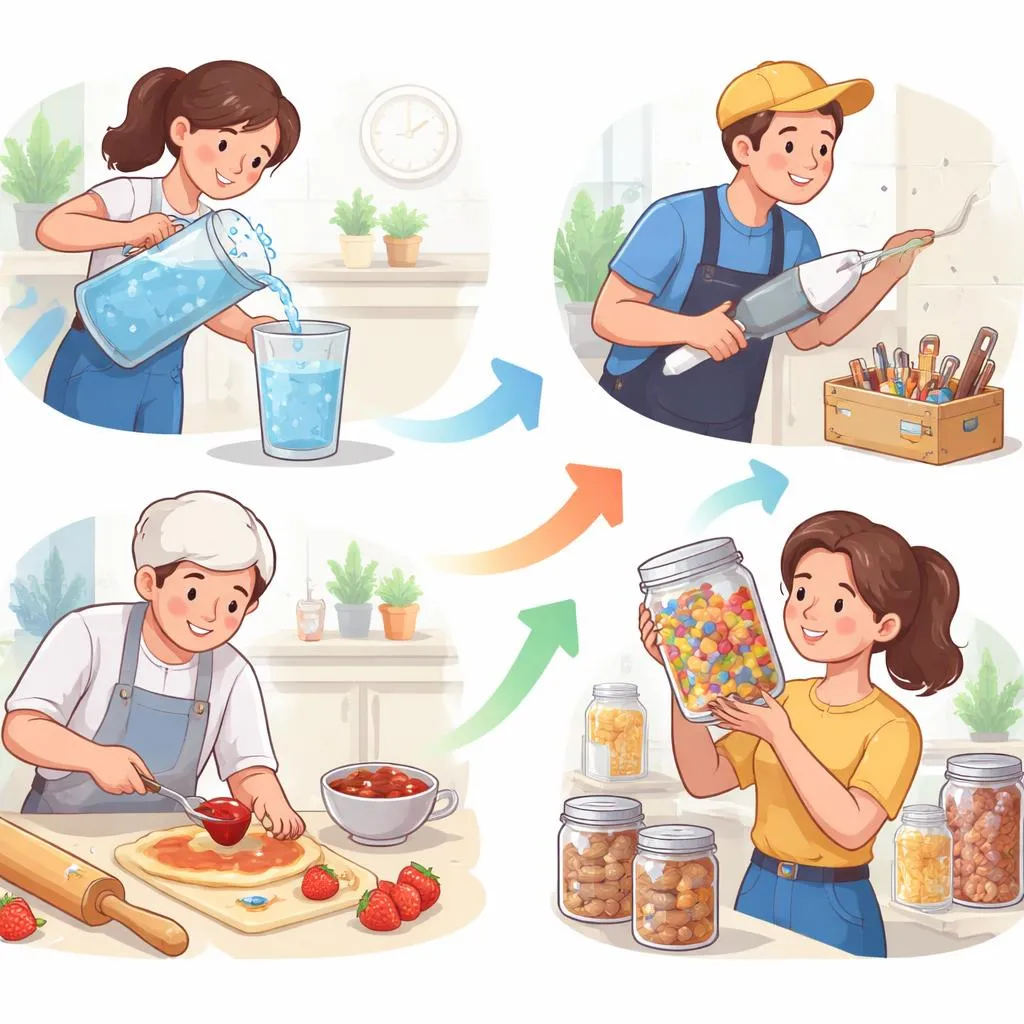

Hello, word builder! Have you ever had a glass of water? You fill the glass. The water is the filler. The action is filling. Now the glass is filled. They all talk about making something full. But they are not the same! The words fill, filler, filling, and filled are a "Word Tool Team". They all connect to putting something in. Each tool has a special use. Your job is to learn their jobs. Let's see a quick example at home.
At home, you might say: "I will fill the glass with milk." That is an action you will do. But you could also say: "The glass is filled with milk." That describes the glass's state. Which one is right? They both are! You need the right tool for the sentence job. Let's open the toolbox and start!
Adventure! Decoding the Tool Team
Welcome to the word workshop! Our four word tools are here. They share a root idea. But they are different. Meet Fill, the main action tool. It's the verb. Meet Filler, the noun for the thing that fills. Meet Filling, the noun for the material or the -ing form. Meet Filled, the past form and adjective. Let's examine their uses.
Dimension One: The Time of Action – Is It Happening, Done, or a Thing?
Some words show action in time. Others are just objects or materials. Let's check the clock.
Fill: The "Do Now" or "Will Do" Action. This is the basic action. It happens in the present or future. It is a general action. Look at "school" and "playground" examples.
School example: "We fill our backpacks with books." This is a regular action. It happens often.
Playground example: "Can you fill the bucket with sand?" This is a request for action. It will happen.
Filling: The "Right Now" Action. This word shows the action is in progress. It is happening at this very moment. It's like watching someone pour.
Home example: "She is filling the bathtub with water now." The action is ongoing. We can see it.
Animal example: "The bird is filling its nest with twigs." The action is live. It happens now.
Filled: The "Already Done" Action or State. This form points to the past. The action of filling is complete. It is finished. It can also describe the current state.
Home example: "I filled the cookie jar yesterday." The action is over. It happened earlier.
School example: "The worksheet is filled with answers." This describes the worksheet's state now.
Dimension Two: The Role Reveal – Action, Object, Material, or State?
Every word has a role. Is it the main action? Is it the thing used? Is it the material inside? Or is it a description?
Fill: The Action Tool (Verb). Its main job is to show the action of making something full. It tells us what someone or something does.
Playground example: "We fill the water balloons quickly." The word "fill" is the main action.
School example: "Please fill the blank with a word." The word "fill" is the action you are asked to do.
Filler: The Object Noun. This word is a noun. It names the substance or thing used to fill something else. It is the material that does the filling.
Home example: "The pillow's filler is soft feathers." It names the material inside the pillow.
Art example: "We used newspaper as filler in the gift box." It names the thing that fills the space.
Filling: The Material or Action Noun. This word is often a noun. It names the material inside something. It can also be the verb's -ing form for ongoing action.
As a material noun: "The pie's apple filling is sweet." This is the name of the stuff inside the pie. As a verb (ongoing action): "He is filling the tank with gas." (With "is", shows ongoing action)
Filled: The Past Action or State Adjective. This word is the past tense and past participle of "fill". It shows a completed action. It can also work as an adjective describing something that is full.
As a past action (verb): "She filled the bird feeder this morning." This tells a finished past event. As an adjective (state): "The room was filled with laughter." This describes the room's condition.
Dimension Three: The Team-Up – What Words Do They Like?
These words have favorite partners. Knowing their common "teammates" helps us use them correctly.
Fill (Verb): It often takes an object and "with". You fill something with something else. "Fill the cup with juice." It teams with helpers like "will", "can", "must".
Filler (Noun): It likes articles and prepositions. "A cotton filler", "the filler in the toy", "used as filler".
Filling (Material Noun): It is often used with possessive forms or "of". "The cake's filling", "a filling of cream".
Filling (Verb -ing): It almost always needs a helper verb. "Am/is/are filling", "was/were filling". "They are filling the pool."
Filled (Past/Participle): For simple past, it can stand alone. "I filled it." For the state, it loves "is", "was", "seems". "The bag is filled." It is also used with "with": "filled with joy".
Our Discovery Map: The Tool Team Guide
Our workshop guide is clear. Do you want to talk about the action of making something full? Use the verb fill. Do you want to name the substance that fills something? Use the noun filler. Do you want to name the material inside something (like in food)? Use the noun filling. Do you want to show the action is happening right now? Use filling with "is" or "are". Do you want to talk about the action in the past? Use filled. Do you want to describe something that is full? Use filled with "is" or "was". Remember their teams: fill takes an object and "with", filler names the material, filling is the stuff inside or the ongoing action, and filled is for the past or the state of being full.
Challenge! Become a Word Tool Master
-
Best Word Choice: Read the scene. Pick the best word. (Nature/Animal Scene) A squirrel is gathering nuts. It is putting the nuts into a hollow tree. This action is happening right now. a) The squirrel is a filler of the tree. b) The squirrel is filling the tree with nuts. Which one describes the action happening at this very moment? (Answer: b)
-
Two-Word Sentence Showdown: (Home/Kitchen Scene) Imagine helping to make a sandwich. First, use "fill" as a verb to give a command for the action. Example: "Please fill the bread with peanut butter." Now, use "filled" as an adjective to describe the sandwich you made. Example: "My sandwich is filled with yummy stuff."
-
Eagle Eye! Find the Glitch: Look at this sentence. One word form is in the wrong job. Can you fix it? (School/Art Class Scene) "We used clay as a fill for the sculpture's base." What's wrong? "Fill" is primarily a verb. When we talk about the material used to fill, we usually use the noun "filler". Fixed sentence: "We used clay as a filler for the sculpture's base." Or, "We used clay to fill the sculpture's base."
Your Takeaway and Mission! Make Your Sentences Complete
Great work, word builder! You learned the special uses of each tool. You can now choose the right word for any situation. Your sentences will be clear and accurate.
What you can learn from this article:
You now see that fill, filler, filling, and filled are a team. But each has a unique function. You learned to use "fill" for the action of making full. You use "filler" for the material that fills. You use "filling" for the material inside something or the ongoing action. You use "filled" for the past action or the state of being full. You know that "fill" is a verb, "filler" and "filling" are nouns (but filling can also be a verb), and "filled" is for the past or an adjective.
Live Practice Application:
Try this today! Look at containers. Do an action: "I will fill this bottle." Name the material: "The filler in this jacket is warm." Talk about food: "The filling in this dumpling is good." Describe a state: "The room is filled with light." When you write or speak, think: Is it the action? Use fill. Is it the stuff inside? Use filler or filling. Is it happening now? Use is filling. Is it done or a state? Use filled. Picking the right word tool makes your English complete. You are now a master of the tool team. Well done!