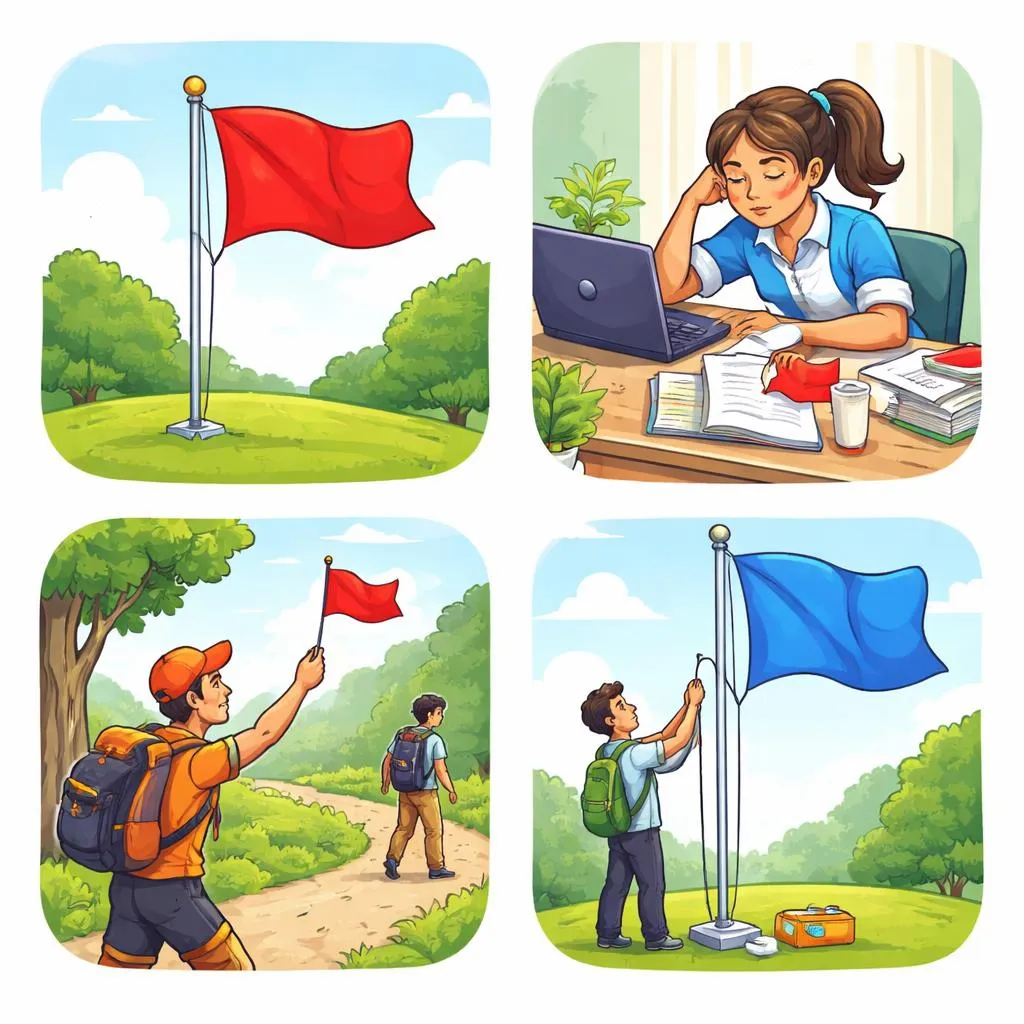

Hey there, word explorer! Look at a schoolyard. You see a colorful flag on a tall pole. A teacher flagged a mistake in your homework. A student is flagging important notes. The flagpole stands straight. They all have "flag" in them. But they are not the same! The words flag, flagged, flagging, and flagpole are a "Word Flag Team". They all connect to signals or markers. Each team member sends a different signal. Your job is to learn their signals. Let's see a quick example at school.
At school, you might say: "We raise the flag every morning." That is a thing, a noun. But you could also say: "The teacher will flag the correct answer." That is an action. Which one is right? They both are! You need the right team member for your sentence. Let's start our signal adventure!
Adventure! Decoding the Flag Team
Welcome to the word parade ground! Our four flag words are here. They share a root idea. But they are different. Meet Flag. It is a noun for a cloth symbol or a verb for marking. Meet Flagged. It is the past form of the verb. Meet Flagging. It is the -ing form of the verb. Meet Flagpole. It is a compound noun for the pole. Let's learn their signals.
Dimension One: The Time of Action – When is the Marking?
Words can show when an action happens. Is it a future plan? Is it happening now? Or is it already done? Let's check the signal clock.
Flag: The "Will Do" or "Can Do" Action. This is the basic action. It can happen in the present or future. It is a general action. Look at "school" and "playground" examples.
School example: "Please flag the page in your book." This is a request for a future action. It will happen.
Playground example: "We flag the best hiding spots." This is a present habit. It happens often.
Flagging: The "Right Now" Action. This word shows the action is in progress. It is happening at this very moment. It's like watching someone mark.
School example: "The librarian is flagging new books now." The action is ongoing. We can see it.
Nature example: "The scientist is flagging the trees for study." The action is live. It happens now.
Flagged: The "Already Done" Action. This form points to the past. The action of marking is complete. It is finished. It tells a story about before.
School example: "I flagged the errors in my report." The action is over. It happened earlier.
Playground example: "The referee flagged the player for a foul." The marking happened in the past.
Dimension Two: The Role Reveal – Object, Action, or Pole?
Every word has a role on the "parade field". Is it a thing? Is it an action? Or is it a part of the thing?
Flag: The Double-Role Word. This word has two common roles. First, as a noun. It names a piece of cloth with a design. Second, as a verb. It means to mark or signal.
As a noun (thing): "The team flag is blue and gold." Here, "flag" is the object. As a verb (action): "Flag the important dates on the calendar." Here, "flag" is the action you do.
Flagged: The Past Action. This word is the past tense and past participle of the verb "flag". It shows a completed action of marking.
Home example: "My mom flagged the recipe she likes." The action of marking is over.
School example: "The computer flagged the message as spam." The marking happened automatically.
Flagging: The Ongoing Action. This word is the -ing form of the verb "flag". It shows the action is happening now. It can also mean becoming tired, but we focus on marking.
As a verb (ongoing): "The editor is flagging grammar mistakes." (With "is", shows ongoing action)
Flagpole: The Object Noun. This word is a compound noun. It names the tall pole that holds a flag. It is a part of the flag display.
Playground example: "The school flag flies on the flagpole." It names the pole. Home example: "We have a small flagpole in our garden." It names the object.
Dimension Three: The Team-Up – What Words Do They Like?
These signals have favorite partners. Knowing their common "teammates" helps us use them correctly.
Flag (Noun): It likes articles and adjectives. "A white flag", "the national flag", "my favorite flag".
Flag (Verb): It often takes an object. "Flag the email." It teams with helpers: "will flag", "must flag".
Flagged (Past): It is used for past actions. It often has an object. "She flagged the issue."
Flagging (Verb -ing): It needs a helper verb. "Is/are flagging", "was/were flagging". "He is flagging the locations."
Flagpole (Noun): It likes articles and adjectives. "A tall flagpole", "the metal flagpole", "on the flagpole".
Our Discovery Map: The Flag Team Guide
Our parade guide is clear. Do you need to name the cloth symbol? Use the noun flag. Do you want to talk about the action of marking or signaling? Use the verb flag. Do you want to talk about that action in the past? Use flagged. Do you want to show the action is happening now? Use flagging with "is" or "are". Do you want to talk about the pole that holds the flag? Use the noun flagpole. Remember, flag is the symbol or the action. Flagged is the past marking. Flagging is the ongoing marking. Flagpole is the pole. Their partners help them: the noun flag needs "a" or "the", the verb flag takes an object, and flagging as a verb needs "is".
Challenge! Become a Word Flag Master
-
Best Word Choice: Read the scene. Pick the best word. (Nature/Animal Scene) A researcher in a forest puts a bright piece of cloth on a tree to mark it for later study. This action is complete. a) The researcher is flagging the tree. b) The researcher flagged the tree. Which one describes the action that is already finished? (Answer: b)
-
Two-Word Sentence Showdown: (School/Project Scene) Imagine you are organizing your science notes. First, use the verb in its -ing form to describe what you are doing now. Example: "I am flagging the key facts with sticky notes." Now, use the noun to talk about the object you see at the front of the class. Example: "Our class flag is in the corner."
-
Eagle Eye! Find the Glitch: Look at this sentence. One word is not quite right for the meaning. Can you fix it? (Home/Gardening Scene) "My dad put the new garden flag on the flag." What's wrong? The second "flag" is meant to be the pole. We need the word for the pole. Fixed sentence: "My dad put the new garden flag on the flagpole."
Your Takeaway and Mission! Make Your Sentences Clear
Great signaling, word explorer! You learned the special roles of each word. You can now choose the right word for any situation. Your English will be precise and clear.
What you can learn from this article:
You now see that flag, flagged, flagging, and flagpole are a team. But they have different functions. You learned to use "flag" for the cloth symbol or the action of marking. You use "flagged" for a past action of marking. You use "flagging" for an ongoing action of marking. You use "flagpole" for the pole that holds a flag. You know that "flag" is a noun or verb. "Flagged" is the past. "Flagging" is ongoing. "Flagpole" is a compound noun.
Live Practice Application:
Try this today! Look at a symbol. Say: "That is a flag." Mark something important: "I will flag this page." Talk about a past mark: "I flagged that error." Describe an ongoing task: "She is flagging the items." Point to the pole: "The flag is on the flagpole." When you write or speak, think: Is it the symbol? Use flag. Is it the action? Use flag, flagged, or flagging. Is it the pole? Use flagpole. Choosing the right word makes your language accurate. You are now a master of the flag team. Well done!