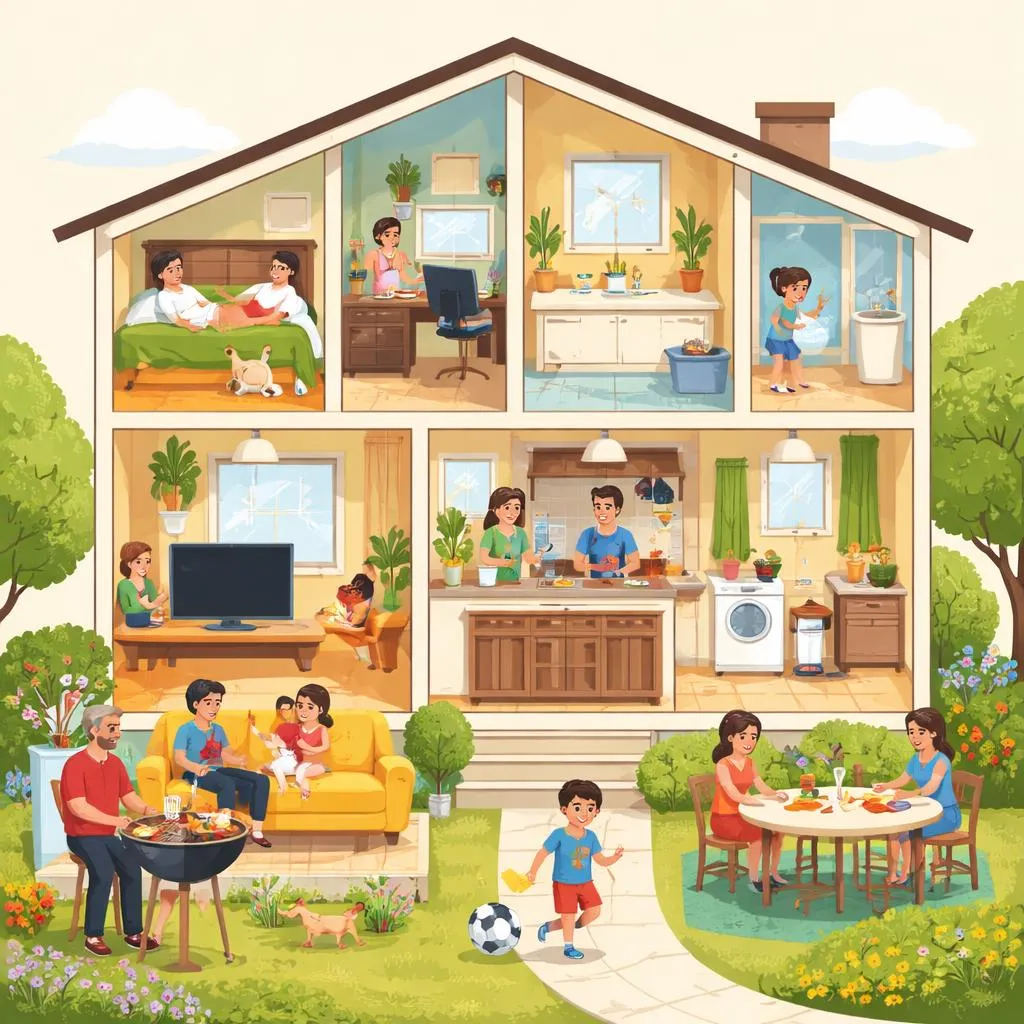

What is the Concept?
Let's explore the concept of a house section. This refers to the different rooms and functional areas inside a home, such as the kitchen, living room, or bedroom. Learning the names of these house sections helps children describe where they are, where things belong, and the daily activities that happen in each part of their home.
Understanding house sections is about building a spatial and functional vocabulary. It connects language directly to a child's most familiar environment. By learning that we cook in the kitchen and sleep in the bedroom, children organize their world linguistically. This knowledge is foundational for giving simple directions, talking about family routines, and building detailed descriptions.
Meaning and Explanation
Each house section has a name that tells us its primary purpose. The meaning of the word is tied to the activity we do there. A bathroom is a room for washing and using the toilet. A living room is a shared space for relaxing and living together. A garage is a section for storing the car and tools.
Learning this goes beyond memorizing a word. It involves connecting the place, its name, and its function. For example, the kitchen typically has a refrigerator and a stove because its function is food storage and preparation. This three-way link makes the vocabulary meaningful and useful for everyday communication.
Categories or Lists
We can list common house sections to create a clear vocabulary set. A typical list includes:
Living Areas: Living room, dining room, family room.
Private Areas: Bedroom, bathroom.
Utility/Work Areas: Kitchen, laundry room, garage, basement, attic.
Entry/Exit Points: Hallway, front door, back door, porch.
We can also categorize them by who uses them: private (my bedroom) vs. shared (the kitchen). Or by their typical location: upstairs (bedrooms) vs. downstairs (living room). Grouping helps structure the learning process.
Daily Life Examples
We use house section names all day long. We give simple instructions: "Please take your backpack to your bedroom." We ask questions: "Where is Mom?" "She is in the kitchen." We describe routines: "We eat breakfast in the dining room. We watch a movie in the living room."
We also use prepositions of place to be more specific: "The cat is sleeping under the table in the kitchen." "Your shoes are by the front door." Pointing out these connections during daily activities reinforces the vocabulary in a natural, stress-free context.
Printable Flashcards
Effective flashcards for house sections should feature a clear, friendly illustration of the room on one side. The other side should have the word (e.g., "BATHROOM") and a simple sentence defining its use ("We take a bath here.").
A highly engaging printable is a "House Floor Plan" coloring sheet. It shows the outline of a house with empty boxes for rooms. Children can label each box (Kitchen, Living Room), color it, and even draw simple furniture inside. This turns vocabulary practice into a creative architecture project.
Learning Activities and Games
A wonderful activity is "House Tour." Give a child a toy phone or microphone and have them give a "tour" of their home (real or drawn), describing each house section: "This is the living room. We sit on the sofa here." This builds speaking confidence and practical vocabulary use.
Play "I Spy, Room Version." Say, "I spy with my little eye... something you find in a bathroom." The child must guess an object (like a toothbrush or towel) and then say the room name. You can reverse it: name a room, and the child must spy an object that belongs there. This strengthens word association.
Educational Games
Play "Room Memory Match." Create pairs of cards: one card has a picture of a house section, and its match has a picture of a key object from that room (e.g., bedroom card matches with a bed card). Lay them all face down and play a memory game where players must find the room-object pairs.
Try "Where Does It Belong?" Gather a basket of small toy objects or picture cards (a toy pot, a book, a pillow). Set out several labeled boxes or papers, each representing a different house section (Kitchen, Bedroom, Living Room). Children must sort the objects into the correct "room." This game teaches categorization and reinforces the functional vocabulary.
Mastering the names of house sections gives children the language to navigate and describe their immediate world with precision. It moves from a general "in my house" to specific, meaningful locations. This vocabulary fosters independence, helps in following and giving instructions, and enriches storytelling about daily life. By connecting words to familiar spaces through play, creativity, and conversation, we build a strong foundation for confident communication, one room at a time.