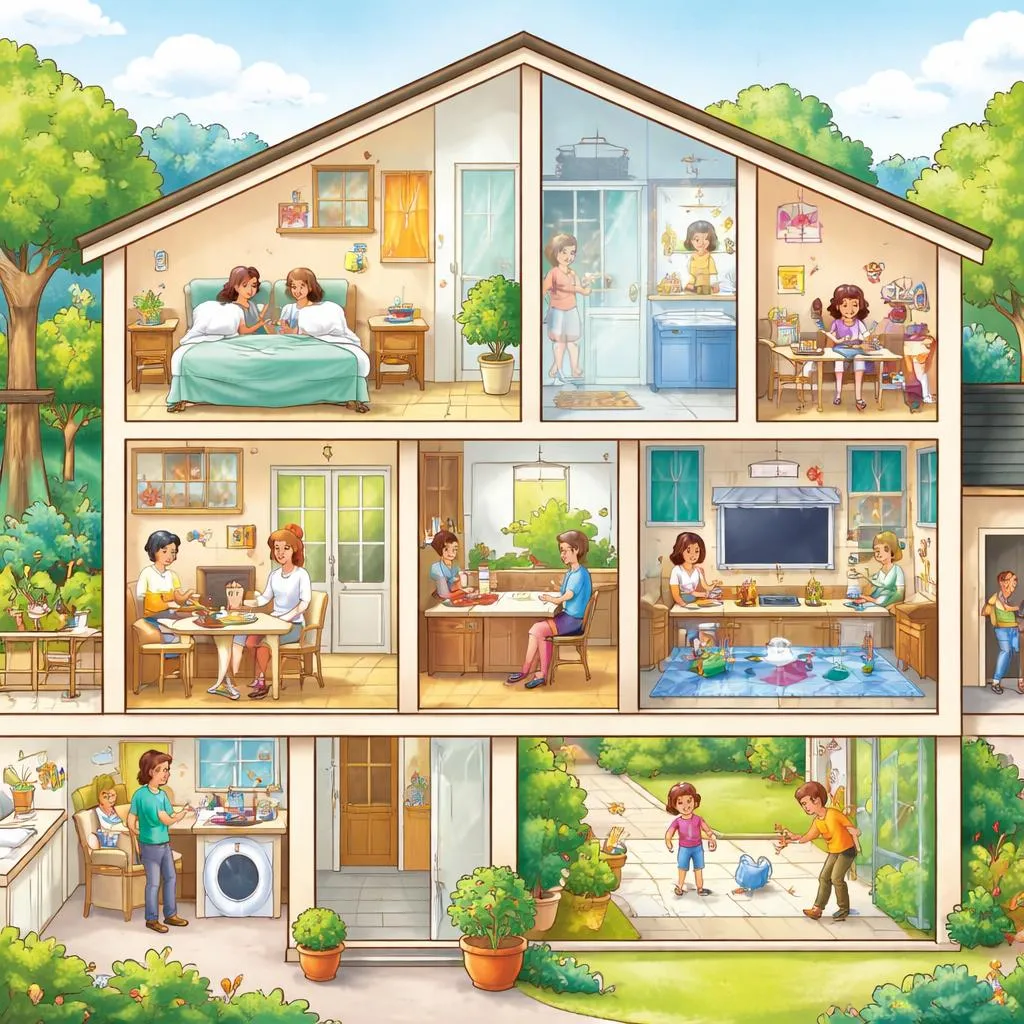

Hello, young learners! Welcome to our special lesson about homes. Today we explore the different parts of a house. Every house has many rooms and areas. Each one has a special purpose.
A house is where families live together. It keeps people safe and warm. It has places to sleep, eat, play, and rest. Learning the names of these places helps us talk about our daily lives.
Let us walk through the front door together. Let us discover every corner of the house. By the end of this lesson, describing a home in English will feel easy and natural.
What is a House?
A house is a building where people live. It provides shelter from weather. It gives families a place to be together. Houses come in many shapes and sizes.
Some houses are big with many rooms. Some houses are small with just a few rooms. Some houses have one floor. Some houses have two or three floors.
Every house has walls, a roof, doors, and windows. These are the basic parts of a house. Inside, there are rooms for different activities. The rooms connect through hallways and doors.
Houses can be made of different materials. Wood, brick, stone, and concrete are common. The materials depend on where the house is built and what is available.
Meaning and Explanation
When we talk about parts of a house, we mean the different areas inside and outside. Inside parts are rooms like the kitchen and bedroom. Outside parts are things like the roof and garden.
Each part has a name and a job. The kitchen is for cooking food. The bedroom is for sleeping. The bathroom is for washing. The living room is for spending time with family.
Knowing these names helps children describe where they are. A child can say "I am in the kitchen" or "My toy is in the bedroom." These sentences are useful every day.
The words for parts of a house are some of the first words children learn. They use them at home with family. Learning them in English builds a strong foundation for more language.
Categories or Lists
Let us look at the different parts of a house by category. We will start with the main rooms inside.
Living Room
This is the family gathering space. People sit on sofas and chairs. They watch television together. They talk and read books. Guests often visit in this room.
Kitchen
This is where food is prepared. There is a stove for cooking. There is a sink for washing dishes. There is a refrigerator for keeping food cold. Families often eat breakfast here.
Bedroom
This is where people sleep. Each bedroom has a bed. There are closets for clothes. Some bedrooms have desks for homework. Children keep toys in their bedrooms.
Bathroom
This is where people clean themselves. There is a toilet, a sink, and a shower or bathtub. People brush their teeth here. They wash their hands here. They take baths here.
Dining Room
This is where families eat meals together. There is a table and chairs. Special dinners and holiday meals happen here. Some houses have a dining area in the kitchen instead.
Hallway
This is a long passage that connects rooms. Doors open into the hallway. People walk through it to get from one room to another. Some hallways have pictures on the walls.
Stairs
These connect different floors in a house. Steps go up and down. People use stairs to reach upstairs bedrooms. Some houses have stairs to a basement too.
Attic
This is the space under the roof. People often use it for storage. Old toys, holiday decorations, and suitcases go in the attic. Some attics are finished into bedrooms.
Basement
This is the space under the main floor. Some basements are finished into playrooms. Others are used for storage and laundry. Basements stay cool in summer.
Garage
This is where cars are parked. Some garages attach to the house. People also store tools and bikes here. The garage has a big door that opens.
Garden or Yard
This is the outside area around the house. Grass, flowers, and trees grow here. Children play in the yard. Families sometimes have barbecues outside.
Daily Life Examples
Let us see how the parts of a house appear in daily life. These examples show real moments in a typical day.
In the morning, the alarm clock rings in the bedroom. A person wakes up and gets out of bed. They walk to the bathroom to wash their face and brush their teeth.
Then they go to the kitchen. They open the refrigerator to get milk. They pour cereal into a bowl. They sit at the kitchen table and eat breakfast.
During the day, children play in the living room. They build with blocks on the floor. They sit on the sofa and look at books. They watch a cartoon on the television.
Someone needs to do laundry. They go to the basement where the washing machine is. They put dirty clothes in the machine and start it.
In the afternoon, children play outside in the yard. They run on the grass. They swing on the swing set. They dig in the sandbox.
At dinner time, the family gathers in the dining room. They sit around the table. They pass food to each other. They talk about their day.
At night, everyone goes upstairs to the bedrooms. They put on pajamas. They read a story in bed. They turn off the light and go to sleep.
Printable Flashcards
Flashcards are a wonderful way to learn the parts of a house. Here are ideas for making and using them.
Make a card for each room and area. Write the name on one side. Kitchen, bedroom, bathroom, living room, dining room, hallway, stairs, attic, basement, garage, yard, garden.
On the other side, draw a simple picture. For kitchen, draw a stove and sink. For bedroom, draw a bed. For bathroom, draw a toilet. Keep drawings simple and clear.
Use these cards for practice. Look at the picture and say the word. Look at the word and imagine the picture. Practice until the words feel natural.
Make another set of cards with furniture and objects. Bed, sofa, table, chair, stove, sink, toilet, bathtub, lamp, closet. Match each object to the room where it belongs.
Learning Activities or Games
Let us play some games to learn about the parts of a house. These activities make vocabulary stick in memory.
Activity 1: Build a Paper House
Give children a large piece of paper. Have them draw the outside of a house. Then draw lines inside to show different rooms. Label each room with its name. Kitchen, bedroom, bathroom, living room. Color each room a different color.
Activity 2: Dollhouse Exploration
If a dollhouse is available, use it for learning. Move small figures from room to room. Say where they are going. "The mom is in the kitchen." "The baby is in the bedroom." This makes the words meaningful.
Activity 3: Room Scavenger Hunt
Give children a list of things to find in different rooms. Find a pillow in the bedroom. Find a spoon in the kitchen. Find a towel in the bathroom. Children search and bring items or check them off.
Activity 4: Draw Your Dream House
Children draw their own dream house. They decide how many rooms to include. They label each room in English. They can add furniture and decorations. Share drawings and describe each room to friends.
Activity 5: Where Am I? Game
Describe a room without saying its name. "In this room, there is a bed and a closet. People sleep here. Where am I?" Children guess the bedroom. Take turns giving clues for different rooms.
Activity 6: House Hopscotch
Draw a simple house floor plan on the ground with chalk. Include squares for each room. Children hop from room to room. When they land on a room, they say its name in English.
Activity 7: Furniture Matching
Make cards with pictures of furniture. Make another set with room names. Children match each piece of furniture to the room where it belongs. Bed goes with bedroom. Stove goes with kitchen. Sofa goes with living room.
Activity 8: House Vocabulary Bingo
Make bingo cards with pictures of different rooms and furniture. Call out the words. Children cover the matching picture. The first to cover a row shouts "House!"
Activity 9: Room Sorting Game
Print pictures of different activities. Eating, sleeping, cooking, bathing, watching TV. Children sort each activity into the correct room. Eating goes in kitchen or dining room. Sleeping goes in bedroom. Bathing goes in bathroom.
Activity 10: House Tour Video
Pretend to give a tour of a house. Walk through each room and describe it. "This is the living room. The sofa is blue. The TV is on the wall." Record the tour and watch it together. This builds speaking skills.
Activity 11: Label the House
Print a simple picture of a house with rooms shown. Children write the name of each room in the correct place. They can also label furniture inside each room.
Activity 12: Memory Game
Make pairs of cards with room pictures. Place them face down. Children take turns flipping two cards. If they match, they keep the pair and say the room name. If not, they flip them back.
Activity 13: Room Charades
Act out something that happens in a specific room. Pretend to cook in the kitchen. Pretend to sleep in the bedroom. Pretend to take a shower in the bathroom. Others guess the room.
Activity 14: House Puzzle
Draw a house on cardboard and cut it into puzzle pieces along room boundaries. Children put the puzzle together and name each room as they place it.
Activity 15: Preposition Practice
Use a small toy figure and a dollhouse or box house. Give directions using prepositions. Put the toy in the kitchen. Put the toy under the bed. Put the toy next to the sofa. This combines room vocabulary with position words.
Activity 16: House Song
Sing a simple song about the parts of a house to a familiar tune. "This is the kitchen where we cook, where we cook, where we cook. This is the kitchen where we cook, in our happy house." Add verses for each room.
Activity 17: Design a Room
Give children a blank room outline. They choose a room type and draw furniture inside. They present their room to others. "This is my bedroom. Here is my bed. Here is my desk." This builds descriptive language.
Activity 18: House Categories Game
Call out a category like "things in the kitchen" or "things in the bedroom." Children take turns naming items in that category. See how many they can list.
Activity 19: What's Missing?
Arrange several room cards or objects. Let children look for one minute. Cover them and remove one. Uncover and ask what is missing. This builds memory and vocabulary.
Activity 20: House Book
Staple several pages together to make a book. Each page is for one room. Children draw the room and write its name. They add pictures of furniture. This becomes a personal dictionary.
Learning the parts of a house gives children words they use every day. These words appear in stories, conversations, and directions. Knowing them builds confidence in English.
Every house is different, but the basic rooms are similar. Practice these words at home. Point to each room and say its name in English. Ask family members to practice with you.
The house is full of English words waiting to be learned. From the front door to the backyard, every part has a name. Keep exploring and naming everything you see.
Happy learning, everyone