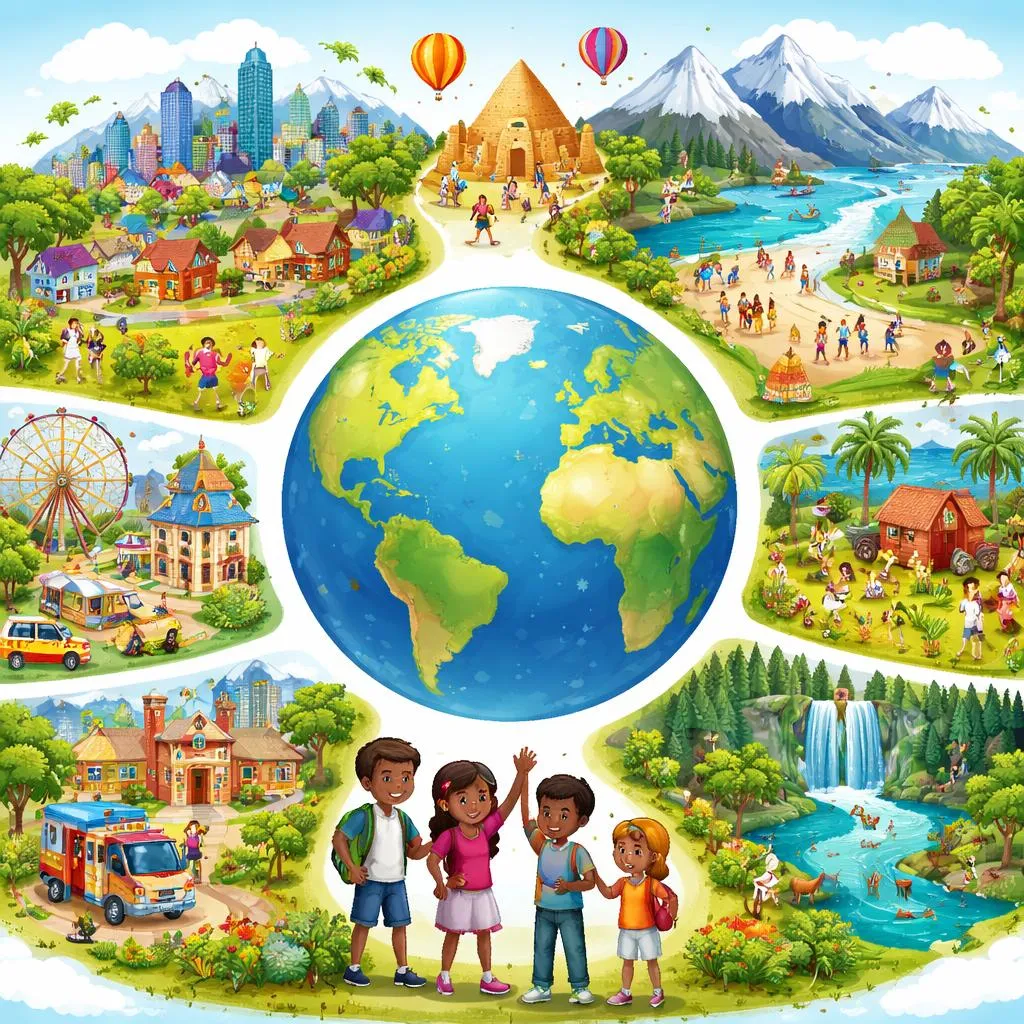

What is the Concept? Let's explore the wonderful concept of types of places. This refers to the different categories of locations, environments, and settings we find on Earth and in our communities. Learning about types of places helps children understand the world's diversity, from the park down the street to a distant mountain or ocean. It builds a framework for geography, storytelling, and describing experiences.
Understanding types of places expands a child's ability to answer "Where?" questions with precision. It moves beyond general words like "there" to specific, descriptive terms like "in the forest" or "at the beach." This vocabulary enriches conversations, boosts reading comprehension, and fosters curiosity about different environments.
Meaning and Explanation Each category of types of places describes a distinct environment with shared characteristics. The meaning comes from the physical features and common activities associated with that place. A city is a busy, built-up area with many buildings and people. A forest is a large area covered with many trees and home to wildlife.
Learning this involves connecting the place's name to its key features. For a library, the features are books, quiet, and learning. For a river, the features are flowing water, banks, and bridges. This helps children create mental images and understand what makes each type of place unique.
Categories or Lists We can organize types of places into broad, child-friendly categories:
Natural Places: Forest, beach, mountain, river, lake, desert, island.
Urban/Community Places: City, town, village, park, neighborhood, street.
Building/Service Places: School, hospital, library, supermarket, post office, restaurant.
Transportation Places: Airport, train station, bus stop, harbor.
Recreational Places: Playground, swimming pool, cinema, zoo.
This categorization helps structure the learning, showing how places can be grouped by their primary nature or purpose.
Daily Life Examples We encounter and discuss different types of places every day. We talk about past visits: "We went to the beach last summer." We make plans: "Let's meet at the park." We read stories set in various locations: "This story happens in a magical forest."
We describe our surroundings: "Our house is in a quiet neighborhood. There is a library and a playground nearby." We use prepositions to be specific: "The ducks are in the pond at the park." Connecting vocabulary to personal experience makes it meaningful and easier to remember.
Printable Flashcards Effective printable flashcards for types of places should have a clear, engaging photograph or illustration on one side. The other side should state the place name (e.g., "DESERT") and list 2-3 key characteristics in simple language ("Very dry, sandy, hot during the day").
A highly useful printable is a "My Community Map" worksheet. It provides a simple street grid. Children can draw, label, and color in different types of places: a school, a shop, a park. They can then use the map to give simple directions, integrating vocabulary with a practical skill.
Learning Activities and Games An excellent activity is "Postcard Creator." Provide templates of blank postcards. Assign or let children choose a type of place (e.g., mountain, zoo). On one side, they draw the place. On the other, they write a short sentence: "I am at the beach. It is sunny!" This combines art, writing, and vocabulary.
Play "Where Am I?" Give a child a card with a place name. They must give clues about that type of place without saying its name. "You can see many animals here. Some are in cages." Others guess: "The zoo!" This game encourages descriptive language and deepens understanding of each place's defining features.
Another engaging game is "Place Sorting." Create a large chart with category headings like "Has Water," "Has Many Buildings," "Has Trees." Provide a stack of picture cards showing different types of places. Children work together to sort the cards onto the chart, discussing why each place belongs in a category. This builds critical thinking and vocabulary.
Understanding the different types of places opens up a child's world, both real and imaginary. It provides the language to explore stories, share adventures, and understand the news. By categorizing, mapping, and playing with these terms, we help children organize their spatial awareness and build a rich, descriptive vocabulary. This knowledge turns every journey, whether to the corner shop or into a storybook, into an opportunity for confident and curious communication.