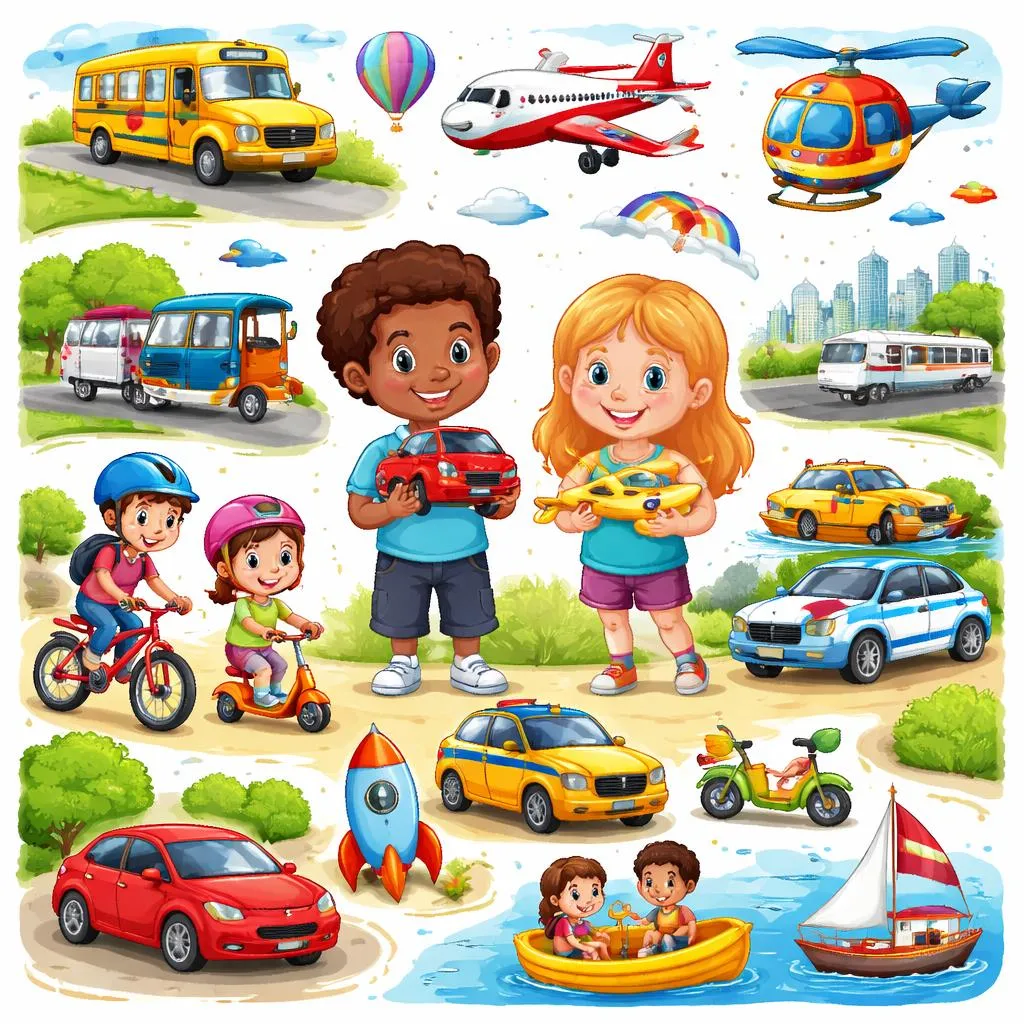

Transportation is a fascinating topic for young children. They see vehicles every day and love learning about them. From cars and trucks to boats and planes, the world of transportation captures their imagination. Today, we are going to explore different types of transportation and discover how teaching about vehicles builds vocabulary, categorization skills, and understanding of how people and goods move.
What Are Types of Transportation? Transportation means moving people or things from one place to another. Different vehicles are used for different purposes and in different environments. Some vehicles travel on land, some on water, and some through the air.
Learning about transportation helps children understand the world around them. They see buses taking people to work. They watch trucks delivering food to stores. They might ride in cars, trains, or planes themselves.
Transportation vocabulary appears in stories, songs, and everyday conversations. Children need these words to talk about their experiences and understand the world.
Meaning and Explanation of Transportation Categories To help children learn about transportation, we organize vehicles into categories based on where they travel.
Land Transportation includes vehicles that move on the ground. Cars, buses, trucks, trains, bicycles, and motorcycles all travel on land. Some use roads. Some use tracks. Some use paths.
Water Transportation includes vehicles that move on water. Boats, ships, sailboats, canoes, and submarines travel on rivers, lakes, and oceans.
Air Transportation includes vehicles that fly through the air. Airplanes, helicopters, hot air balloons, and rockets travel above the ground.
Some vehicles are for people. Cars carry families. Buses carry many people. Some vehicles are for things. Trucks carry food and goods. Trains carry heavy loads.
Categories or Lists of Types of Transportation Let us explore different categories of transportation in more detail.
Land Transportation - Road Vehicles: Car, bus, truck, motorcycle, bicycle, scooter, taxi, van, jeep, ambulance, fire truck, police car, garbage truck, ice cream truck, school bus. These vehicles travel on roads and streets.
Land Transportation - Rail Vehicles: Train, subway, tram, trolley, monorail, bullet train, steam train, freight train. These vehicles travel on tracks.
Land Transportation - Special Purpose: Tractor, bulldozer, crane, forklift, tank, race car, go-kart, skateboard, roller skates. These are for work, play, or special situations.
Water Transportation: Boat, ship, sailboat, canoe, kayak, raft, submarine, yacht, ferry, cruise ship, speedboat, rowboat, barge, hovercraft. These vehicles travel on or under water.
Air Transportation: Airplane, helicopter, hot air balloon, blimp, glider, jet, rocket, space shuttle, drone, seaplane. These vehicles fly through the air.
Emergency Vehicles: Ambulance, fire truck, police car, coast guard boat, rescue helicopter. These special vehicles help people in emergencies.
Construction Vehicles: Bulldozer, excavator, dump truck, cement mixer, crane, backhoe, roller. These vehicles help build things.
Daily Life Examples of Transportation The best way to learn about transportation is to notice vehicles in daily life.
On the way to school, children might see cars, buses, and maybe a train. "Look at that big bus! It carries many people to work." "There goes a mail truck delivering packages."
At the grocery store, delivery trucks bring food. "That truck brought the apples we buy. Trucks carry food from farms to stores."
On a trip, children might experience different transportation. "We are going on an airplane to visit Grandma." "We will take a boat across the lake."
In stories, vehicles come alive. Thomas the Tank Engine, Cars, and many other stories feature vehicles as characters.
Printable Flashcards for Types of Transportation Flashcards help children learn vehicle names and recognize what they look like. Each card should show a clear picture of the vehicle and its name.
Create cards for each category:
Land: car, bus, truck, train, bicycle, motorcycle
Water: boat, ship, sailboat, submarine
Air: airplane, helicopter, hot air balloon, rocket
Emergency: fire truck, ambulance, police car
Construction: bulldozer, excavator, dump truck
On the back of each card, include a simple sentence. "A car carries people on roads." "A boat travels on water." "An airplane flies in the sky."
Learning Activities or Games for Transportation Games make learning about transportation active and engaging. Here are activities that work well in the classroom.
Vehicle Sort: Provide a collection of toy vehicles or vehicle pictures. Children sort them into categories. Land vehicles go together. Water vehicles go together. Air vehicles go together. This builds classification skills.
Where Does It Go? Game: Create three sorting mats labeled "Land," "Water," and "Air." Children place each vehicle picture on the correct mat. A car goes on land. A boat goes on water. A plane goes in the air.
Vehicle Bingo: Create bingo cards with pictures of different vehicles. Call out descriptions. "This vehicle carries many people on roads." Children cover the bus. "This vehicle flies in the sky." Children cover the airplane.
I Spy with Vehicles: Play I Spy with vehicle pictures or toy vehicles. "I spy something with wings that flies." Children find the airplane. "I spy something with a siren that helps people." Children find the fire truck.
Vehicle Parade: Children each choose a vehicle to be. They line up and move around the room like that vehicle. Cars drive. Boats float. Airplanes fly. This adds physical movement.
Build a Vehicle: Use blocks, boxes, and other materials to build vehicles. Children create cars, boats, or planes. They name their vehicle and describe what it does.
Transportation Songs Music helps children remember vehicle names and characteristics. Here are some simple songs to sing.
The Wheels on the Bus is a classic. It describes different parts of a bus and what they do.
The wheels on the bus go round and round... The doors on the bus go open and shut... The wipers on the bus go swish, swish, swish...
I'm a Little Airplane (to the tune of "I'm a Little Teapot"):
I'm a little airplane, watch me fly. Here are my wings in the sky. When I get all ready, watch me go. First I'm fast, then I'm slow.
Row, Row, Row Your Boat is about water transportation.
Row, row, row your boat, Gently down the stream. Merrily, merrily, merrily, merrily, Life is but a dream.
Down by the Station is about trains.
Down by the station, early in the morning, See the little puffer bellies all in a row. See the engine driver pull the little handle, Chug, chug, toot, toot, off we go!
Transportation Books Picture books about vehicles reinforce vocabulary and build interest.
"Freight Train" by Donald Crews uses simple words and bold illustrations to show different train cars.
"Things That Go" by various authors is a popular topic for picture dictionaries and concept books.
"The Little Engine That Could" by Watty Piper tells the story of a small engine that helps a train over a mountain.
"Richard Scarry's Cars and Trucks and Things That Go" is packed with vehicles of all kinds. Children love finding Goldbug on every page.
"Trashy Town" by Andrea Zimmerman features a garbage truck and the driver who empties trash cans.
While reading, point out the vehicles. Name them. Talk about where they go and what they do.
Transportation Art Projects Art activities help children express their learning about vehicles creatively.
Vehicle Prints: Use toy vehicles with paint. Roll car and truck wheels through paint and across paper. See the different tracks each vehicle makes.
Paper Plate Vehicles: Create vehicles from paper plates. Add construction paper wheels, windows, and other details. Make cars, buses, boats, or airplanes.
Box Cars: Use cardboard boxes to create vehicles children can sit in. Add paper plates for wheels. Add steering wheels. Children can "drive" their vehicles.
Vehicle Collage: Cut vehicle pictures from magazines. Children arrange and glue them to create a transportation collage. They name each vehicle as they work.
Popsicle Stick Vehicles: Use popsicle sticks to build simple vehicle shapes. Glue them together. Add wheels from circles cut from paper.
Emergency Vehicles Emergency vehicles deserve special attention because they help people in important ways.
Fire trucks carry firefighters and equipment to put out fires. They are usually red and have loud sirens.
Ambulances carry sick or injured people to the hospital. They have lights and sirens to get through traffic quickly.
Police cars help keep people safe. Officers drive them to respond to calls and patrol neighborhoods.
Children can learn what to do if they see emergency vehicles. Pull over, let them pass, and know that they are helping someone.
Transportation Then and Now For older children, compare transportation from long ago with transportation today.
Long ago, people traveled by horse and carriage. Now we travel by car and plane. Long ago, ships had sails. Now they have engines. Long ago, trains were powered by steam. Now they use electricity or diesel.
This builds understanding of how technology changes over time.
Transportation Around the World Different places have different types of transportation. In some countries, people ride tuk-tuks. In others, they take gondolas through canals. In some cities, cable cars carry people up mountains.
Sharing these examples builds cultural awareness and shows children that transportation varies around the world.
Creating a Transportation Museum A wonderful culminating project is creating a classroom transportation museum. Children help collect toy vehicles, books, and pictures.
Set up different areas for land, water, and air transportation. Display vehicles in each area. Add signs with vehicle names.
Invite another class to visit. Children explain the exhibits and answer questions about different vehicles.
As we explore different types of transportation with young children, we open their eyes to the many ways people and goods move. They learn to name vehicles they see every day. They understand that different vehicles are for different environments and purposes. They discover the special vehicles that help in emergencies and build things. Through songs, games, and hands-on activities, transportation becomes a familiar and fascinating topic. This foundation will serve them as they travel and learn more about the world.