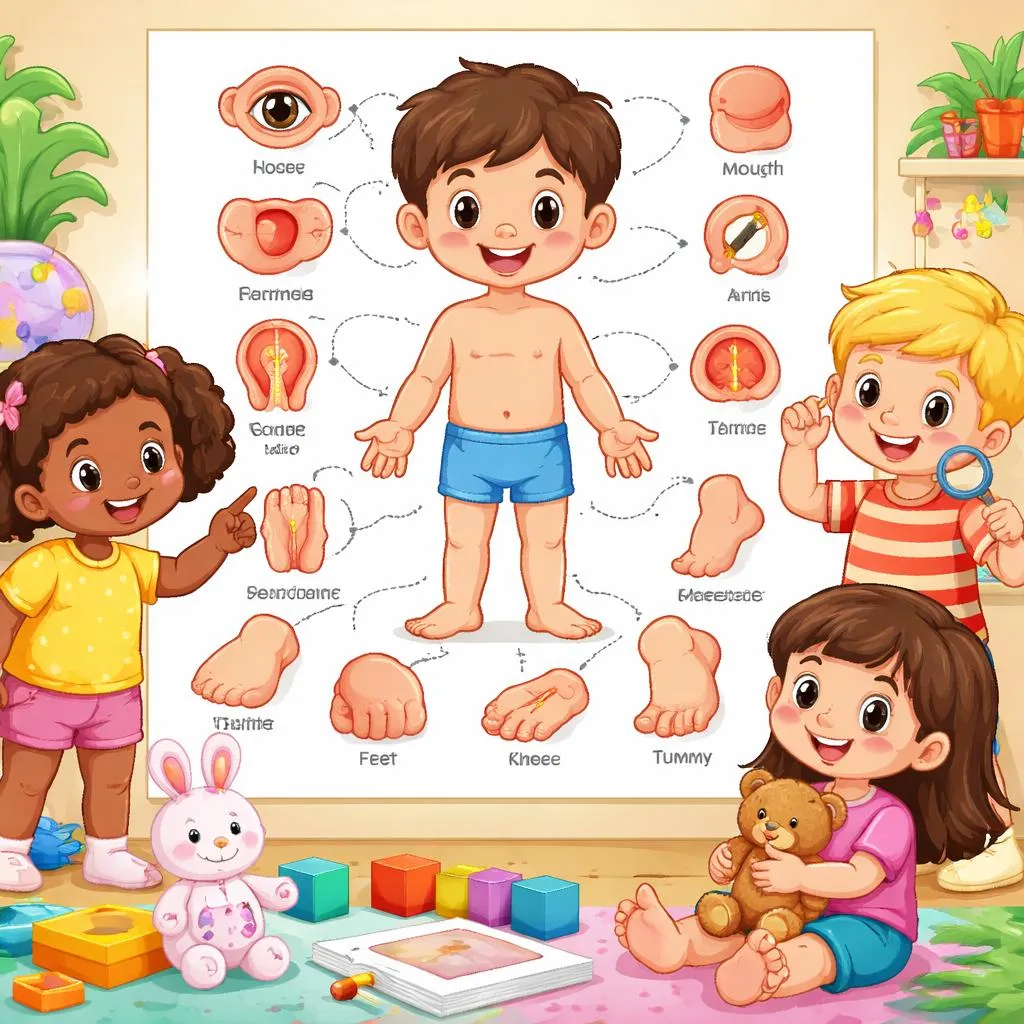

Hello, young learners! Today, we are going to learn about a very important and personal topic. We are going to study "body parts for kids". Knowing the names of our body parts in English helps us describe ourselves, follow instructions, and talk about how we feel. It is a fun and practical part of learning the language. Let's start this exciting exploration together.
What is "Body Parts for Kids"? The phrase "body parts for kids" refers to the basic, common names of the external parts of the human body, taught in a child-friendly way. This includes words for the head, face, limbs, and torso. Learning these terms builds a foundation for more complex language about health, senses, actions, and emotions. It is one of the first and most useful vocabulary sets for young English learners because it is directly connected to their own experience every single day.
Meaning and Explanation Learning body parts is about more than just memorizing words. It is about self-awareness and description. Each part has a name and a function. We see with our eyes. We hear with our ears. We walk with our legs and feet. We pick things up with our hands and fingers.
This vocabulary also introduces the concept of singular and plural (one hand, two hands) and possessive pronouns (my head, your nose). It helps children follow simple commands like "touch your nose" or "clap your hands," which are great for Total Physical Response (TPR) learning methods. Understanding these words is the first step in being able to say "I have a pain in my ear" or "I washed my face."
Categories or Lists We can organize body parts into friendly categories to make learning easier.
The Head and Face: Head, hair, face, forehead, eye, ear, nose, mouth, lip, tooth/teeth, chin, cheek, eyebrow, eyelash.
The Torso (Main Body): Neck, shoulder, back, chest, stomach, waist.
Arms and Hands: Arm, elbow, wrist, hand, palm, finger, thumb, nail.
Legs and Feet: Leg, knee, ankle, foot/feet, heel, toe.
This structure helps children group related words together, making them easier to remember.
Daily Life Examples We use body part words constantly in daily routines. When getting dressed, we put a sock on our foot and a hat on our head.
When we eat, we use our mouth and hands. We brush our teeth and wash our face.
We sing songs like "Head, Shoulders, Knees and Toes." We give hugs with our arms. We describe people: "She has blue eyes." "He has curly hair." We talk about feelings: "My stomach hurts." or "I have a big smile on my face." This vocabulary is alive in everything we do.
Printable Flashcards Flashcards are a perfect tool for learning body parts for kids. Create a set with a clear, simple picture on one side.
For "Knee," show a picture of a bent leg with the knee circled. On the back, write: "KNEE. The middle joint of your leg. You bend it to walk, run, and jump."
For "Ear," show a picture of an ear. The back states: "EAR. You hear sounds with your ears. You have two ears."
You can create matching games. One card has a picture of a hand, the matching card has the word "HAND." Or, create a full-body poster where children can stick labels on the correct parts.
Learning Activities or Games Learning body parts should be active and fun. Here are some great activities.
-
"Simon Says" (Body Parts Edition): The classic game is perfect. "Simon says touch your nose! Simon says point to your elbow! Touch your knees!" (If Simon didn't say it, they shouldn't do it!). This practices listening and word recognition.
-
"Doctor, Doctor!" Role-Play: Set up a simple doctor's clinic. One child is the patient and says, "My ear hurts." The "doctor" uses a toy stethoscope and says, "Let me check your ear." This encourages using the vocabulary in a realistic, playful context.
-
Body Part Puzzle: Print or draw a large outline of a body. Cut it into sections (head, torso, arms, legs). Have children assemble the puzzle, naming each part as they put it in place.
-
"I Spy with My Little Eye...": Describe a body part by its function or feature. "I spy with my little eye... something you use to smell flowers." (Nose). "Something you have ten of on your hands." (Fingers). This encourages thinking about the function of each part.
Mastering "body parts for kids" vocabulary is a fundamental and empowering step in learning English. It gives children the words to talk about their most familiar subject: themselves. Encourage them to point and name as you sing songs, read stories, or go about your day. Each word learned builds confidence and a stronger connection to the English language. Keep exploring, pointing, and naming—you are doing a wonderful job building the vocabulary for a lifetime of communication.