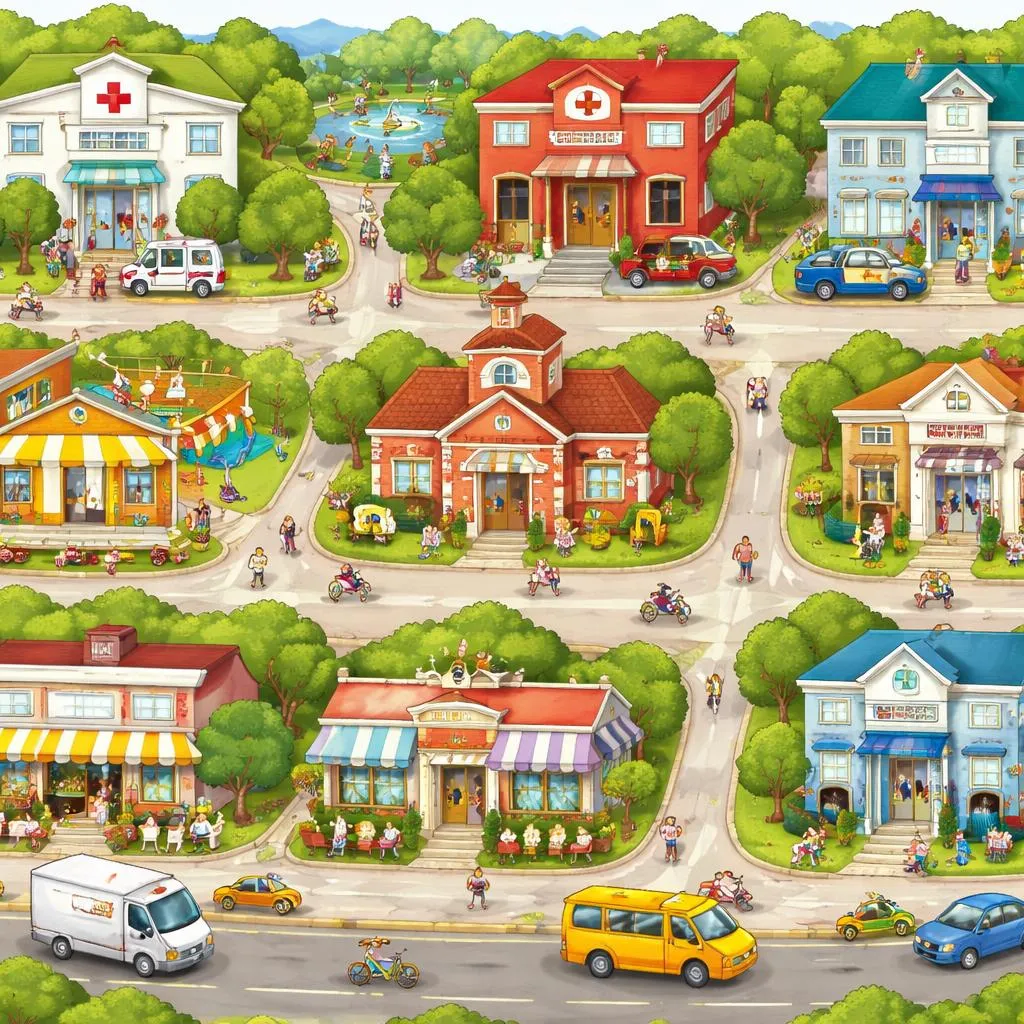

Hello, wonderful learners! Today, we're going on a vocabulary walk through an imaginary town. We'll explore the common buildings in a town. Knowing these names helps us describe where we go and what we see. It connects our English learning to the real world around us. Let's start our tour and learn about the places that make up a community.
What is "Buildings in a Town"? The phrase "buildings in a town" refers to the different structures and places we find in a typical community. Each building has a specific name and purpose. A school is for learning. A post office is for sending mail. Learning these terms helps children navigate and understand their environment. It builds the vocabulary needed for giving directions, telling stories, and discussing daily life. This knowledge turns a simple walk into a rich language lesson.
Meaning and Explanation Understanding these buildings is about more than just words. It's about understanding community functions. Each building serves the people who live in the town. The fire station keeps everyone safe from fires. The library provides books and information. The supermarket sells food.
We learn prepositions by describing where these buildings are. "The bank is next to the cafe." "The park is between the school and the library." We also learn about the people who work inside them, connecting to lessons about jobs. This vocabulary helps paint a complete picture of how a town works and where things are located.
Categories or Lists We can group buildings in a town into helpful categories.
Essential Services: These are crucial for safety and daily needs. They include the Hospital (or Clinic), Police Station, Fire Station, and Post Office.
Education & Learning: Buildings focused on knowledge. The main ones are School, Library, and sometimes a Museum.
Shopping & Business: Places where people buy things or work. Examples are Supermarket, Bakery, Bookshop, Bank, Restaurant, Cafe, and Cinema.
Community & Leisure: Places for fun, exercise, and community gatherings. These are the Park, Playground, Sports Centre (or Gym), Swimming Pool, and Community Centre.
Transport & Living: These include the Train Station, Bus Station, Hotel, and different types of Houses and Apartment Buildings.
Daily Life Examples We see and use the names of these buildings all the time. On a Saturday, you might say, "Let's go to the library to borrow a book." Then, "After that, we can buy bread at the bakery."
If you feel sick, your parent takes you to the hospital or a clinic. To send a birthday card, you visit the post office. For a fun day out, your family goes to the cinema or the swimming pool.
When giving directions, you might say, "Walk straight past the school, turn right at the bank, and you'll see the park." Using these words in context makes them memorable and practical.
Printable Flashcards Flashcards are a fantastic way to practice. Create a set with a clear picture of a building on one side.
For the Fire Station, show a picture of the building with a fire engine. On the back, write: "FIRE STATION. Firefighters work here. They help put out fires."
For the Supermarket, show a picture of a grocery store. The back states: "SUPERMARKET. We buy food and drinks here. It is also called a grocery store."
You can create "Town Map" cards. Have a base map and separate cards for each building. Children can place the buildings on the map to create their own town, saying sentences like, "I put the hospital here."
Learning Activities or Games Learning comes alive with games! Here are some fun activities.
-
"Town Builder" Game: Using blocks, LEGO, or drawn paper cut-outs, work together to build a model town on a large table. Label each building as you place it. Give directions to add new buildings. "Put the bakery next to the bookshop." This combines vocabulary with spatial reasoning.
-
"Where Am I Going?" Guessing Game: Describe what you do in a building without naming it. "I go here to read books, borrow stories, and study quietly." Others guess, "The library!" Then, they take a turn describing another building.
-
Map Drawing Adventure: Draw a simple, blank street map with roads and rivers. Give learners a list of buildings to draw and label on their map. "Draw a school near your house. Draw a park across from the school." This activity reinforces word recognition and placement.
-
"My Day in Town" Storyboard: Create a comic strip with four boxes. In each box, draw a different building and write a simple sentence. "1. I go to the post office. 2. Then, I go to the park. 3. Next, I eat at a restaurant. 4. Finally, I see a movie at the cinema." This practices sequencing and vocabulary.
Knowing the names of buildings in a town empowers children to describe their world. It builds the foundation for conversations about where they've been and where they're going. Encourage them to be detectives on their next car ride or walk, pointing out and naming the buildings they see. Each word they learn is another landmark on their map of English fluency. Keep exploring, keep naming, and have fun building your vocabulary town, one word at a time.