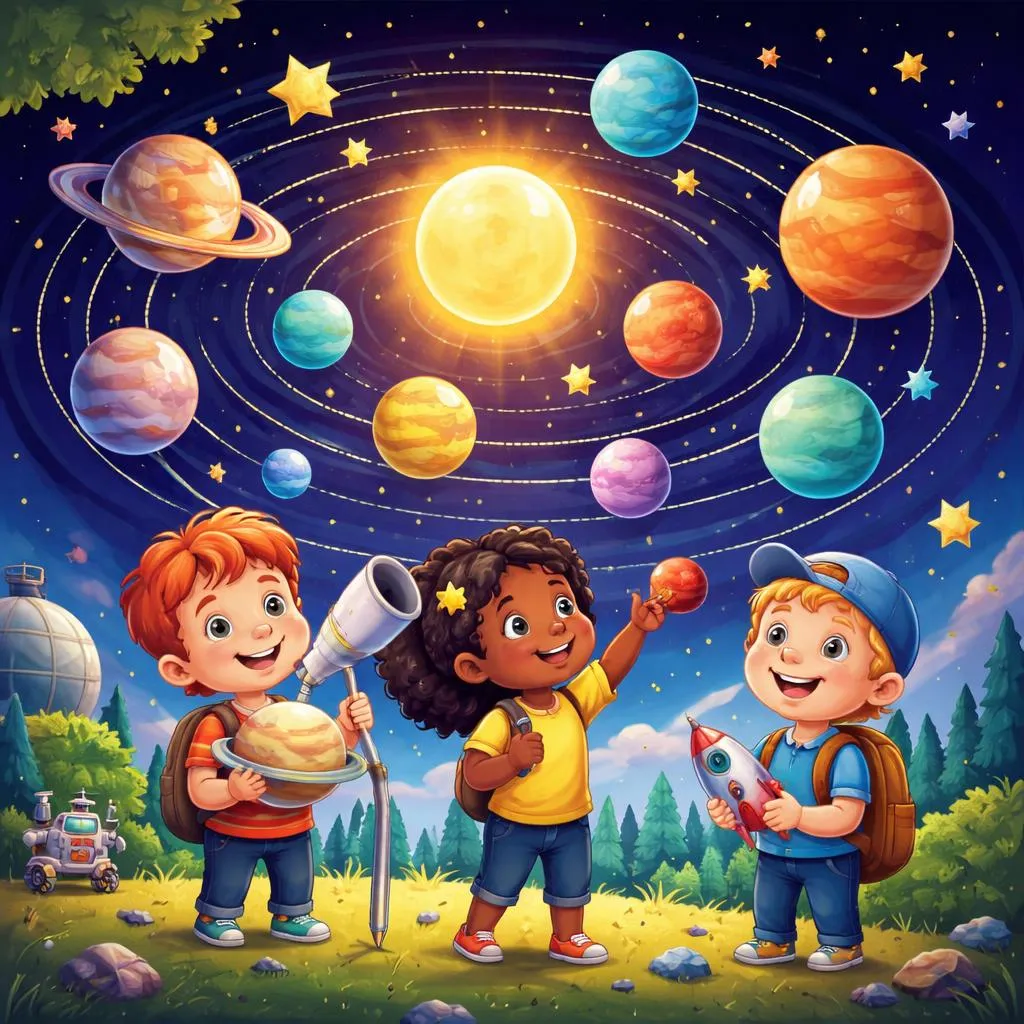

Welcome, young astronomers and educators! Today, we are embarking on an incredible journey across space. We will explore the fascinating "solar system names". Learning these names is our first step into astronomy. It helps us talk about the planets, the sun, and our place in the universe. Let's put on our imaginary space helmets and begin this stellar adventure together!
What is "Solar System Names"? The term "solar system names" refers to the official titles of the major celestial bodies in our cosmic neighborhood. This includes our star, the Sun, and the eight planets that orbit it. It also includes other significant objects like moons, dwarf planets, and asteroids. Knowing these names is like learning the addresses of our closest space neighbors. It gives us the vocabulary to describe our solar system's structure. This knowledge forms the foundation for all future space exploration and science learning.
Meaning and Explanation Understanding these names goes beyond simple memorization. Each name has a story, often from ancient mythology. This connects language, history, and science. For example, "Mercury" is named after the Roman messenger god, known for speed. This fits because Mercury orbits the Sun the fastest.
Learning these names also teaches us about order and classification. We learn that planets are sorted into two main groups: the rocky inner planets and the gas giant outer planets. We learn that "Solar" comes from "Sol," the Latin name for our Sun. This means everything in the "solar system" belongs to the Sun. Grasping these names helps us build a mental map of our place in space.
Categories or Lists We can organize the solar system names into clear and memorable categories.
The Star: At the center of it all is the Sun. It is not a planet. It is a giant star that provides light and heat.
The Inner Rocky Planets: These four planets are closest to the Sun. They are Mercury, Venus, Earth, and Mars. They are relatively small and have solid surfaces.
The Outer Gas Giants: These are the four large planets beyond the asteroid belt. They are Jupiter, Saturn, Uranus, and Neptune. They are mostly made of gases and are much larger than the inner planets.
Dwarf Planets and Other Objects: This category includes Pluto, Ceres, and Eris. We also have moons, like Earth's Moon, and the asteroid belt between Mars and Jupiter. Remembering the main eight planets is a perfect starting goal.
Daily Life Examples We see and use solar system names more often than we might think. Each morning, we see the Sun rise. At night, we might see the Moon and sometimes the bright planet Venus, often called the "Evening Star."
We use the names in our calendar. "Saturday" comes from Saturn. "Sunday" comes from the Sun. "Monday" comes from the Moon.
When we describe something very large, we say "jumbo," which comes from Jupiter. When we talk about something fast, we might reference "mercurial," from Mercury. Even the word "disaster" comes from "bad star" in Latin, linking back to ancient observations of the sky. These connections make the vocabulary relevant and alive.
Printable Flashcards Flashcards are a fantastic way to master the solar system names. Create a colorful set with a clear image on one side and key facts on the back.
For Earth, the front shows a beautiful blue-and-green planet. The back states: "EARTH. The third planet. Our home! It has water and air."
For Saturn, the front shows the planet with its magnificent rings. The back states: "SATURN. The sixth planet. Known for its bright rings made of ice and rock."
Include cards for the Sun and the Moon. You can create a separate set for ordering the planets. A fun activity is to lay the planet cards on the floor in a long line to show the vast scale of the solar system.
Learning Activities or Games Learning about space should be as fun as it is educational. Here are some engaging activities.
-
Planet Walk: Create a scaled model on a playground or long hallway. Use different-sized balls to represent planets. Take a "walk" from the Sun (a large yellow ball) all the way to Neptune. Say each planet's name as you reach its spot. This demonstrates the vast distances.
-
"Name That Planet!" Guessing Game: Give clues about a planet. "I am the red planet. I have two moons. What am I?" (Mars). "I am the biggest planet. I have a giant red storm. What am I?" (Jupiter). This encourages listening and critical thinking.
-
Planet Sorting Relay: Set up two hoops or bins labeled "Rocky Planets" and "Gas Giants." Write planet names on cards. Teams race to sort the cards into the correct categories. This reinforces the classification system.
-
Create a Mnemonic: Work together to make a silly sentence to remember the planet order. A classic is "My Very Educated Mother Just Served Us Noodles" for Mercury, Venus, Earth, Mars, Jupiter, Saturn, Uranus, Neptune. Inventing your own is even more memorable.
Remember, learning the solar system names is about inspiring wonder. It is not just about reciting words. It is about understanding that we live on a beautiful planet in a vast, amazing system. Start by learning one or two names well. Look up at the night sky and point out the Moon. Say the names aloud. Draw the planets in colorful detail. Each time you use a name, you are building a bridge between language and the incredible universe around us. Keep looking up and wondering. Your journey through the stars has just begun.