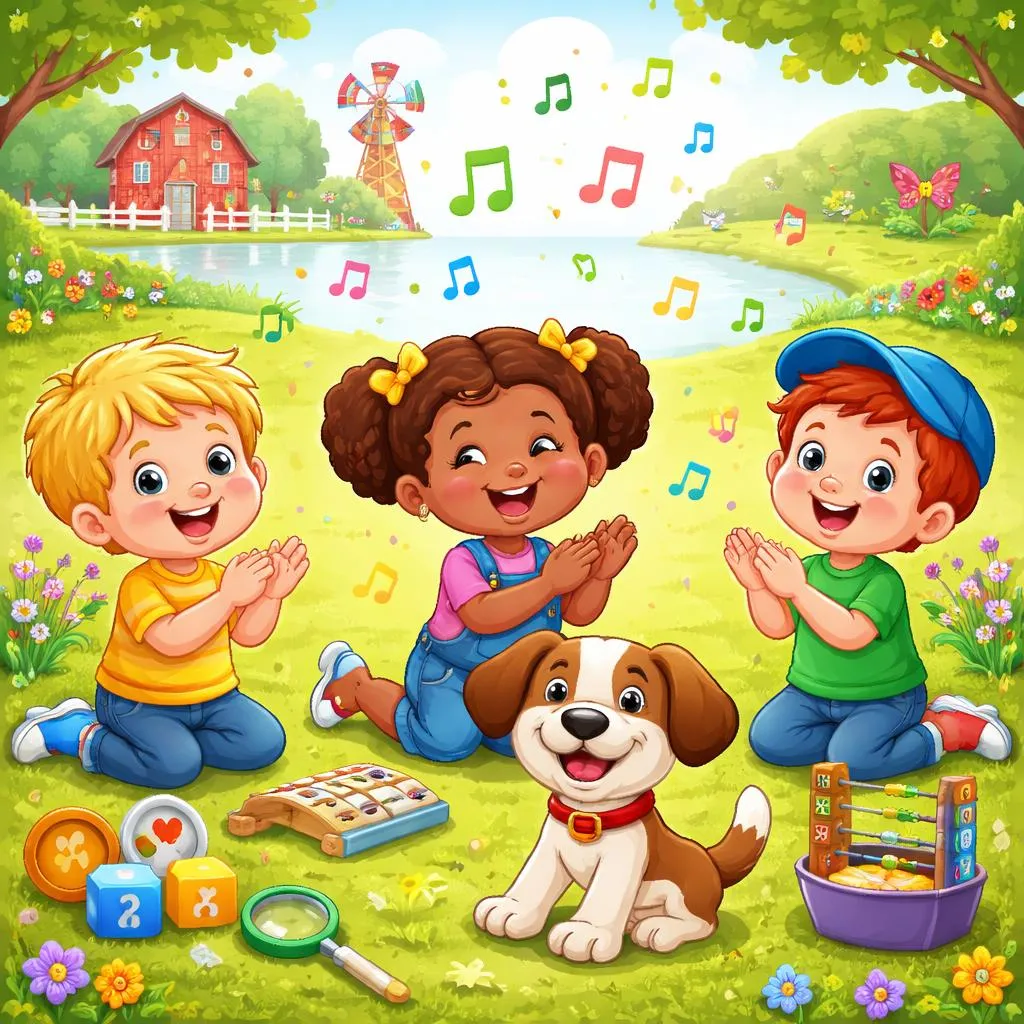

What is the Rhyme?
Let's explore a classic and energetic classroom favorite, the Bingo rhymes song. This is a cumulative song, meaning it builds upon itself with each verse. The song tells a simple story about a farmer and his dog named B-I-N-G-O. Its primary magic lies in its focus on spelling.
The Bingo rhymes song is a powerful tool for teaching letter recognition and sequencing. With each verse, we replace one letter of the dog's name with a hand clap. This structure requires careful listening and memory. It turns spelling practice into an engaging, musical game that children eagerly participate in, reinforcing the alphabetic principle in a joyful way.
The Lyrics of the Nursery Rhyme
The Bingo rhymes song lyrics follow a clear, predictable pattern. The traditional version starts like this:
There was a farmer who had a dog,
And Bingo was his name-o.
B-I-N-G-O, B-I-N-G-O, B-I-N-G-O,
And Bingo was his name-o!
The brilliance is in the subsequent verses. In the next verse, we clap on the first letter: “(clap)-I-N-G-O.” The verse after, we clap on the first two letters: “(clap)-(clap)-N-G-O.” This continues until all letters are replaced by claps. The full lyrics provide a complete framework for interactive spelling fun, making the sequence of letters memorable.
Vocabulary Learning
The Bingo rhymes song introduces and reinforces several useful vocabulary words. The key noun is "farmer," a common community helper. We can discuss what a farmer does. The word "dog" is a high-frequency animal name. The possessive pronoun "his" is used repeatedly ("his name-o"), providing clear context for its meaning.
The core learning, however, is in the letters themselves: B, I, N, G, O. The song treats each letter as a discrete unit of sound and symbol. This practice strengthens the understanding that words are made of individual letters in a specific order. It builds a foundational skill for later decoding and encoding of words.
Phonics Points
This song is exceptional for isolating and practicing letter sounds. We don't just say the letter names; we segment them. Saying "B-I-N-G-O" slowly emphasizes each distinct sound that makes up the word. This is a key phonemic awareness skill.
We can focus on the hard /b/ sound at the beginning. The long 'i' sound in the letter "I" is clear. The /n/ and /g/ sounds are also distinct. The song allows us to blend the sounds together slowly: "/b/.../i/.../n/.../g/.../o/... Bingo!" This playful blending and segmenting is direct phonics practice in a memorable, rhythmic format.
Grammar Patterns
The Bingo rhymes song offers a simple but solid grammatical frame. The opening line uses the past tense structure "There was..." to set the story. The phrase "who had a dog" introduces a relative clause in a very accessible way, describing the farmer.
The repetitive use of the verb "was" in "Bingo was his name-o" provides multiple examples of the past tense of "to be" for third-person singular. The possessive pronoun "his" is consistently linked to the farmer. This repeated exposure to basic sentence structures in a musical context helps internalize common grammar patterns.
Learning Activities
A perfect starter activity is the full-body spelling version. Assign each of five children a letter: B, I, N, G, O. Have them hold up large letter cards. As the class sings the Bingo rhymes song, the child holding the letter to be "clapped" sits down or turns their card around. This visual and physical representation of letter removal makes the song's structure tangible.
Try "Bingo Word Swap." Use the same melody but spell a different five-letter word relevant to your theme (like "A-P-P-L-E" or "G-R-E-E-N"). Keep the same clapping pattern. This activity transfers the skill beyond the familiar word, testing true understanding of the song's spelling mechanics and encouraging flexibility.
Printable Materials
A highly effective printable is a "Bingo Letter Sequencing Strip." It shows the five letters in order with a blank box above each. Provide Velcro dots and separate letter cards. As children sing and "clap" a letter, they remove that letter card from the strip, placing it in a "clap" pile. This hands-on material reinforces the left-to-right sequence and the concept of letter omission.
Create a "Song Sequence Mat." This printable has six panels illustrating the song's progression: 1. Farmer with dog. 2. All letters visible. 3. First letter missing (clap icon). 4. Two letters missing. 5. Three letters missing. 6. All letters clapped. Children can place the correct letter cards or clap icons in the panels, solidifying their understanding of the song's cumulative nature.
Educational Games
Play "Rhythmic Clap Substitute." Instead of just clapping, change the action for each verse. For the first clap, stomp your feet. For the second, pat your head. This variation challenges auditory processing and memory, as children must remember which action corresponds to which missing letter, all while maintaining the song's rhythm and sequence.
Introduce "Mystery Word Bingo." The leader secretly chooses a new five-letter word. Children must guess the word by asking, "Is it _ _ _ _ _?" The leader sings the Bingo rhymes song using the guessed word, clapping where letters are incorrect. This game blends spelling, logic, and the familiar song structure into a captivating guessing game that stretches critical thinking.
The enduring power of the Bingo rhymes song lies in its perfect fusion of music, movement, and literacy fundamentals. It transforms the abstract task of spelling into a concrete, participatory experience. By engaging with this song, children build more than just letter knowledge; they develop critical listening skills, sequential memory, and the joy of collaborative learning. It remains a timeless example of how play and education can harmoniously create a foundation for lifelong language skills.