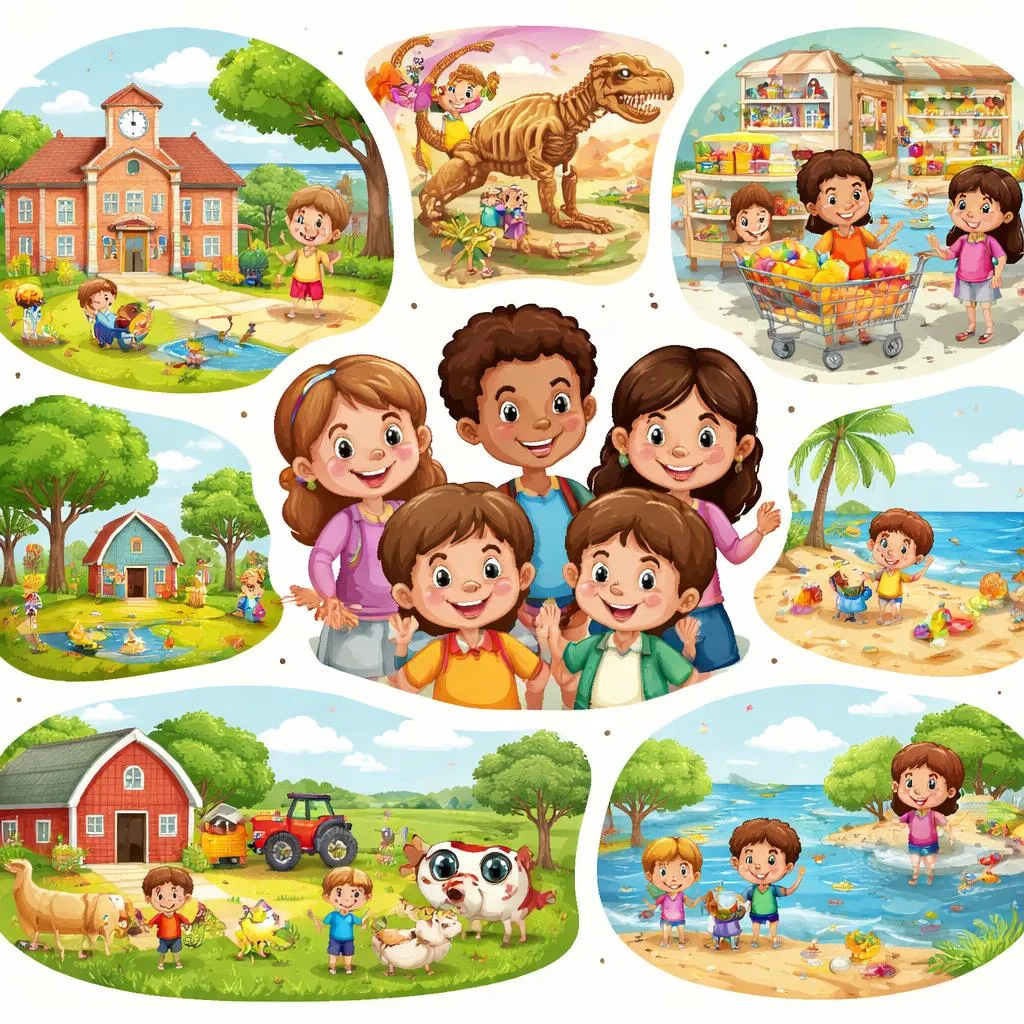

What Is The Rhyme? Many classic songs introduce children to places in english. A wonderful example is “Goin’ to the Zoo” or “The Wheels on the Bus.” While not exclusively about places, these songs journey to locations like the zoo or travel past various spots in a city. These places in english rhymes are adventures set to music. They often have a repetitive, exploratory structure. The melody is catchy and easy to follow. Singing about these locations builds familiarity and excitement. It turns a simple vocabulary list into a memorable story. Music provides the perfect, low-pressure context for learning new words.
The Lyrics of Nursery Rhymes The lyrics of nursery rhymes for places are often simple and list-like. A song might go: “We’re going to the playground, the park, and the library too. We’re going to the fire station, and so can you!” Another common lyric structure is question and answer. “Where do you go to read a book? I go to the library! Where do you go to see a fire truck? I go to the fire station!” The lyrics pair the place in english with its common purpose or activity. This repetition of the place name within a meaningful sentence helps anchor the word in a child’s memory.
Vocabulary Learning Learning places in english builds practical, everyday vocabulary. We start with core community locations: park, school, library, hospital, supermarket, bakery, zoo, playground, cinema, swimming pool. We can categorize them. Places for learning: school, library. Places for fun: park, zoo, cinema. Places for shopping: supermarket, bakery. Places for help: hospital, police station. We also learn useful nouns for inside these places: books, toys, food, doctor, cashier. Action verbs are key: go to, visit, play at, buy from, read at. This creates a full thematic network of related English words.
Phonics Points The names of places in english offer rich phonics material. We can focus on beginning blends. The /l/ blend in library. The /pl/ blend in playground and planetarium. The /sk/ sound in school. We practice the soft “c” sound in cinema and city. Many names are compound words, perfect for breaking down. “Play-ground.” “Super-market.” “Book-store.” We also find common endings like “-ary” in library and “-ium” in aquarium and stadium. Clapping syllables for longer words like “a-qua-ri-um” builds phonological awareness and aids pronunciation.
Grammar Patterns Talking about places in english introduces essential grammar. The most important is the preposition “at” for specific locations. “We are at the park.” “She works at the hospital.” We use “in” for being inside or within a larger area. “The books are in the library.” “We live in a city.” We practice asking and answering “Where?” questions. “Where are you?” “I am at the bus stop.” We also use the verb “go” in different tenses. “I go to school. I went to the zoo. I will go to the park.” These patterns are the foundation for giving directions and sharing experiences.
Learning Activities Interactive activities bring these places in english to life. A fantastic activity is “Build a Model Town.” Use blocks or drawings to create a simple town map. Children place labels on different buildings and describe them. “This is the school. It is next to the park.” Another is “Where Am I?” Give clues about a place. “You can buy bread here.” Children guess, “The bakery!” Also, “A Trip Diary” lets children draw or write about a real or imaginary trip to different places, using the new vocabulary in a personal story.
Printable Materials Printable resources provide visual and hands-on practice. Create “My Town” flashcards with a picture of a place on one side and its name on the back. Design a “Places in My Community” coloring book. Each page says, “This is the ______.” Children color and trace the word. A “Cut and Paste” map worksheet is excellent. Children glue pictures of buildings onto a street grid and then write sentences. “The library is between the school and the post office.” Another printable is a “Word Search” puzzle with key place names.
Educational Games Games make vocabulary practice fun and memorable. “Places Bingo” is always a hit. Use picture bingo cards. The caller gives a clue. “This is where you mail a letter.” Players mark the post office. “Charades” works well for actions associated with places. A child acts out “reading a book” or “buying groceries.” Others guess the place. “Library!” or “Supermarket!” For an active game, set up an “Obstacle Course City.” Set up stations labeled with places. At each station, children perform a related action (e.g., pretend to swim at the “pool” station) and say the place name.
Learning places in english does more than expand a word list. It helps children understand and describe their community. This knowledge is immediately useful for everyday conversations, storytelling, and following instructions. The topic is naturally engaging because it connects to a child’s own experiences and adventures. By using songs, categorization, creative play, and games, we build a deep and active vocabulary. Children learn not just to name a place, but to talk about what happens there, how to get there, and who they might see. This holistic approach builds confidence and fluency, turning a simple lesson on locations into a powerful tool for navigating the world in English.