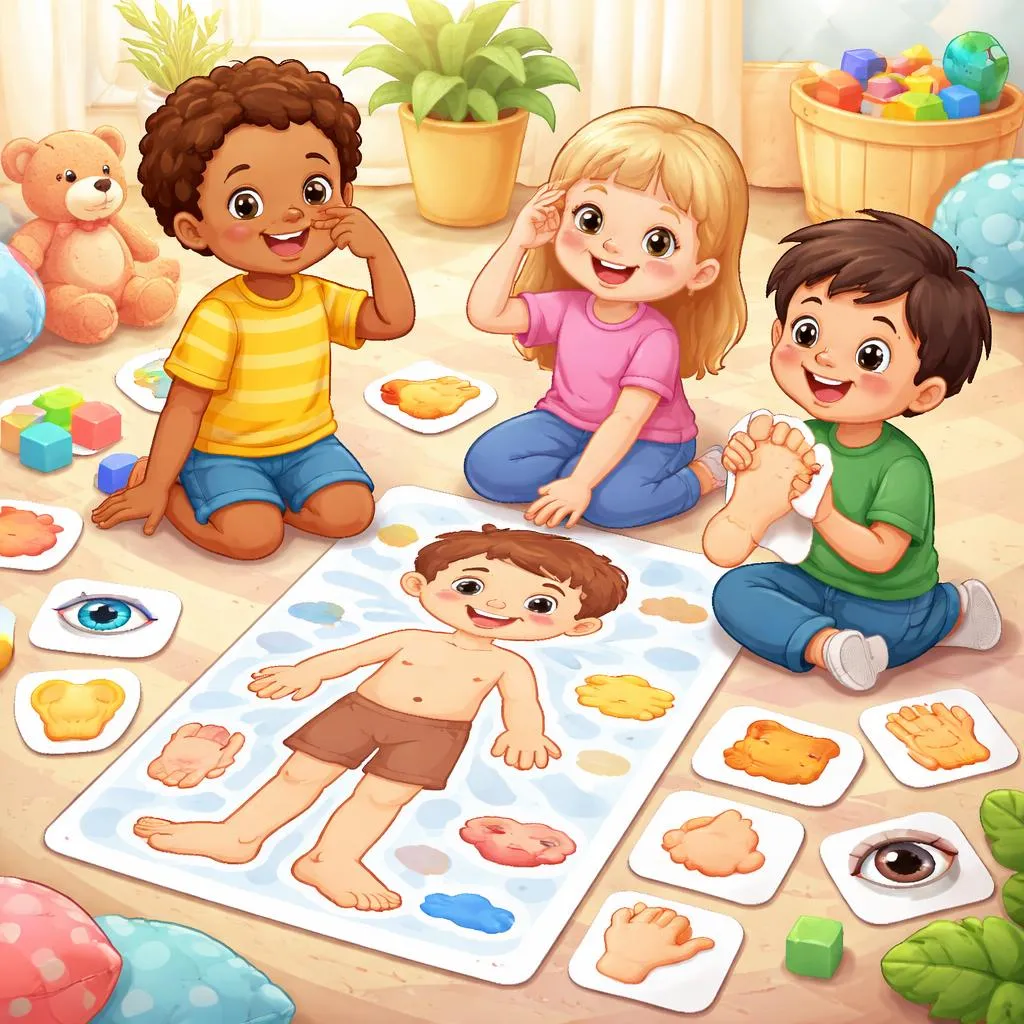

What Is The Rhyme? A wonderful way to introduce body parts for kids to learn is through a song. Classics like "Head, Shoulders, Knees and Toes" or "The Hokey Pokey" are perfect. These are action songs. They pair vocabulary with movement. The melody is energetic and repetitive. The lyrics are a simple list of body parts for kids to learn. Children touch each part as they sing its name. This multi-sensory approach is powerful. It links the English word to a physical sensation and location. Music makes memorization fun and active, turning a vocabulary list into a playful game.
The Lyrics of Nursery Rhymes The lyrics of nursery rhymes for body parts are clear and sequential. "Head, Shoulders, Knees and Toes" goes: "Head, shoulders, knees and toes, knees and toes. Eyes and ears and mouth and nose." The order is logical, moving from top to bottom. "The Hokey Pokey" uses a different structure: "You put your right foot in, you put your right foot out." This song introduces left/right and specific actions. The lyrics are instructional and repetitive. This allows children to predict the next word and perform the corresponding action confidently, reinforcing the vocabulary through consistent practice.
Vocabulary Learning Building a list of body parts for kids to learn starts with the basics. Core words include: head, eyes, ears, nose, mouth, shoulders, arms, hands, fingers, knees, legs, feet, toes. We can expand to more specific terms: eyebrows, eyelashes, cheeks, chin, neck, elbows, wrists, ankles, heels. We group words into categories. Parts on the face. Parts on the arm and hand. We learn useful adjectives: left, right, big, small. We also pair them with action verbs: touch, wiggle, shake, clap, stamp. This creates full sentences. "Touch your nose." "Wiggle your fingers."
Phonics Points Body part names offer excellent phonics practice. We focus on beginning sounds. The /h/ sound in head and hand. The /n/ sound in nose and neck. The /m/ sound in mouth. We practice blends like the /sh/ in shoulder. We can highlight vowel sounds. The long 'e' in knee. The 'oo' sound in foot. Many words are also compound words, ideal for breaking down. "Eye-lash." "Eye-brow." "Finger-nail." We find rhyming pairs within the theme. Head and bed. Nose and toes. Clapping syllables in words like "shoulder" (shoul-der) or "elbow" (el-bow) helps with pronunciation and decoding.
Grammar Patterns Songs about body parts for kids to learn teach foundational grammar. We learn possessive pronouns. "This is my head. These are your eyes." We practice imperative sentences for instructions. "Touch your nose. Shake your hands." We use "I have..." sentences. "I have two eyes. I have ten fingers." We introduce simple plurals. "One foot, two feet." "One hand, two hands." We can also use prepositions of place. "My nose is on my face. My fingers are at the end of my hands." These patterns are essential for self-description and following directions in English.
Learning Activities Interactive activities deepen understanding. "Simon Says" is a classic for body parts. "Simon says, touch your elbows!" Another is "Body Part Puzzle." Draw a simple outline of a person. Provide separate cut-out parts. Children glue them on while saying, "This is the arm." "Draw on a Friend" is a fun, safe activity using washable markers. With guidance, one child gently places a dot on another's hand while saying "hand." This reinforces the connection between the word and the actual body part in a memorable way.
Printable Materials Printable resources provide visual anchors. Create a "My Body" poster with labels. Children can color it. Design "Body Part Cards" with a picture on one side and the word on the back. Perfect for memory games. A "Matching Worksheet" can connect a picture of an ear to the word "ear." A "Label the Diagram" sheet with a simple cartoon body is excellent for writing practice. Also, create a "Body Part Spinner" game. Spin, land on a picture, and say the word or use it in a sentence. "I see a nose!"
Educational Games Games make practice joyful. "Body Part Bingo" uses picture cards. The caller says a word, and players mark the picture. "Guess the Part" is a guessing game. "I'm thinking of a body part you use to hear." "Ears!" For a whole-body game, play "Musical Body Parts." Place body part word cards on the floor. When the music stops, each child stands on a card and says, "I am standing on the word 'foot.'" This combines movement, reading, and speaking.
Teaching body parts for kids to learn is one of the most personal and engaging vocabulary topics. It connects language directly to the child's own physical experience. The combination of song, movement, and play ensures the words are learned in context and retained. This knowledge is not just a list. It is a toolkit for following instructions, playing games, describing oneself, and even discussing health and feelings. By making the learning process active and joyful, we help children build a strong, confident foundation in English, starting with the most familiar subject of all: themselves.