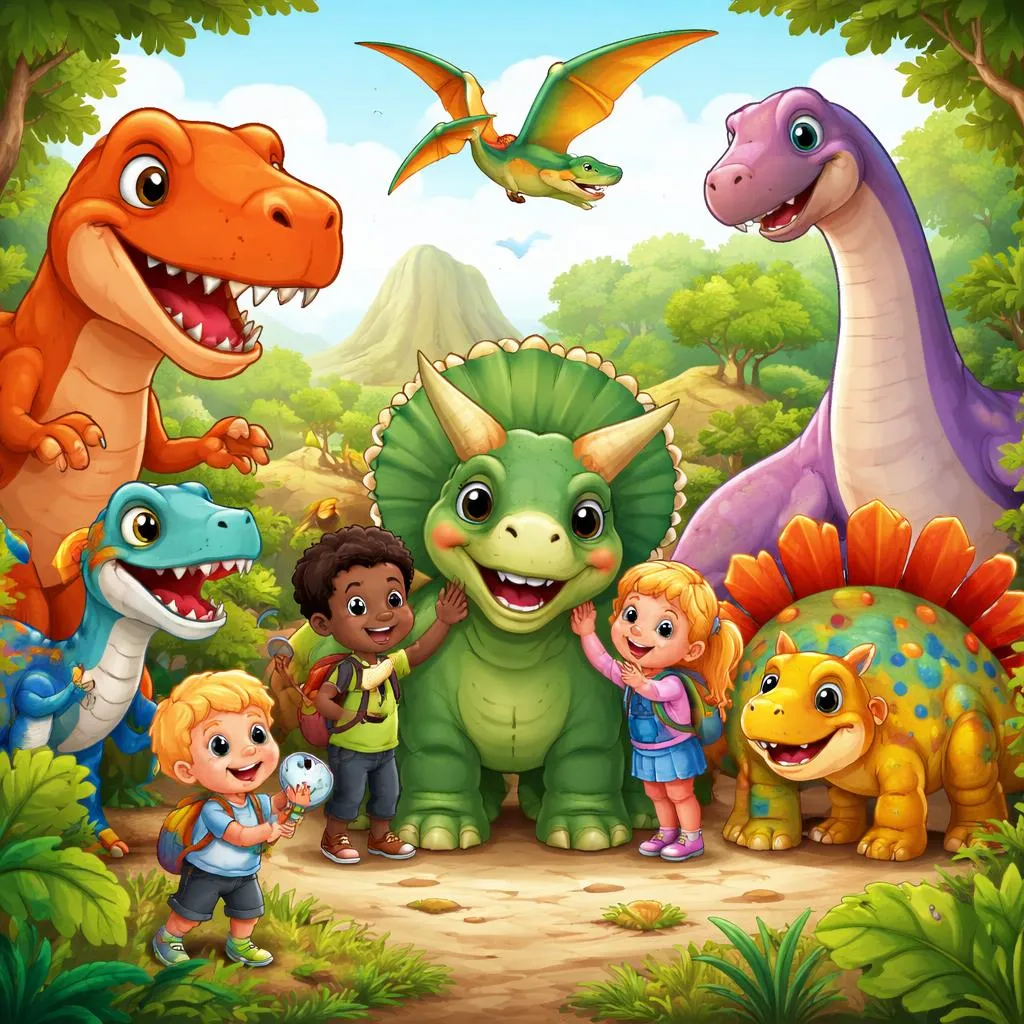

Dinosaurs capture the imagination of young children like few other topics. These magnificent creatures that lived millions of years ago spark curiosity and wonder. Today, we are going to explore 5 dinosaurs that are perfect for introducing young learners to the prehistoric world. Each dinosaur has unique features that make it memorable and exciting for children.
What Are Dinosaurs? Dinosaurs were a group of reptiles that lived on Earth millions of years ago. They dominated the land for over 160 million years. Then, about 65 million years ago, most dinosaurs went extinct. Scientists study their fossils to learn about how they lived.
Dinosaurs came in all shapes and sizes. Some were as small as chickens. Others were as long as several school buses. Some ate plants. Others ate meat. Some walked on two legs. Others walked on four.
Learning about dinosaurs helps children understand concepts like extinction, adaptation, and the passage of time. It also builds vocabulary and sparks interest in science.
Meaning and Explanation of Dinosaur Names Dinosaur names often describe something special about the dinosaur. Many names come from Greek or Latin words. Teaching children what the names mean helps them remember each dinosaur.
Tyrannosaurus Rex means "tyrant lizard king." This name tells us it was a powerful ruler of its time.
Triceratops means "three-horned face." This describes the three horns on its head.
Stegosaurus means "roof lizard" because the plates on its back looked like a roof.
Brachiosaurus means "arm lizard" because its front legs were longer than its back legs, like arms.
Velociraptor means "swift thief" because it was fast and probably stole eggs.
Understanding name meanings makes dinosaurs more memorable and connects to vocabulary building.
Categories or Lists of 5 Dinosaurs Let us explore 5 dinosaurs that are especially engaging for young children. Each represents a different type of dinosaur with distinct features.
Tyrannosaurus Rex: T-Rex is perhaps the most famous dinosaur. It was a large meat-eater that walked on two powerful legs. It had tiny arms that were surprisingly small for its huge body. Its massive head had dozens of sharp teeth. T-Rex lived at the very end of the dinosaur age. Children love its fierce appearance and dramatic roar in movies.
Triceratops: Triceratops was a plant-eater with three horns on its face and a large frill behind its head. It walked on four sturdy legs. The horns were probably used for defense against predators like T-Rex. Triceratops looked a bit like a modern rhinoceros. Its name means "three-horned face," which is easy for children to remember.
Stegosaurus: Stegosaurus is known for the distinctive plates along its back and the spikes on its tail. It was a plant-eater with a very small brain. In fact, its brain was about the size of a walnut. The plates may have been used for temperature control or for display. The tail spikes, called a thagomizer, were probably used for defense.
Brachiosaurus: Brachiosaurus was one of the tallest dinosaurs. Its front legs were longer than its back legs, so its body sloped upward. It had a very long neck that allowed it to reach leaves high in trees. Brachiosaurus was a plant-eater that probably traveled in herds. Children are amazed by its enormous size.
Velociraptor: Velociraptor was smaller than many people think, about the size of a turkey. It was a fast, intelligent meat-eater. It had a large claw on each foot that it used to attack prey. Velociraptor probably hunted in packs. It had feathers, making it look more like a bird than the scaly movie version.
Daily Life Examples of Dinosaur Learning Dinosaurs can connect to many daily learning experiences throughout the week.
During art time, children draw their favorite dinosaurs. They think about colors, shapes, and features. They might add volcanoes or prehistoric plants to their scenes.
During block play, children build dinosaur habitats. They create forests, rivers, and mountains where dinosaurs might have lived.
During music time, children move like different dinosaurs. Stomp like a T-Rex. Stretch necks like Brachiosaurus. Run fast like Velociraptor.
During story time, we read dinosaur books. We learn new facts. We imagine what it would be like to live with dinosaurs.
During show and tell, children share dinosaur toys or books from home. They tell what they know about their favorite dinosaur.
Printable Flashcards for 5 Dinosaurs Flashcards help children learn dinosaur names and features. Each card should show a clear picture of the dinosaur and its name.
For each dinosaur, include basic facts on the back:
What it ate (meat or plants)
How big it was
What made it special
When it lived
Children can use these cards to quiz each other. They can sort them by diet, size, or time period. They can arrange them in order of size.
Learning Activities or Games for 5 Dinosaurs Games make dinosaur learning active and engaging. Here are activities that work well in the classroom.
Dinosaur Sort: Create cards showing different dinosaurs. Children sort them into meat-eaters and plant-eaters. This builds classification skills and reinforces diet facts.
Dinosaur Size Line-Up: Research the sizes of different dinosaurs. Cut strings or paper strips to represent their lengths. Children arrange them from smallest to largest. This builds measurement concepts.
Dinosaur Fossil Dig: Bury plastic dinosaur bones or skeletons in a sand table. Children use brushes and tools to carefully uncover them. They identify which dinosaur they found. This builds fine motor skills and scientific thinking.
Dinosaur Stomp: Play music and have children stomp like dinosaurs. When the music stops, they freeze in a dinosaur pose. Call out a dinosaur name, and children strike that dinosaur's pose. T-Rex has tiny arms. Brachiosaurus has a long neck.
Dinosaur Bingo: Create bingo cards with pictures of different dinosaurs. Call out facts instead of names. "This dinosaur had three horns." Children cover Triceratops. This builds listening and knowledge.
Dinosaur Footprint Match: Create dinosaur footprint cards and matching dinosaur cards. Children match each footprint to the dinosaur that made it. This builds observation and reasoning.
Dinosaur Songs and Rhymes Music helps children remember dinosaur facts. Here are some simple songs to sing.
Five Dinosaurs (to the tune of "Five Little Ducks"): Five dinosaurs went out to play, Over the hills and far away. Mother dinosaur said, "Roar, roar, roar, roar," But only four dinosaurs came back.
Continue with four, three, two, one, and finally none. Then mother dinosaur finds them all.
Dinosaur Stomp (original chant): Stomp, stomp, stomp like T-Rex does. Chomp, chomp, chomp with powerful jaws. Swing your tail like Stegosaurus might. Dinosaurs roamed both day and night.
I'm a Little Dinosaur (to the tune of "I'm a Little Teapot"): I'm a little dinosaur, hear me roar. Here are my claws and here are my jaws. When I get all excited, hear me shout. Just watch out or I'll stomp about!
Dinosaur Books Picture books bring dinosaurs to life. Here are some favorites for young children.
"How Do Dinosaurs Say Goodnight?" by Jane Yolen uses dinosaurs to teach bedtime routines. Children love seeing dinosaurs acting like children.
"Dinosaur Roar!" by Paul and Henrietta Stickland uses opposites to describe dinosaurs. "Dinosaur roar, dinosaur squeak. Dinosaur fierce, dinosaur meek."
"National Geographic Little Kids First Big Book of Dinosaurs" by Catherine Hughes provides simple facts and beautiful illustrations. It's perfect for curious young learners.
"Tyrannosaurus Rex" by Daniel Nunn is part of a series that introduces individual dinosaurs with simple text and clear pictures.
While reading, we pause to notice details. "Look at the long neck on Brachiosaurus. How do you think it ate leaves from tall trees?"
Dinosaur Art Projects Art activities help children express their dinosaur learning creatively.
Paper Plate Dinosaurs: Use paper plates as dinosaur bodies. Add construction paper heads, legs, tails, and spikes. Paint and decorate. Children choose which dinosaur to create.
Salt Dough Fossils: Make salt dough and press dinosaur toys into it to create fossil impressions. Bake until hard. Children have their own fossils to keep.
Dinosaur Footprint Painting: Dip plastic dinosaur feet into paint and make footprints on paper. Compare how different dinosaur feet make different prints.
Dinosaur Hats: Create simple headbands with dinosaur features. Add spikes for Stegosaurus. Add horns for Triceratops. Add a crest for other dinosaurs.
Volcano Eruption: Create a baking soda and vinegar volcano in a sensory bin. Add toy dinosaurs around it. This dramatic play captures the prehistoric world.
Dinosaur Vocabulary Introduce and reinforce dinosaur-related vocabulary throughout your unit.
Body Parts: Horns, frill, plates, spikes, claws, teeth, tail, neck, beak, crest.
Actions: Stomp, roar, chomp, eat, hunt, graze, hatch, grow, roam.
Science Words: Fossil, extinct, prehistoric, paleontologist, skeleton, museum, dig, bone.
Descriptive Words: Huge, giant, tiny, fierce, gentle, fast, slow, tall, long, sharp.
Use these words in conversation. Add them to your word wall. Encourage children to use them in their play and discussion.
Dramatic Play as Paleontologists Set up a dinosaur dig in your dramatic play area. Provide:
Sand or dirt table with buried dinosaur bones (plastic or made from salt dough)
Small brushes for careful digging
Magnifying glasses for close observation
Notebooks and pencils for recording findings
Pictures of dinosaurs for identification
Children become paleontologists. They dig carefully, brush off dirt, and identify their discoveries. This builds scientific thinking and vocabulary.
Comparing Dinosaurs Help children compare and contrast different dinosaurs. Use simple charts or Venn diagrams.
Compare T-Rex and Triceratops. Both lived at the same time. One ate meat, one ate plants. One had sharp teeth, one had a beak. One had tiny arms, one had four strong legs. They might have fought each other.
Compare Brachiosaurus and Stegosaurus. Both ate plants. One was very tall, one was medium height. One had a long neck, one had plates on its back. They lived at different times.
These comparisons build critical thinking and observation skills.
As we explore 5 dinosaurs with young children, we open a window to a world millions of years old. These magnificent creatures spark curiosity about science and history. They build vocabulary through their unusual names. They inspire art, movement, and imaginative play. Through T-Rex's mighty roar, Triceratops's three horns, Stegosaurus's spiky tail, Brachiosaurus's long neck, and Velociraptor's swift speed, children discover the wonder of the prehistoric world.