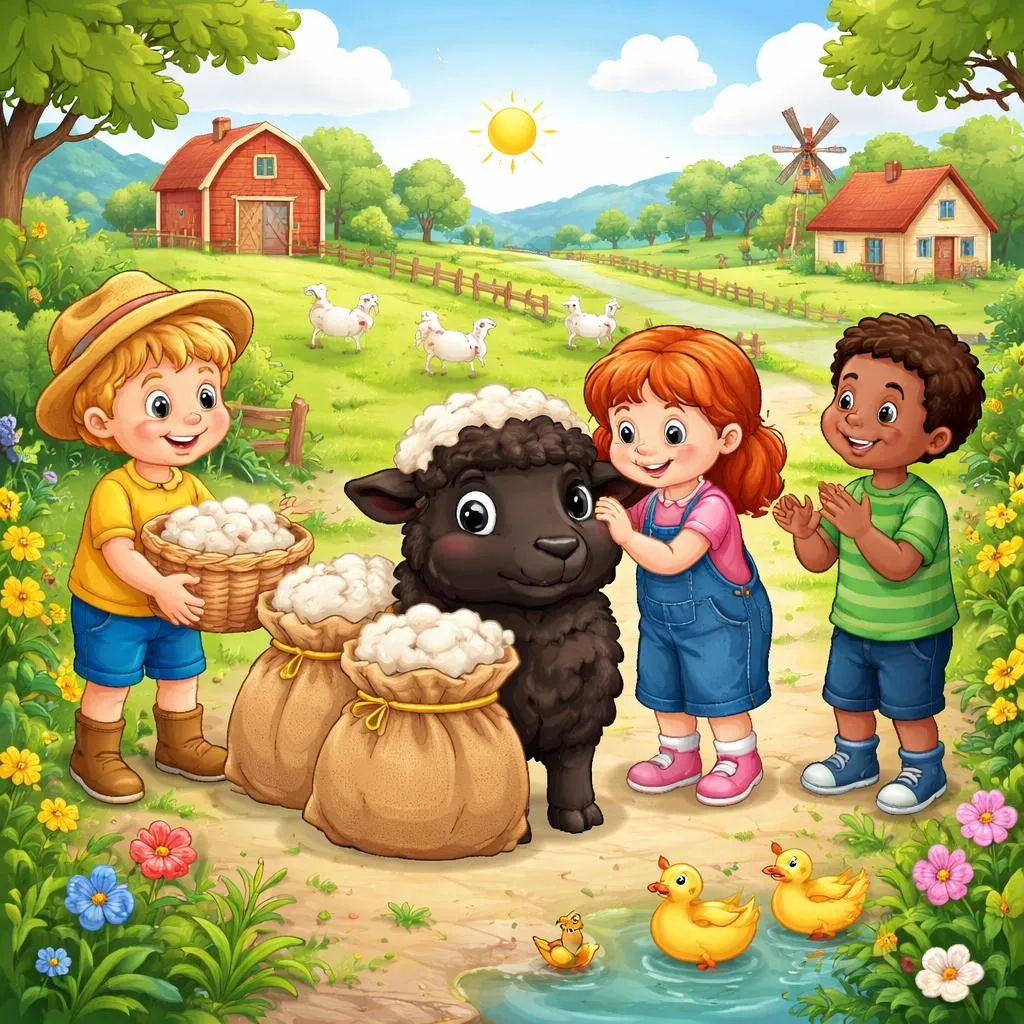

What Is The Rhyme? "Baa Baa Black Sheep" is one of the oldest and most beloved English nursery rhymes. It is a simple, repetitive song about a sheep and its wool. The rhyme takes the form of a polite question and answer. A person asks the sheep if it has any wool. The sheep replies politely that it does. It then describes sharing its wool with three characters. The words to Baa Baa Black Sheep are short, clear, and rhythmic. This makes the rhyme a perfect first song for young learners. Its gentle melody and structured dialogue provide an excellent framework for early English lessons.
The Lyrics of Nursery Rhymes The traditional lyrics of nursery rhymes for "Baa Baa Black Sheep" are consistent. They follow a clear call-and-response pattern. The standard first verse is: "Baa, baa, black sheep, have you any wool? Yes sir, yes sir, three bags full. One for my master, one for my dame, and one for the little boy who lives down the lane." The lyrics are a model of polite conversation. The question uses "have you" and "any." The answer uses "yes sir" and clear numbers. The repetition of the "Baa, baa" line makes it easy for children to join in.
Vocabulary Learning The words to Baa Baa Black Sheep introduce specific, useful vocabulary. Key nouns include: sheep, wool, bag, master, dame (an old word for lady or mistress), boy, lane. We learn the animal sound baa. We learn the adjective black and the number three. We can expand this list. We talk about other farm animals and their sounds. We discuss colors of sheep: white, brown. We learn synonyms: road for lane. We also focus on the concept of sharing. This builds a small but meaningful thematic vocabulary set around farm life and kindness.
Phonics Points This rhyme is a treasure trove for early phonics. The most prominent feature is the repetition of the /b/ sound: Baa, baa, black. This gives great practice with a plosive consonant. The long 'a' sound appears in baa and lane. We can highlight the /l/ blend in black and full. The rhyme also features the /m/ sound in master, my, and dame. The word wool is excellent for practicing the /w/ sound and the tricky double 'o' which makes a short 'u' sound. Clapping the steady beat of the lyrics helps children feel the syllables and rhythm of the words.
Grammar Patterns The words to Baa Baa Black Sheep beautifully model several grammar patterns. The opening line is a question using "have you" to ask about possession. This is a common English structure. The answer, "Yes sir, yes sir," shows polite agreement. The phrase "three bags full" uses a number adjective before a noun. The next lines introduce the preposition "for" to indicate purpose or recipient. "One for my master." This is a fundamental way to express giving. The rhyme also uses the simple present tense throughout, describing a general, recurring situation.
Learning Activities Creative activities can extend learning from the rhyme. Try "Wool Bag Counting." Use cotton balls as "wool" and small bags. Children count out three bags full while singing. Another activity is "Character Puppets." Create simple stick puppets for the sheep, master, dame, and boy. Act out the rhyme, emphasizing who gets each bag. This reinforces the concept of sharing. Also, try "Colorful Sheep." Sing the rhyme but change the color. "Baa, baa, white sheep..." or "Baa, baa, spotted sheep..." This encourages vocabulary substitution within the safe grammar structure.
Printable Materials Printable resources make the lesson tangible. Create a "Baa Baa Black Sheep" storyboard. It has four boxes: 1. The question to the sheep. 2. The sheep with three bags. 3. Giving a bag to the master. 4. Giving a bag to the boy. Children can color and sequence the pictures. Design "Word Matching Cards." One card has a picture (wool, bag, sheep), and the child finds the matching word card. A "Trace the Words" sheet with the key vocabulary (sheep, wool, bag) is great for early writing. Also, provide a black sheep outline for children to glue cotton balls onto while repeating the rhyme.
Educational Games Games solidify the rhyme's lessons. Play "Guess the Animal Sound." Start with "baa," then move to other sounds from farm animal songs (moo, oink). Children guess the animal in English. "Sheep Says" is a twist on Simon Says. The leader says, "Sheep says, show me three fingers!" or "Sheep says, point to something black." Another game is "Rhyme Bag." Place objects related to the song in a bag (a black toy, cotton wool, three small pouches). A child pulls one out and says the corresponding word or sentence. "This is wool!"
Exploring the words to Baa Baa Black Sheep opens a door to classic English language and culture. This simple rhyme teaches more than vocabulary. It models polite social interaction, sharing, and counting. Its repetitive, musical structure builds phonemic awareness and grammatical intuition in a gentle, enjoyable way. By acting it out, changing its words, and playing related games, children move from passive singing to active language use. They learn that English can be playful, rhythmic, and kind—just like the black sheep with three bags full. This foundational experience fosters a positive and confident approach to learning more complex language skills.