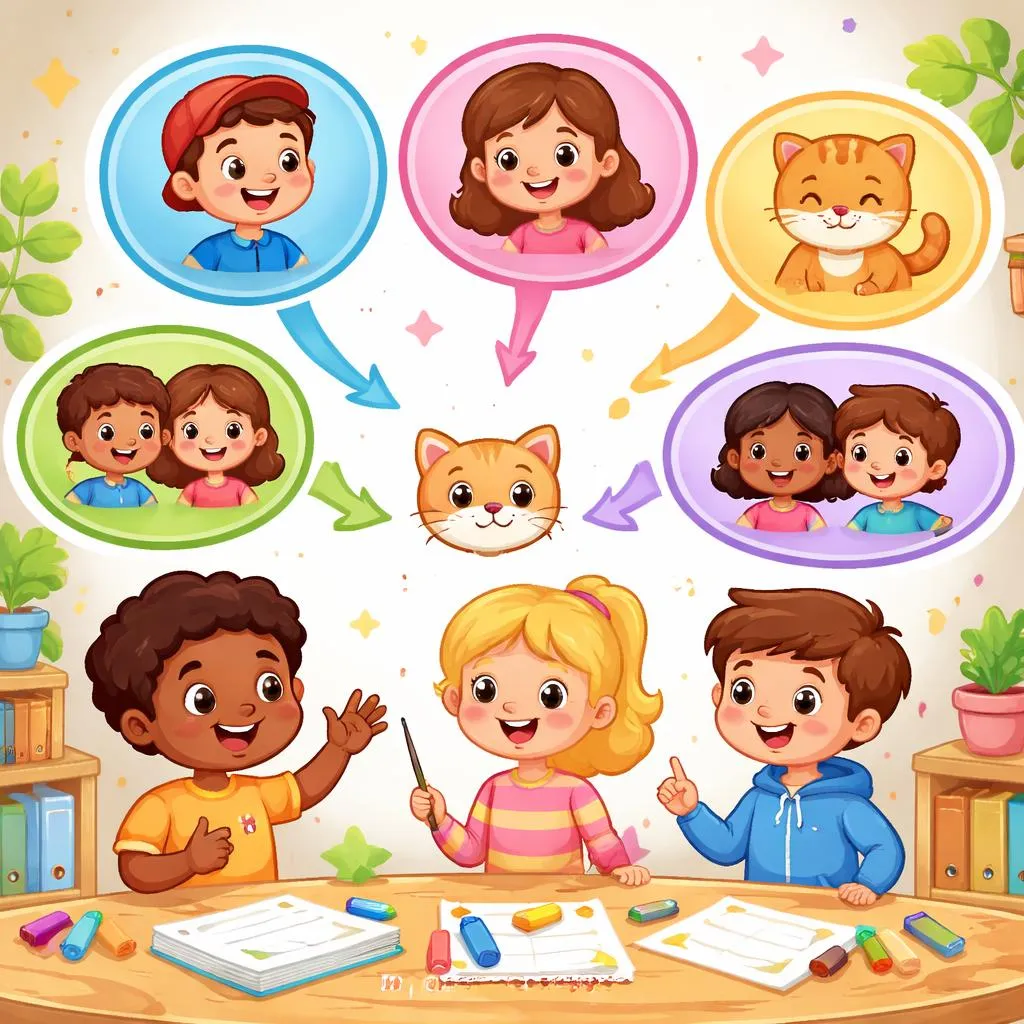

Meaning
Hello, word detectives. Today, we are going to learn about a very helpful group of words. We are going to learn the rules for using object pronouns. Pronouns are words that take the place of a noun. An object pronoun is a special pronoun that receives the action in a sentence. It tells us who or what is getting the action.
Think of a sentence as a relay race. The subject is the runner who starts. The verb is the act of passing the baton. The object pronoun is the teammate who catches the baton. In the sentence "I see him," the action of seeing is passed to "him." The word "him" is the object pronoun. It is the catcher. Using object pronouns correctly makes your sentences clear and smooth. Let's learn how to be great at this grammar relay.
Conjugation
The word "conjugation" here means matching. You must match the correct object pronoun to the person or thing it replaces. The list is very important. Let's look at the subject pronouns and their object pronoun partners.
Singular Object Pronouns: I ➔ me. (I like dogs. Dogs like me.)
You ➔ you. (You are funny. I see you.)
He ➔ him. (He is my brother. I play with him.)
She ➔ her. (She is a teacher. We listen to her.)
It ➔ it. (It is a ball. I kick it.)
Plural Object Pronouns: We ➔ us. (We are happy. She smiles at us.)
You ➔ you. (You are my friends. I will call you.)
They ➔ them. (They are birds. Look at them fly!)
Remember, "you" and "it" stay the same. Using object pronouns correctly means picking the right word from this list.
Present tense
We use object pronouns in the present tense to talk about actions happening now or as habits. The pronoun comes after the action verb.
My mom helps me. I like you very much. She sees him every day. He calls her on the phone. We need it for school. The teacher asks us a question. I will tell you a secret. Can you hear them singing.
In all these sentences, the action flows from the subject to the object pronoun. Using object pronouns in the present tense is very common in daily talk. It makes our language efficient.
Past tense
We also use object pronouns to talk about actions that already happened. The pronoun form does not change for the past, but the main verb does.
The gift surprised me. I called you yesterday. She invited him to the party. He thanked her for the help. We found it under the bed. They joined us for lunch. I told you the answer. I saw them at the park.
Even though the action (surprised, called, invited) is finished, the object pronoun (me, you, him) is still the receiver of that past action. Using object pronouns in the past tense helps us tell clear stories.
Future tense
We can use object pronouns to talk about actions that will happen later. We use "will" or "going to" with the object pronoun.
The news will shock me. I will visit you tomorrow. She is going to help him. He is going to call her. We will need it later. They will meet us there. I will remind you. Will you join them.
The object pronoun still receives the future action. Using object pronouns correctly in the future tense helps you share your plans.
Questions
We often use object pronouns in questions. The pronoun usually comes at the end of the question.
Can you help me? Did you see him? Will she call us? Where did you meet them? Who told you that story? What can I do for her? The object pronoun is a key part of the question, showing who the action affects.
A very common question is, "Can you hear me?" The word "me" is the object pronoun. Using object pronouns in questions is essential for everyday communication.
Other uses
Object pronouns are also used after small words called prepositions. Words like to, for, with, at, of. Please give this to her. This gift is for you. Will you go with us? Look at them. I am proud of him. The preposition introduces the object pronoun.
You cannot use a subject pronoun (I, he, she, we, they) in these spots. You must use the object form. Not "Give it to I," but "Give it to me." This is a very important rule for using object pronouns correctly.
Learning tips
A great tip is the "Ask the Question" method. Find the verb. Ask "Who?" or "What?" after it. The answer is the object. "I see (who?) --> him." This helps you identify when you need an object pronoun.
Make a matching chart. Write the subject pronouns in one column: I, you, he, she, it, we, you, they. In the next column, write their object partners: me, you, him, her, it, us, you, them. Practice saying them together every day.
Play the "Not I, Me!" game. When someone says something like "Who wants ice cream?" you shout "Me!" not "I!" This is a fun, real-life way to practice choosing the object pronoun correctly.
Educational games
Let's play "Pronoun Toss." Get a soft ball. Stand in a circle. The first player says a sentence with a subject and a verb. "I see..." Then they toss the ball to another player and say an object pronoun. "I see you!" The catcher must make a new sentence. "You threw the ball to me!" This game combines movement with quick grammar thinking.
Try the "Sentence Doctor" game. Write some simple sentences on a board, but use the wrong pronoun. "The gift is for I." "Can you help we?" "She gave the book to he." Give each child a "doctor's kit" (a whiteboard and marker). Their job is to diagnose and fix the sick sentence with the correct object pronoun. "The gift is for me." This corrective activity reinforces the right form.
Create an "Object Pronoun Story Chain." Sit in a circle. Start a simple story. "One day, I saw a magic frog. I looked at it." The next person continues, but must use an object pronoun in their sentence. "The frog looked at me and smiled." The next person adds, "Then, it hopped towards us!" Keep the story going. This creative, collaborative game makes practicing the rules for using object pronouns a fun and memorable storytelling adventure.