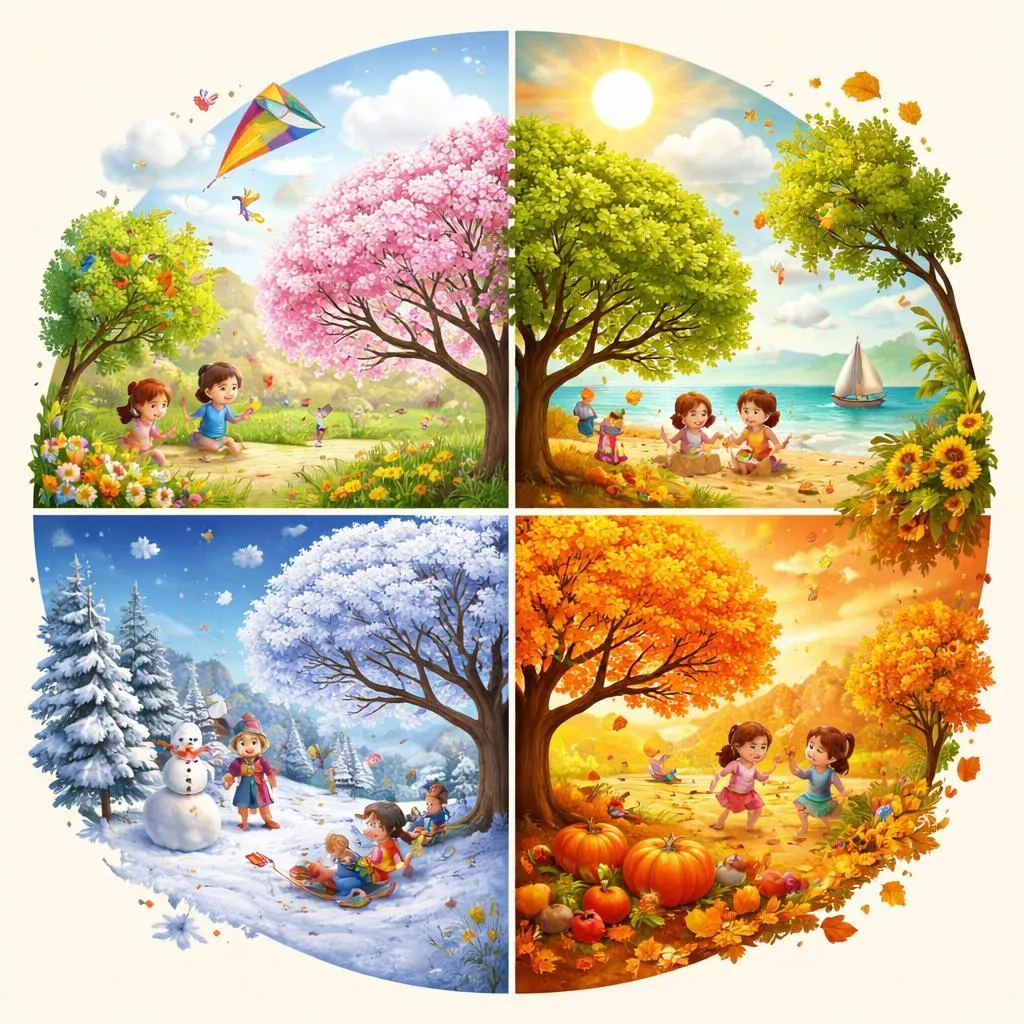

Welcome, everyone! Today, we are going on a journey through time and weather. We are learning about "the seasons of the year". This is a wonderful topic that connects English to the world around us. Knowing the seasons helps us describe months, weather, activities, and changes in nature. Let's explore the cycle of the year together.
What is "The Seasons of the Year"?
The phrase "the seasons of the year" refers to the four main divisions of the year. These divisions are marked by distinct weather patterns and daylight hours. The seasons are Spring, Summer, Autumn (or Fall), and Winter. In many places, the year moves in this never-ending cycle. Each season lasts about three months. Learning these names gives us a framework for talking about time, planning activities, and observing the natural world. It is a fundamental part of everyday conversation.
Meaning and Explanation
The meaning of the seasons goes beyond just names. Each season represents a different state of nature and a different feeling.
Spring is a time of new beginnings. Plants grow, flowers bloom, and baby animals are born. The weather often becomes warmer and rainier.
Summer is the warmest season. Days are long and sunny. It is a time for holidays, playing outside, and enjoying sunshine.
Autumn or Fall is a time of change. Leaves change color and fall from trees. The air becomes cooler. We harvest crops like apples and pumpkins.
Winter is the coldest season. Days are short. In many places, it snows. Animals may hibernate, and people enjoy indoor activities or winter sports.
Understanding this cycle helps explain why we wear different clothes and do different things throughout the year.
Categories or Lists
We can list the seasons of the year in their correct order, along with key traits.
Spring (March, April, May): Key words: grow, bloom, rain, warm, flower, lamb, bunny.
Summer (June, July, August): Key words: hot, sunny, beach, swim, holiday, ice cream, sun.
Autumn / Fall (September, October, November): Key words: cool, windy, harvest, leaves, pumpkin, rake, brown, orange.
Winter (December, January, February): Key words: cold, snow, ice, coat, scarf, mittens, fireplace, snowman.
Remember, the months listed are for the Northern Hemisphere. The order of the seasons is always the same: Spring → Summer → Autumn → Winter → Spring again.
Daily Life Examples
We talk about the seasons all the time in daily life. We might say, "I love Summer because we go to the beach."
When choosing clothes, we think, "It is Winter, so I need my coat and hat." In Spring, we might say, "Look at the new flowers in the garden!"
During Autumn, we could explain, "We are raking the leaves into a big pile." We describe the weather: "Today is a cold Winter day" or "It's a hot Summer afternoon." Our activities change with the seasons, giving us constant opportunities to use this vocabulary.
Printable Flashcards
Flashcards are a great tool for learning the seasons. Create a set with four main cards.
Each card should have a large, beautiful picture representing one season. For Spring, a picture of blooming flowers and a rainbow. For Winter, a snowy scene with a snowman.
On the back of each card, write the season's name and three key sentences. "This is Spring. The weather is warm and rainy. Flowers grow."
You can also create matching cards. One card has a picture of a swimming costume, and children match it to the Summer card. A picture of a rake matches Autumn. This builds association between the season and its typical items and activities.
Learning Activities or Games
Make learning about seasons interactive and fun with these activities.
-
Season Sorting Game: Gather many pictures from magazines or printouts: a snowflake, a sunflower, a leaf, an umbrella, a pumpkin, a swimsuit. Have learners sort these pictures into four boxes labeled Spring, Summer, Autumn, Winter. This encourages discussion and vocabulary use.
-
"What Season Am I?": Pin a picture of a seasonal item (like a mittens for winter or a butterfly for spring) on a child's back. They ask the group yes/no questions to guess the item and then deduce the season. "Is it cold? Do I wear it? Is it for Winter?" This practices question formation and logical thinking.
-
Seasonal Wheel Craft: Create a paper plate "Season Wheel." Divide the plate into four sections. Draw or glue pictures for each season in each section. Attect a paper arrow with a brass fastener. Spin the arrow and name the season, a weather word, and an activity. This is a great hands-on reference tool.
-
"A Year in My Life" Poster: Help learners create a poster with four sections. In each section, they draw themselves doing something they enjoy in that season. They label it: "In Spring, I fly my kite." This personalizes the vocabulary.
Learning about "the seasons of the year" teaches more than just four words. It teaches observation, cycles, and the language to describe change. Encourage children to look out the window and name the season. Talk about what is happening to the trees, the weather, and their clothes. This constant, real-world connection makes the vocabulary meaningful and easy to remember. Keep observing the wonderful changes each season brings