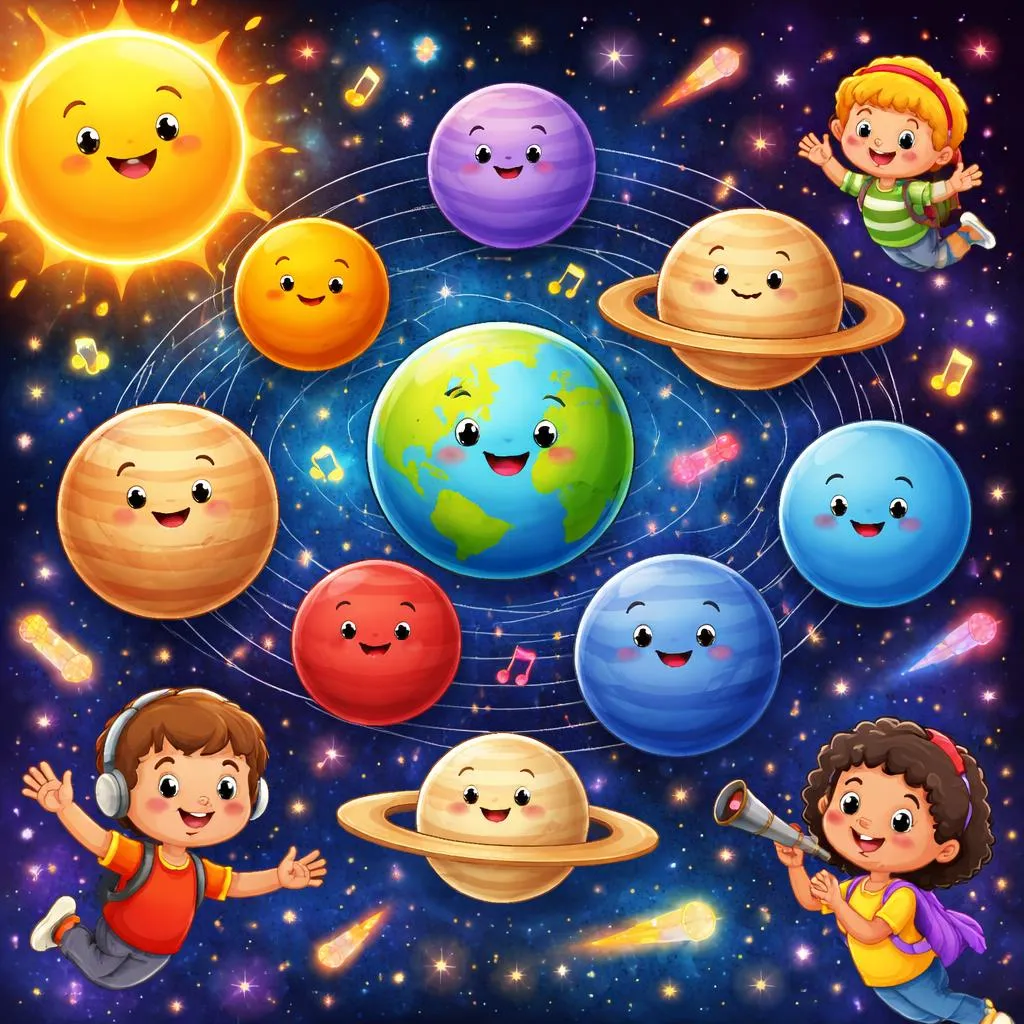

Teaching children about the solar system is an exciting journey. The planets capture their imagination with their sizes, colors, and mysterious qualities. Music makes learning the planet names and order fun and memorable. Today, we are going to explore the there are 8 planets in the solar system song lyrics and discover how this catchy tune helps children remember the planets and their sequence.
What Is the There Are 8 Planets in the Solar System Song? The "There Are 8 Planets in the Solar System" song is a educational children's tune that teaches the names and order of the planets. It helps children remember that there are eight planets orbiting our sun.
For many years, children learned about nine planets. But in 2006, scientists decided that Pluto is a dwarf planet. Now we teach that there are eight planets in our solar system. This song reflects that current scientific understanding.
The song typically lists the planets in order from the sun outward. Mercury, Venus, Earth, Mars, Jupiter, Saturn, Uranus, Neptune. Some versions include fun facts about each planet. Others focus on just the names and order.
The Lyrics of There Are 8 Planets in the Solar System Let us look at some common there are 8 planets in the solar system song lyrics. Here is a popular version:
There are 8 planets in the solar system, 8 planets as we sing. Mercury, Venus, Earth, and Mars, These are the ones close to the sun, you see.
Jupiter, Saturn, Uranus, Neptune, These are the outer planets, way out in space.
Mercury is the closest to the sun, Venus is the hottest one. Earth is where we all live, Mars has a red-colored give.
Jupiter is the biggest by far, Saturn has rings that shine like a star. Uranus spins on its side, Neptune has a windy ride.
There are 8 planets in the solar system, 8 planets in space. Now we know them one and all, The planets in their place!
Another simple version uses the tune of "Twinkle, Twinkle, Little Star":
Mercury, Venus, Earth, and Mars, Jupiter, Saturn, in their stars. Uranus, Neptune far away, These are the planets that we say. Eight of them go round the sun, Learning about them is so fun!
Vocabulary Learning from the Song The there are 8 planets in the solar system song lyrics introduce rich vocabulary about space.
Planet Names: Mercury, Venus, Earth, Mars, Jupiter, Saturn, Uranus, Neptune. Children learn to say these distinctive names.
Space Words: Solar system, sun, orbit, space, planet, star. These words describe our cosmic neighborhood.
Descriptive Words: Closest, hottest, biggest, red, windy, far away. These adjectives describe each planet's features.
Position Words: Close to the sun, outer planets, way out, on its side. These words describe location in space.
Number Words: Eight. Children learn how many planets are in our solar system.
Phonics Points in the Song We can use this song to practice specific sounds. The planet names offer excellent phonics practice.
The /m/ sound appears in "Mercury" and "Mars." This nasal sound requires closed lips.
The /v/ sound appears in "Venus." This voiced sound requires the bottom lip on the top teeth.
The /j/ sound appears in "Jupiter." This sound is made with the tongue near the roof of the mouth.
The /s/ sound appears in "Saturn" and "solar system." This sibilant sound requires the tongue near the teeth.
The /y/ sound appears in "Uranus" at the beginning. This sound requires the tongue high in the mouth.
Grammar Patterns in the Lyrics The song contains several important grammar patterns that children absorb naturally.
There Are Construction: "There are 8 planets" teaches existence in plural form. Children learn this common structure for describing what exists.
Present Tense: "Mercury is the closest" uses present tense. Children learn to describe facts that are always true.
Superlative Adjectives: "Closest," "hottest," "biggest" teach the superlative form. Children learn to describe extremes.
Prepositional Phrases: "In the solar system," "close to the sun" teach prepositions of location.
Descriptive Sentences: "Saturn has rings" teaches possession in space vocabulary.
Learning Activities with the Song The song can be the center of many engaging activities. Here are some ways to extend the learning.
Planet Order Line-Up: Give each child a card with a planet name. Ask them to line up in order from the sun. Mercury first, then Venus, Earth, Mars, Jupiter, Saturn, Uranus, Neptune. This builds sequencing skills.
Planet Facts Match: Create cards with planet names and separate cards with facts. "I am the hottest planet." Children match Venus. "I have rings." Children match Saturn. This builds knowledge and reading skills.
Planet Art: Create planet art projects. Paint Mercury gray. Paint Venus yellow. Paint Earth blue and green. Paint Mars red. Paint Jupiter orange with stripes. Paint Saturn with rings. Paint Uranus blue-green. Paint Neptune deep blue.
Planet Mobile: Create a hanging mobile with all eight planets in order. Use different sizes to show relative sizes. Hang it in the classroom.
Planet Walk: Create a scale model of the solar system in the playground. Mark distances from a "sun" spot. Children walk from Mercury to Neptune, seeing how far apart the planets really are.
Printable Materials for the Song Printable resources can enhance the learning experience. Here are some materials to create.
Planet Flashcards: Create cards with each planet name and a clear picture. Include a simple fact on the back. "Mercury is the closest to the sun." "Venus is the hottest planet."
Planet Order Chart: Create a chart showing all eight planets in order from the sun. Include pictures and names. Display it in the classroom.
Planet Coloring Pages: Create coloring pages for each planet. Children color them accurately based on real images.
Mini Planet Book: Create a simple foldable book with one planet on each page. Children write a fact about each planet.
Solar System Poster: Create a large poster of the solar system. Children help label the planets.
Educational Games with the Song Games make learning about planets even more engaging. Here are some games to try.
Planet Bingo: Create bingo cards with planet names. Call out facts about each planet. "I am the largest planet." Children cover Jupiter. "I am known as the Red Planet." Children cover Mars.
Planet Memory Match: Create pairs of planet cards. Place them face down. Children take turns flipping two to find matches. When they find a match, they name the planet.
Planet Order Race: Give each child a planet card. Time how fast they can arrange themselves in correct order from the sun.
What Planet Am I? Game: Describe a planet without naming it. "I am the closest to the sun. I am small and gray. I have no moons. What planet am I?" Children guess Mercury.
Planet Hop: Place planet cards on the floor in order. Children hop from Mercury to Neptune, naming each planet as they land.
Planet Facts for Each Planet Learning a few facts about each planet makes them more memorable.
Mercury is the closest planet to the sun. It is very hot during the day and very cold at night. It is covered in craters.
Venus is the hottest planet. It has thick clouds that trap heat. It is sometimes called Earth's twin because it is similar in size.
Earth is our home. It is the only planet we know that has life. It has water and air.
Mars is called the Red Planet because its soil is rusty. It has the biggest volcano in the solar system.
Jupiter is the largest planet. It has a giant storm called the Great Red Spot. It has many moons.
Saturn is famous for its beautiful rings. The rings are made of ice and rock. It is very light for its size.
Uranus spins on its side. It looks blue-green because of gas in its atmosphere. It has faint rings.
Neptune is the farthest planet. It is very cold and windy. It also looks blue.
Pluto and Dwarf Planets Children may ask about Pluto. We can explain that scientists decided Pluto is a dwarf planet. There are other dwarf planets too, like Ceres and Eris.
Pluto is still interesting. It is small and icy. It has five moons. It is part of the Kuiper Belt, a region of icy objects beyond Neptune.
Teaching about Pluto's change in status helps children understand that science is always learning new things.
The Sun The sun is at the center of our solar system. It is a star, not a planet. It is much bigger than all the planets combined.
The sun gives us light and heat. Without it, there would be no life on Earth. The planets orbit around the sun because its gravity pulls on them.
We can talk about never looking directly at the sun because it hurts our eyes.
Creating New Verses Children can create new verses for the planet song. This builds creativity and language skills.
What other facts could we include? "Mercury has many craters." "Venus has thick clouds of gas." "Earth has one big moon." "Mars has two little moons."
What about the dwarf planets? "Pluto is small and cold." "Ceres is in the asteroid belt."
Writing new verses together builds confidence and deepens knowledge.
Space Books Picture books about space reinforce planet vocabulary. Here are some favorites.
"There's No Place Like Space" by Tish Rabe is a Cat in the Hat introduction to the solar system.
"National Geographic Little Kids First Big Book of Space" has beautiful photos and simple facts.
"Hello, World! Solar System" by Jill McDonald is perfect for younger children.
"8 Little Planets" by Chris Ferrie is a rhyming board book about each planet.
While reading, connect to the song. "Remember the song? Which planet comes after Mars?"
Planet Songs in Different Languages Children can learn the planet names in other languages. This builds cultural awareness.
In Spanish: Mercurio, Venus, Tierra, Marte, Júpiter, Saturno, Urano, Neptuno. In French: Mercure, Vénus, Terre, Mars, Jupiter, Saturne, Uranus, Neptune. In German: Merkur, Venus, Erde, Mars, Jupiter, Saturn, Uranus, Neptun.
Many are similar to English because they come from Roman god names.
As we explore the there are 8 planets in the solar system song lyrics with young children, we open a window to the cosmos. They learn the names and order of the planets. They discover fascinating facts about each world. They begin to understand our place in space. Through songs, games, and hands-on activities, the solar system becomes a familiar neighborhood. This foundation will serve them as they grow and learn more about astronomy and science.