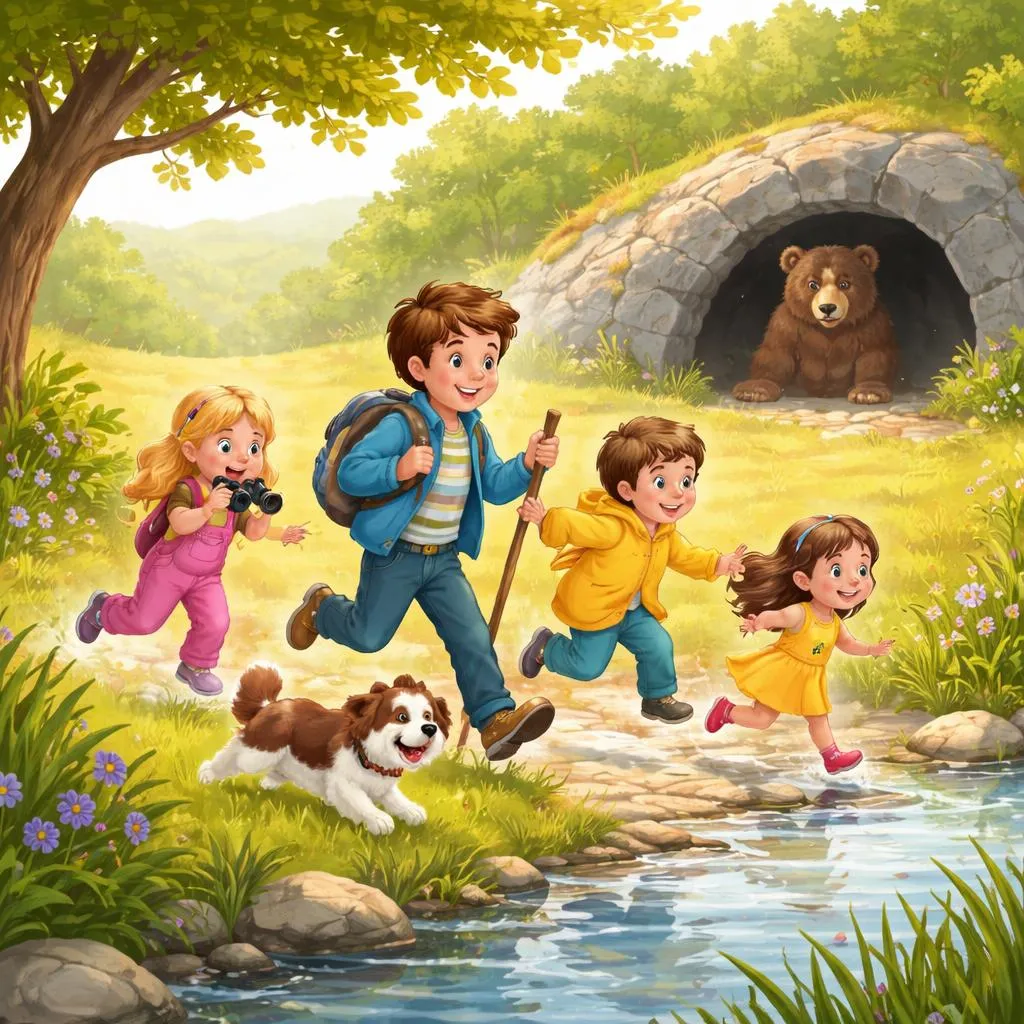

"We're Going on a Bear Hunt" is one of the most beloved children's stories of all time. Written by Michael Rosen and illustrated by Helen Oxenbury, this classic tale has captivated young readers for generations. Today, we are going to explore the we are going on a bear hunt song and discover how this rhythmic, repetitive story can build language skills, phonemic awareness, and a love of adventure.
What Is the We're Going on a Bear Hunt Story? "We're Going on a Bear Hunt" is a classic children's picture book published in 1989. The story follows a family on an adventure. They go through different obstacles to find a bear. The story has a repetitive pattern that children quickly learn and love to chant along.
The family encounters various environments on their journey. Long, wavy grass. A deep, cold river. Thick, oozy mud. A big, dark forest. A swirling, whirling snowstorm. And finally, a narrow, gloomy cave.
Each obstacle has a sound effect and a repeated response. "We can't go over it. We can't go under it. Oh no! We've got to go through it!" This pattern builds anticipation and invites participation.
The story ends with a surprise. They find the bear, get scared, and rush back through all the obstacles to the safety of home. The final line, "We're never going on a bear hunt again!" always brings laughter.
The Words of We're Going on a Bear Hunt Let us look at the key we are going on a bear hunt song words that appear throughout the story.
The Chorus: We're going on a bear hunt. We're going to catch a big one. What a beautiful day! We're not scared.
This chorus repeats before each obstacle. Children learn it quickly and chant along with enthusiasm.
The Obstacles:
Long, wavy grass. Swishy swashy! Swishy swashy!
A deep, cold river. Splash splosh! Splash splosh!
Thick, oozy mud. Squelch squerch! Squelch squerch!
A big, dark forest. Stumble trip! Stumble trip!
A swirling, whirling snowstorm. Hoooo woooo! Hoooo woooo!
A narrow, gloomy cave. Tiptoe! Tiptoe!
Each obstacle has descriptive words and a sound effect. The combination creates a rich sensory experience.
The Bear Encounter: One shiny wet nose! Two big furry ears! Two big goggly eyes! IT'S A BEAR!
The discovery of the bear builds excitement. The description helps children visualize the bear.
The Retreat: The family rushes back through all the obstacles, but in reverse order and much faster. The sounds come quickly as they escape.
The Ending: We're not going on a bear hunt again.
The story ends where it began, at home, safe under the covers.
Vocabulary Learning from the Story The we are going on a bear hunt song words introduce rich vocabulary through an exciting context.
Action Words: Going, catch, go over, go under, go through, run, rush, tiptoe, stumble, trip. Children learn verbs for movement and action.
Descriptive Words: Long, wavy, deep, cold, thick, oozy, big, dark, swirling, whirling, narrow, gloomy, shiny, wet, furry, goggly. These adjectives paint vivid pictures.
Nature Words: Grass, river, mud, forest, snowstorm, cave. Children learn about different natural environments.
Sound Words: Swishy swashy, splash splosh, squelch squerch, stumble trip, hoooo woooo. These onomatopoeic words are fun to say and remember.
Family Words: The story features a family with a father, children, and a dog. Children can identify with these characters.
Phonics Points in the Story The story is rich with opportunities for phonics practice.
The /s/ sound appears in "swishy swashy" and "splash splosh." Children practice this sibilant sound through repetition.
The /k/ sound appears in "catch" and "cold." This voiceless sound appears throughout.
The /g/ sound appears in "going" and "goggly." Children practice the difference between /g/ and /k/.
The /f/ sound appears in "forest" and "furry." This sound requires teeth on the bottom lip.
The /sh/ sound appears in "swishy" and "splash." This digraph appears in the sound effects children love to say.
The /t/ sound appears in "tiptoe" and "stumble trip." This quick sound requires the tongue behind the teeth.
Grammar Patterns in the Story The story contains several important grammar patterns that children absorb naturally.
Present Continuous Tense: "We're going" uses the present continuous form. Children learn to talk about actions happening now.
Future Intention: "We're going to catch" expresses future intention. Children learn this pattern for talking about plans.
Negative Contractions: "We're not scared" and "can't" teach negative contractions naturally.
Repetitive Structure: "We can't go over it. We can't go under it. We've got to go through it." This pattern teaches prepositions and modal verbs.
Exclamations: "IT'S A BEAR!" teaches excitement in language. Children learn that punctuation and volume change meaning.
Learning Activities with the Story The story can be the center of many engaging activities. Here are some ways to extend the learning.
Obstacle Course: Create a bear hunt obstacle course in the classroom or playground. Use cushions for grass, a blue blanket for the river, pillows for mud, chairs for the forest, white sheets for snow, and a tent or table for the cave. Children move through each obstacle, making the sounds as they go.
Sound Effect Orchestra: Assign different sound effects to different groups. One group does "swishy swashy." Another does "splash splosh." Another does "squelch squerch." As the story is read, each group makes their sound at the right time.
Story Mapping: Create a map showing the family's journey. Draw the house, the grass, the river, the mud, the forest, the snowstorm, and the cave. Children trace the path with their fingers as the story progresses.
Bear Hunt Art: Children draw their favorite part of the story. They can add speech bubbles with the words from that part. Display the pictures in order around the room.
Movement Exploration: Explore different ways to move through each obstacle. How do we move through thick mud? Slowly, with heavy steps. How do we move through a deep river? Swimming motions. How do we move through a dark forest? Carefully, looking around.
Printable Materials for the Story Printable resources can enhance the bear hunt experience. Here are some materials to create.
Story Sequence Cards: Create cards showing each part of the journey in order. The house, the grass, the river, the mud, the forest, the snowstorm, the cave, the bear, the rush home, the bedroom. Children arrange them in order and retell the story.
Sound Effect Cards: Create cards with each sound effect written out. Swishy swashy, splash splosh, squelch squerch, stumble trip, hoooo woooo, tiptoe. Children hold up the right card when that sound occurs.
Obstacle Description Cards: Create cards with the descriptive phrases. "Long, wavy grass." "Deep, cold river." "Thick, oozy mud." Children match the description to the picture.
Bear Hunt Mini-Book: Create a simple foldable book with the key phrases from the story. Children can "read" their book at home. This builds pride and extends learning beyond the classroom.
Bear Mask: Create a simple bear mask. After the story, children can wear the mask and be the bear that the family finds.
Educational Games with the Story Games make the story even more engaging. Here are some games to try.
Bear Hunt Charades: One child acts out an obstacle without speaking. Others guess which obstacle it is. Are they moving through mud? Swimming in the river? Tiptoeing into the cave? This builds observation and inference.
Bear Hunt Freeze: Play the story audio or read it aloud. Children act out the movements. When you say "Stop!" they freeze in place. When you continue, they resume moving. This builds listening and self-control.
Obstacle Memory: Place picture cards of the obstacles face down. Children take turns flipping two cards to find matches. When they find a match, they make the sound effect for that obstacle.
Bear Hunt Bingo: Create bingo cards with pictures of the obstacles. Call out descriptions. "This is long and wavy. We go swishy swashy through it." Children cover the matching picture.
What Comes Next? Game: Recite the story but pause before naming the next obstacle. Children guess what comes next. "We went through the grass. Then we came to a..." Children shout "river!" This builds prediction and memory.
Movement and Music The story cries out for movement and music. Children learn best when they are physically engaged.
We can create simple movements for each obstacle. Swishy swashy grass: sway arms side to side. Splash splosh river: make swimming motions. Squelch squerch mud: lift feet high and step heavily. Stumble trip forest: step carefully over imaginary roots. Hoooo woooo snowstorm: shiver and blow. Tiptoe cave: walk on tiptoes very quietly.
We can add sound effects with instruments. Shakers for swishy swashy. Drums for squelch squerch. Bells for tiptoe.
The rhythm of the words naturally invites movement. Children feel the beat in their bodies.
Building Confidence Through Repetition The repetitive nature of the story builds confidence in young readers. After hearing it a few times, children know what comes next. They can chime in with the familiar phrases.
This success builds reading confidence. Children feel like readers even before they can decode words. They learn that books have patterns they can predict.
We can use this confidence to introduce early literacy concepts. Point to the words as we read. Show that the same words appear on each page. Children begin to recognize "we're" and "going" and "bear" by sight.
Creating Class Versions After becoming familiar with the original, classes can create their own versions. Where will we go on a hunt? What will we find?
Maybe we go on a dinosaur hunt. Through tall buildings, over bridges, under tunnels. We find a T-Rex and run home.
Maybe we go on a treasure hunt. Through a playground, over a wall, under a slide. We find a treasure chest and celebrate.
Maybe we go on a monster hunt. Through a spooky house, over a creaky floor, under a dusty bed. We find a friendly monster and have a party.
Creating new versions builds creativity and language skills. Children use the familiar pattern to create something new.
As we explore the we are going on a bear hunt song with young children, we discover a story rich with learning potential. It builds vocabulary through vivid descriptions. It teaches grammar through repetitive patterns. It develops phonemic awareness through playful sound effects. Most importantly, it creates joy through shared storytelling. Children chant along, move their bodies, and become part of the adventure. This classic story will continue to delight and educate for generations to come.